

Electron-Transfer Equivalents
321
There are 2 equiv/mole of CaCO 3 ; therefore, the weight of CaCO 3 in the
original sample is
wtofCaCO 3 = (0.004255 equiv) ( '
mole ) ( 100.1
\ 2 equiv/ \
.
2 equiv/ \
mole/
= 0.2277 g CaC0 3
0 2277 a
Percentage of CaCO 3 = n f ^ on
s x 100 = 43.13% CaCO 3
0.5280 g
PROBLEM:
An organic chemist synthesizes a new compound X with acidic properties.
A 0.7200 g sample requires 30.00 ml of 0.2000 M Ba(OH) 2 for titration. What
is the equivalent weight of X?
SOLUTION:
Equivalents of Ba(OH) 2 = ( 0.2000 £2!iW 2 ¥HL\ (Q.03000 liter)
V
liter / \ mole /
= 0.01200 equiv of X
0.7200 g
"
equiv wt of X = Am „*..;.. =
60
-°°
0.01200 equiv
equiv
This knowledge, together with the empirical formula and the molecular weight
of X, will help the chemist elucidate the structure of the compound and determine how many acidic groups there are in the molecule.
ELECTRON-TRANSFER EQUIVALENTS
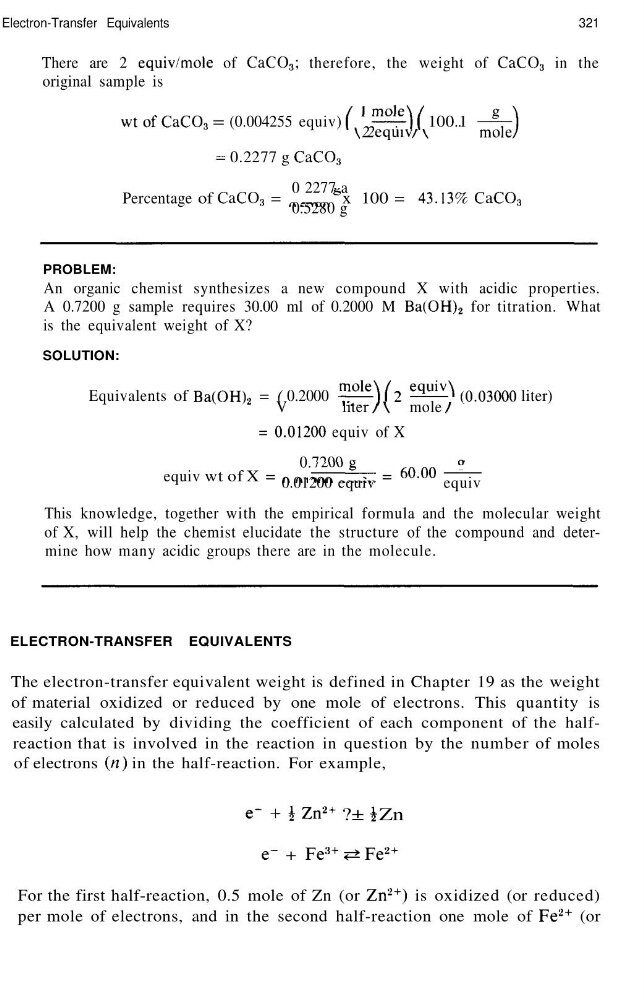
The electron-transfer equivalent weight is defined in Chapter 19 as the weight
of material oxidized or reduced by one mole of electrons. This quantity is
easily calculated by dividing the coefficient of each component of the halfreaction that is involved in the reaction in question by the number of moles
of electrons (n) in the half-reaction. For example,
?± | Zn
e- + Fe
3+ <=> Fe
2+
For the first half-reaction, 0.5 mole of Zn (or Zn
2+ ) is oxidized (or reduced)
per mole of electrons, and in the second half-reaction one mole of Fe
2+ (or
321
There are 2 equiv/mole of CaCO 3 ; therefore, the weight of CaCO 3 in the
original sample is
wtofCaCO 3 = (0.004255 equiv) ( '
mole ) ( 100.1
\ 2 equiv/ \
.
2 equiv/ \
mole/
= 0.2277 g CaC0 3
0 2277 a
Percentage of CaCO 3 = n f ^ on
s x 100 = 43.13% CaCO 3
0.5280 g
PROBLEM:
An organic chemist synthesizes a new compound X with acidic properties.
A 0.7200 g sample requires 30.00 ml of 0.2000 M Ba(OH) 2 for titration. What
is the equivalent weight of X?
SOLUTION:
Equivalents of Ba(OH) 2 = ( 0.2000 £2!iW 2 ¥HL\ (Q.03000 liter)
V
liter / \ mole /
= 0.01200 equiv of X
0.7200 g
"
equiv wt of X = Am „*..;.. =
60
-°°
0.01200 equiv
equiv
This knowledge, together with the empirical formula and the molecular weight
of X, will help the chemist elucidate the structure of the compound and determine how many acidic groups there are in the molecule.
ELECTRON-TRANSFER EQUIVALENTS
The electron-transfer equivalent weight is defined in Chapter 19 as the weight
of material oxidized or reduced by one mole of electrons. This quantity is
easily calculated by dividing the coefficient of each component of the halfreaction that is involved in the reaction in question by the number of moles
of electrons (n) in the half-reaction. For example,
?± | Zn
e- + Fe
3+ <=> Fe
2+
For the first half-reaction, 0.5 mole of Zn (or Zn
2+ ) is oxidized (or reduced)
per mole of electrons, and in the second half-reaction one mole of Fe
2+ (or