

Problems B
267
14. Four moles of COC1 2 are put into a sealed vessel and heated to 395.0°C at a
pressure of 0.200 atm. At equilibrium, analysis shows 30.0% by volume of CO
in the mixture. Calculate K v for the dissociation reaction COC1 2 *± CO + C1 2
at this temperature.
15. An equilibrium mixture results from heating 2.00 moles of NOC1 to a temperature of 225.0°C at a pressure of 0.200 atm. Analysis shows the presence of
34.0% NO by volume. Calculate the value of K v for the dissociation reaction
2NOC1 ?* 2NO + C1 2 at this temperature.
16. Calculate the values of K L for (a) the reaction of SO 2 with O 2 at 900.0°C and
1000.0°C, and (b) the reaction of CO 2 with H 2 at 700.0°C and 1000.0°C, using
the K e values given in Table 16-1. (c) Calculate the values of A^ p for the
reaction of CO with H 2 O at 700.0°C and 1000.0°C.
17. Calculate the percentage of C1 2 that dissociates to atoms at a total pressure of
1.00 atm and (a) 1000.0°C and (b) 2000.0°C.
18. Calculate the percentage of H 2 O that dissociates at a pressure of 0.500 atm
and (a) 1000°C and (b) 1700°C.
19. What percentage of H 2 will be converted to HC1 at 1800°C using (a) an equimolar mixture of H 2 and C1 2 at a total pressure of 0.900 atm, and (b) an 8: 1
mixture of C1 2 to H 2 at a total pressure of 0.900 atm.
20. Calculate the composition of the equilibrium gas mixture that results when (a)
2.00 moles of NO and 1.00 mole of O 2 are mixed at 210.0°C and a total
pressure of 0.800 atm, and (b) 10.0 moles of NO and 1.00 mole of O 2 are mixed
at210.0°C and a total pressure of 5.00 atm. The value of K v is 3.36 x 10
3 aim'
1
for the reaction 2NO< 9) + O 2(0) «=s 2NO 2(fl) . (c) Calculate the value of K c for
this reaction.
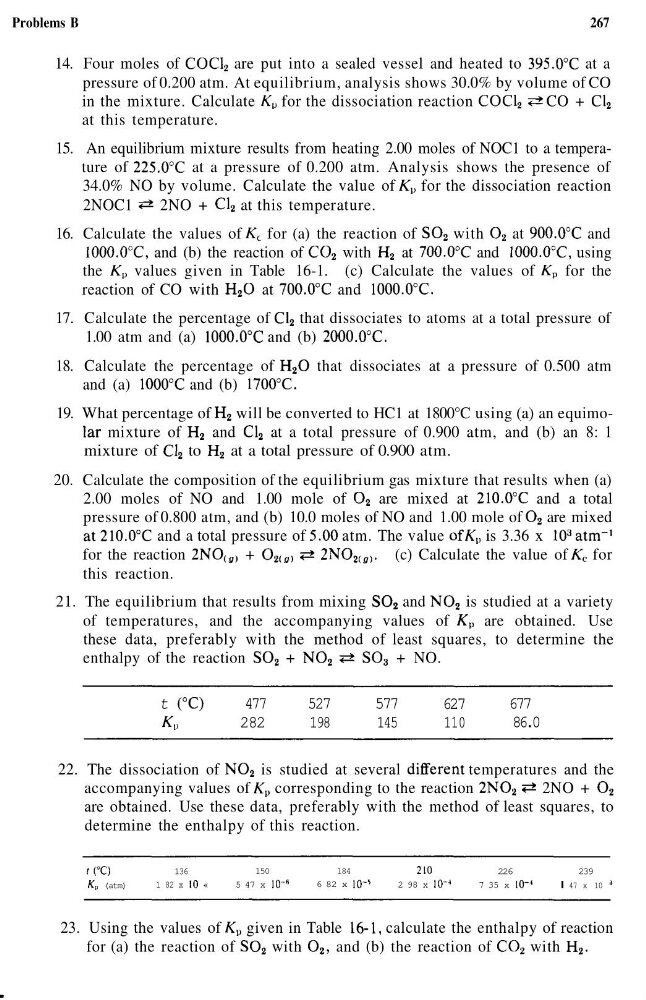
21. The equilibrium that results from mixing SO 2 and NO 2 is studied at a variety
of temperatures, and the accompanying values of K v are obtained. Use
these data, preferably with the method of least squares, to determine the
enthalpy of the reaction SO 2 + NO 2 <=s SO 3 + NO.
t (°C)
477
K v
282
527
198
577
145
627
110
677
86.0
22. The dissociation of NO 2 is studied at several different temperatures and the
accompanying values of K v corresponding to the reaction 2NO 2 «=* 2NO + O 2
are obtained. Use these data, preferably with the method of least squares, to
determine the enthalpy of this reaction.
K°C)
K, (atm)
136
1 82 x 10 «
150
5 47 x 10-"
184
6 82 x 10-'
210
2 98 x 10-*
226
7 35 x 10- 4
239
1 47 x 10 '
23. Using the values of K v given in Table 16-1, calculate the enthalpy of reaction
for (a) the reaction of SO 2 with O 2 , and (b) the reaction of CO 2 with H 2 .
267
14. Four moles of COC1 2 are put into a sealed vessel and heated to 395.0°C at a
pressure of 0.200 atm. At equilibrium, analysis shows 30.0% by volume of CO
in the mixture. Calculate K v for the dissociation reaction COC1 2 *± CO + C1 2
at this temperature.
15. An equilibrium mixture results from heating 2.00 moles of NOC1 to a temperature of 225.0°C at a pressure of 0.200 atm. Analysis shows the presence of
34.0% NO by volume. Calculate the value of K v for the dissociation reaction
2NOC1 ?* 2NO + C1 2 at this temperature.
16. Calculate the values of K L for (a) the reaction of SO 2 with O 2 at 900.0°C and
1000.0°C, and (b) the reaction of CO 2 with H 2 at 700.0°C and 1000.0°C, using
the K e values given in Table 16-1. (c) Calculate the values of A^ p for the
reaction of CO with H 2 O at 700.0°C and 1000.0°C.
17. Calculate the percentage of C1 2 that dissociates to atoms at a total pressure of
1.00 atm and (a) 1000.0°C and (b) 2000.0°C.
18. Calculate the percentage of H 2 O that dissociates at a pressure of 0.500 atm
and (a) 1000°C and (b) 1700°C.
19. What percentage of H 2 will be converted to HC1 at 1800°C using (a) an equimolar mixture of H 2 and C1 2 at a total pressure of 0.900 atm, and (b) an 8: 1
mixture of C1 2 to H 2 at a total pressure of 0.900 atm.
20. Calculate the composition of the equilibrium gas mixture that results when (a)
2.00 moles of NO and 1.00 mole of O 2 are mixed at 210.0°C and a total
pressure of 0.800 atm, and (b) 10.0 moles of NO and 1.00 mole of O 2 are mixed
at210.0°C and a total pressure of 5.00 atm. The value of K v is 3.36 x 10
3 aim'
1
for the reaction 2NO< 9) + O 2(0) «=s 2NO 2(fl) . (c) Calculate the value of K c for
this reaction.
21. The equilibrium that results from mixing SO 2 and NO 2 is studied at a variety
of temperatures, and the accompanying values of K v are obtained. Use
these data, preferably with the method of least squares, to determine the
enthalpy of the reaction SO 2 + NO 2 <=s SO 3 + NO.
t (°C)
477
K v
282
527
198
577
145
627
110
677
86.0
22. The dissociation of NO 2 is studied at several different temperatures and the
accompanying values of K v corresponding to the reaction 2NO 2 «=* 2NO + O 2
are obtained. Use these data, preferably with the method of least squares, to
determine the enthalpy of this reaction.
K°C)
K, (atm)
136
1 82 x 10 «
150
5 47 x 10-"
184
6 82 x 10-'
210
2 98 x 10-*
226
7 35 x 10- 4
239
1 47 x 10 '
23. Using the values of K v given in Table 16-1, calculate the enthalpy of reaction
for (a) the reaction of SO 2 with O 2 , and (b) the reaction of CO 2 with H 2 .