

266
Chemical Equilibrium in Gases
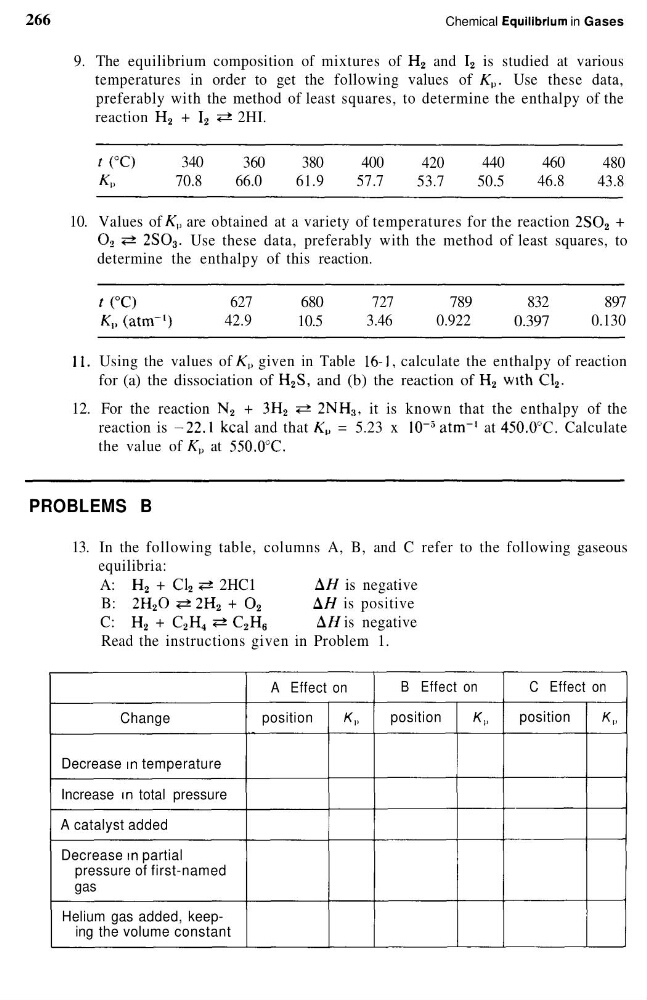
9. The equilibrium composition of mixtures of H 2 and I 2 is studied at various
temperatures in order to get the following values of K v . Use these data,
preferably with the method of least squares, to determine the enthalpy of the
reaction H 2 + I 2 +± 2HI.
340
70.8
360
66.0
380
61.9
400
57.7
420
53.7
440
50.5
460
46.8
480
43.8
10. Values of K v are obtained at a variety of temperatures for the reaction 2SO 2 +
O 2 «=* 2SO 3 . Use these data, preferably with the method of least squares, to
determine the enthalpy of this reaction.
v (atrrr
1 )
627
42.9
680
10.5
727
3.46
789
0.922
832
0.397
897
0.130
11. Using the values of K v given in Table 16-1, calculate the enthalpy of reaction
for (a) the dissociation of H 2 S, and (b) the reaction of H 2 with C1 2 .
12. For the reaction N 2 + 3H 2 +± 2NH 3 , it is known that the enthalpy of the
reaction is -22.1 kcal and that K v = 5.23 x 10~
5 atirr
1 at 450.0°C. Calculate
the value of K u at 550.0°C.
PROBLEMS B
13. In the following table, columns A, B, and C refer to the following gaseous
equilibria:
A: H 2 + C1 2 ?2 2HC1
A// is negative
B: 2H 2 O ?± 2H 2 + O 2
A// is positive
C: H 2 + C 2 H 4 ?± C 2 H 6
^H is negative
Read the instructions given in Problem 1.
Change
Decrease in temperature
Increase in total pressure
A catalyst added
Decrease in partial
pressure of first-named
gas
Helium gas added, keeping the volume constant
A Effect on
position
*,.
B Effect on
position
K,
C Effect on
position
K,,
Chemical Equilibrium in Gases
9. The equilibrium composition of mixtures of H 2 and I 2 is studied at various
temperatures in order to get the following values of K v . Use these data,
preferably with the method of least squares, to determine the enthalpy of the
reaction H 2 + I 2 +± 2HI.
340
70.8
360
66.0
380
61.9
400
57.7
420
53.7
440
50.5
460
46.8
480
43.8
10. Values of K v are obtained at a variety of temperatures for the reaction 2SO 2 +
O 2 «=* 2SO 3 . Use these data, preferably with the method of least squares, to
determine the enthalpy of this reaction.
v (atrrr
1 )
627
42.9
680
10.5
727
3.46
789
0.922
832
0.397
897
0.130
11. Using the values of K v given in Table 16-1, calculate the enthalpy of reaction
for (a) the dissociation of H 2 S, and (b) the reaction of H 2 with C1 2 .
12. For the reaction N 2 + 3H 2 +± 2NH 3 , it is known that the enthalpy of the
reaction is -22.1 kcal and that K v = 5.23 x 10~
5 atirr
1 at 450.0°C. Calculate
the value of K u at 550.0°C.
PROBLEMS B
13. In the following table, columns A, B, and C refer to the following gaseous
equilibria:
A: H 2 + C1 2 ?2 2HC1
A// is negative
B: 2H 2 O ?± 2H 2 + O 2
A// is positive
C: H 2 + C 2 H 4 ?± C 2 H 6
^H is negative
Read the instructions given in Problem 1.
Change
Decrease in temperature
Increase in total pressure
A catalyst added
Decrease in partial
pressure of first-named
gas
Helium gas added, keeping the volume constant
A Effect on
position
*,.
B Effect on
position
K,
C Effect on
position
K,,