

The Effect of Temperature on K, and Equilibrium Position
263
intercept is 1 6637, with a correlation coefficient of 0 9999 Because the slope is
equal to -A///2 30«, we can find A//
(
cal \
1987
—-)
mole K/
(
cal \
1 987 ——— = 8270
mole K/
mole
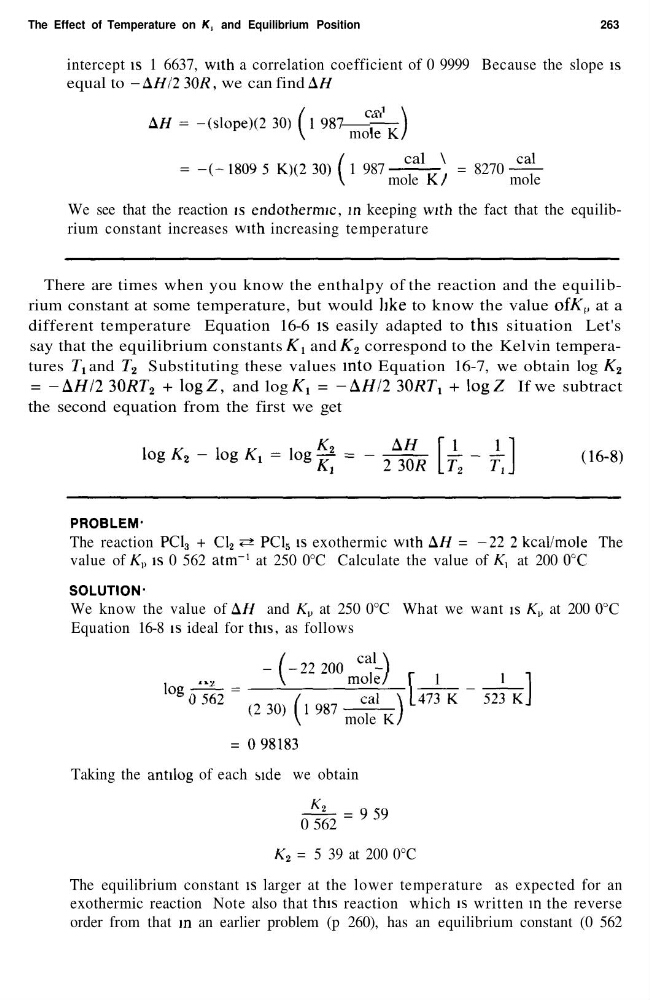
We see that the reaction is endothermic, in keeping with the fact that the equilibrium constant increases with increasing temperature
There are times when you know the enthalpy of the reaction and the equilibrium constant at some temperature, but would like to know the value of K v at a
different temperature Equation 16-6 is easily adapted to this situation Let's
say that the equilibrium constants K l and AT 2 correspond to the Kelvin temperatures TI and T 2 Substituting these values into Equation 16-7, we obtain log K 2
= -A///2 3QRT 2 + logZ, and log K l = -A///2 30RT l + logZ If we subtract
the second equation from the first we get
PROBLEMThe reaction PC1 3 + C1 2 «=? PC1 5 is exothermic with Ml = -222 kcal/mole The
value of K v is 0 562 atm-' at 250 0°C Calculate the value of K, at 200 0°C
SOLUTIONWe know the value of A// and K v at 250 0°C What we want is K v at 200 0°C
Equation 16-8 is ideal for this, as follows
-1-22200
Ca '
(-2220
,*,
^
mole/ f 1
log;
mole
= 098183
Taking the antilog of each side we obtain
= 959
0 562
K 2 = 5 39 at 200 0°C
The equilibrium constant is larger at the lower temperature as expected for an
exothermic reaction Note also that this reaction which is written in the reverse
order from that in an earlier problem (p 260), has an equilibrium constant (0 562
263
intercept is 1 6637, with a correlation coefficient of 0 9999 Because the slope is
equal to -A///2 30«, we can find A//
(
cal \
1987
—-)
mole K/
(
cal \
1 987 ——— = 8270
mole K/
mole
We see that the reaction is endothermic, in keeping with the fact that the equilibrium constant increases with increasing temperature
There are times when you know the enthalpy of the reaction and the equilibrium constant at some temperature, but would like to know the value of K v at a
different temperature Equation 16-6 is easily adapted to this situation Let's
say that the equilibrium constants K l and AT 2 correspond to the Kelvin temperatures TI and T 2 Substituting these values into Equation 16-7, we obtain log K 2
= -A///2 3QRT 2 + logZ, and log K l = -A///2 30RT l + logZ If we subtract
the second equation from the first we get
PROBLEMThe reaction PC1 3 + C1 2 «=? PC1 5 is exothermic with Ml = -222 kcal/mole The
value of K v is 0 562 atm-' at 250 0°C Calculate the value of K, at 200 0°C
SOLUTIONWe know the value of A// and K v at 250 0°C What we want is K v at 200 0°C
Equation 16-8 is ideal for this, as follows
-1-22200
Ca '
(-2220
,*,
^
mole/ f 1
log;
mole
= 098183
Taking the antilog of each side we obtain
= 959
0 562
K 2 = 5 39 at 200 0°C
The equilibrium constant is larger at the lower temperature as expected for an
exothermic reaction Note also that this reaction which is written in the reverse
order from that in an earlier problem (p 260), has an equilibrium constant (0 562