

252
Chemical Kinetics
Determine the order of this reaction with respect to each reactant, and the rate
constant for the reaction. Express concentrations as partial pressures in torr,
not moles per liter.
23. (a) Calculate average molar kinetic energies for Ne, Ar, CO, and C 2 H 6 at
127.0°C.
(b) How many molecules of each gas are present in 1.00 ml at 730 torr and
127.0°C?
24. Calculate the fraction of N 2 molecules having kinetic energies greater than
15.0 kcal/mole at each of the following temperatures.
(a) 27.0°C
(d) 327.0°C
(b) 127.0°C
(e) 427.0°C
(c) 227.0°C
25. How much faster will a reaction be at 40.0°C than at 25.0°C, when its activation energy is 18.0 kcal?
26. The initial rate of reaction is observed by mixing given concentrations of A
and B. First doubling the concentration of A (keeping B constant) and then
doubling B (keeping A constant) causes a doubling of the initial rate in the first
instance but a quadrupling in the second. What can be said about the order of
the reaction with respect to A and B?
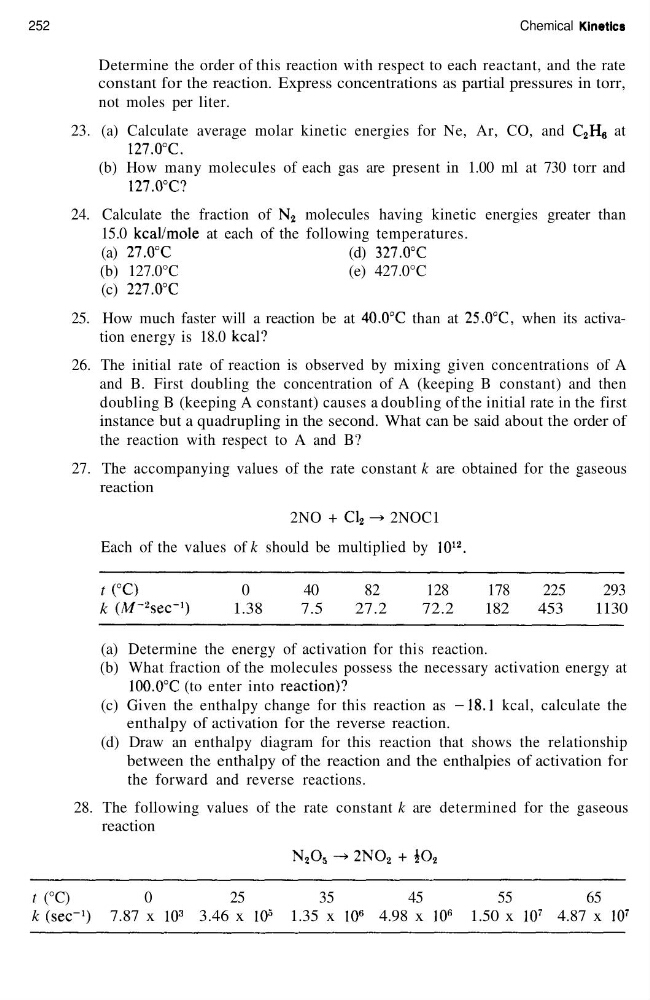
27. The accompanying values of the rate constant k are obtained for the gaseous
reaction
2NO + C1 2 -> 2NOC1
Each of the values of k should be multiplied by 10
12
.
t (°C)
0
40
82
128
178
225
293
k (M2 sec-')
1.38
7.5
27.2
72.2
182
453
1130
(a) Determine the energy of activation for this reaction.
(b) What fraction of the molecules possess the necessary activation energy at
100.0°C (to enter into reaction)?
(c) Given the enthalpy change for this reaction as -18.1 kcal, calculate the
enthalpy of activation for the reverse reaction.
(d) Draw an enthalpy diagram for this reaction that shows the relationship
between the enthalpy of the reaction and the enthalpies of activation for
the forward and reverse reactions.
28. The following values of the rate constant k are determined for the gaseous
reaction
N 2 O 5 -» 2NO 2 + iO 2
t (°C)
0
25
35
45
55
65
k (sec1 ) 7.87 x 10
3
3.46 x 10
5
1.35 x 10
6
4.98 x 10" 1.50 x 10
7
4.87 x 10
7
Chemical Kinetics
Determine the order of this reaction with respect to each reactant, and the rate
constant for the reaction. Express concentrations as partial pressures in torr,
not moles per liter.
23. (a) Calculate average molar kinetic energies for Ne, Ar, CO, and C 2 H 6 at
127.0°C.
(b) How many molecules of each gas are present in 1.00 ml at 730 torr and
127.0°C?
24. Calculate the fraction of N 2 molecules having kinetic energies greater than
15.0 kcal/mole at each of the following temperatures.
(a) 27.0°C
(d) 327.0°C
(b) 127.0°C
(e) 427.0°C
(c) 227.0°C
25. How much faster will a reaction be at 40.0°C than at 25.0°C, when its activation energy is 18.0 kcal?
26. The initial rate of reaction is observed by mixing given concentrations of A
and B. First doubling the concentration of A (keeping B constant) and then
doubling B (keeping A constant) causes a doubling of the initial rate in the first
instance but a quadrupling in the second. What can be said about the order of
the reaction with respect to A and B?
27. The accompanying values of the rate constant k are obtained for the gaseous
reaction
2NO + C1 2 -> 2NOC1
Each of the values of k should be multiplied by 10
12
.
t (°C)
0
40
82
128
178
225
293
k (M2 sec-')
1.38
7.5
27.2
72.2
182
453
1130
(a) Determine the energy of activation for this reaction.
(b) What fraction of the molecules possess the necessary activation energy at
100.0°C (to enter into reaction)?
(c) Given the enthalpy change for this reaction as -18.1 kcal, calculate the
enthalpy of activation for the reverse reaction.
(d) Draw an enthalpy diagram for this reaction that shows the relationship
between the enthalpy of the reaction and the enthalpies of activation for
the forward and reverse reactions.
28. The following values of the rate constant k are determined for the gaseous
reaction
N 2 O 5 -» 2NO 2 + iO 2
t (°C)
0
25
35
45
55
65
k (sec1 ) 7.87 x 10
3
3.46 x 10
5
1.35 x 10
6
4.98 x 10" 1.50 x 10
7
4.87 x 10
7