

Problems B
251
/(sec)
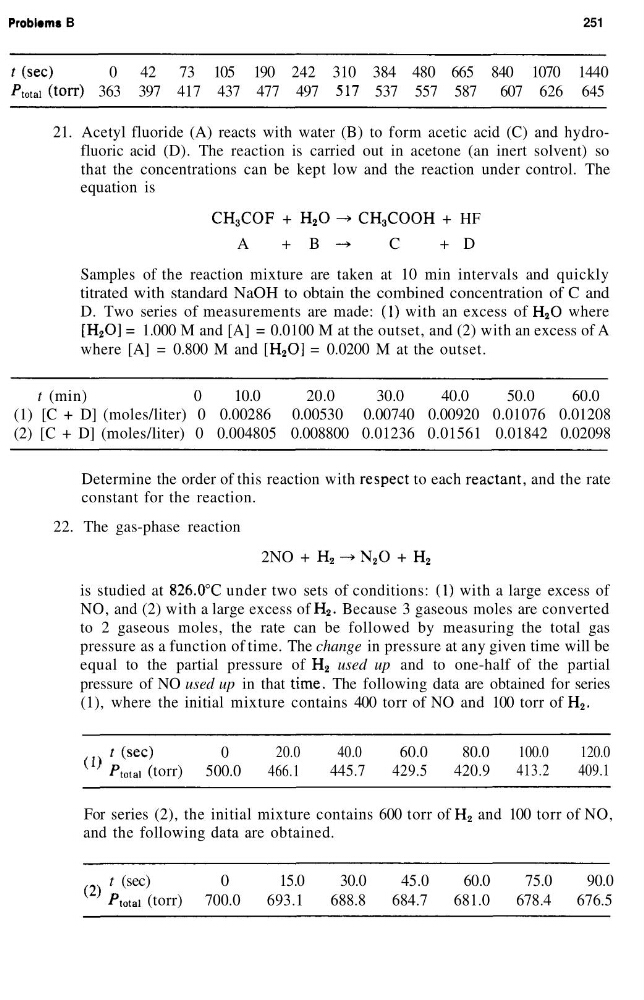
0 42 73 105 190 242 310 384 480 665 840 1070 1440
Aotai (torr) 363 397 417 437 477 497 517 537 557 587 607 626 645
21. Acetyl fluoride (A) reacts with water (B) to form acetic acid (C) and hydrofluoric acid (D). The reaction is carried out in acetone (an inert solvent) so
that the concentrations can be kept low and the reaction under control. The
equation is
CH 3 COF + H 2 O -» CH 3 COOH + HF
A
+ B -»
C
+ D
Samples of the reaction mixture are taken at 10 min intervals and quickly
titrated with standard NaOH to obtain the combined concentration of C and
D. Two series of measurements are made: (1) with an excess of H 2 O where
[H 2 O] = 1.000 M and [A] = 0.0100 M at the outset, and (2) with an excess of A
where [A] = 0.800 M and [H 2 O] = 0.0200 M at the outset.
t (min)
0
10.0
20.0
30.0
40.0
50.0
60.0
(1) [C + D] (moles/liter) 0 0.00286 0.00530 0.00740 0.00920 0.01076 0.01208
(2) [C + D] (moles/liter) 0 0.004805 0.008800 0.01236 0.01561 0.01842 0.02098
Determine the order of this reaction with respect to each reactant, and the rate
constant for the reaction.
22. The gas-phase reaction
2NO + H 2 -» N 2 O + H 2
is studied at 826.0°C under two sets of conditions: (1) with a large excess of
NO, and (2) with a large excess of H 2 . Because 3 gaseous moles are converted
to 2 gaseous moles, the rate can be followed by measuring the total gas
pressure as a function of time. The change in pressure at any given time will be
equal to the partial pressure of H 2 used up and to one-half of the partial
pressure of NO used up in that time. The following data are obtained for series
(1), where the initial mixture contains 400 torr of NO and 100 torr of H 2 .
(l)
/(sec)
u; P total (torr)
0
500.0
20.0
466.1
40.0
445.7
60.0
429.5
80.0
420.9
100.0
413.2
120.0
409.1
For series (2), the initial mixture contains 600 torr of H 2 and 100 torr of NO,
and the following data are obtained.
t (sec)
0
15.0
30.0
45.0
60.0
75.0
90.0
/'total (torr) 700.0
693.1
688.8
684.7
681.0
678.4
676.5
251
/(sec)
0 42 73 105 190 242 310 384 480 665 840 1070 1440
Aotai (torr) 363 397 417 437 477 497 517 537 557 587 607 626 645
21. Acetyl fluoride (A) reacts with water (B) to form acetic acid (C) and hydrofluoric acid (D). The reaction is carried out in acetone (an inert solvent) so
that the concentrations can be kept low and the reaction under control. The
equation is
CH 3 COF + H 2 O -» CH 3 COOH + HF
A
+ B -»
C
+ D
Samples of the reaction mixture are taken at 10 min intervals and quickly
titrated with standard NaOH to obtain the combined concentration of C and
D. Two series of measurements are made: (1) with an excess of H 2 O where
[H 2 O] = 1.000 M and [A] = 0.0100 M at the outset, and (2) with an excess of A
where [A] = 0.800 M and [H 2 O] = 0.0200 M at the outset.
t (min)
0
10.0
20.0
30.0
40.0
50.0
60.0
(1) [C + D] (moles/liter) 0 0.00286 0.00530 0.00740 0.00920 0.01076 0.01208
(2) [C + D] (moles/liter) 0 0.004805 0.008800 0.01236 0.01561 0.01842 0.02098
Determine the order of this reaction with respect to each reactant, and the rate
constant for the reaction.
22. The gas-phase reaction
2NO + H 2 -» N 2 O + H 2
is studied at 826.0°C under two sets of conditions: (1) with a large excess of
NO, and (2) with a large excess of H 2 . Because 3 gaseous moles are converted
to 2 gaseous moles, the rate can be followed by measuring the total gas
pressure as a function of time. The change in pressure at any given time will be
equal to the partial pressure of H 2 used up and to one-half of the partial
pressure of NO used up in that time. The following data are obtained for series
(1), where the initial mixture contains 400 torr of NO and 100 torr of H 2 .
(l)
/(sec)
u; P total (torr)
0
500.0
20.0
466.1
40.0
445.7
60.0
429.5
80.0
420.9
100.0
413.2
120.0
409.1
For series (2), the initial mixture contains 600 torr of H 2 and 100 torr of NO,
and the following data are obtained.
t (sec)
0
15.0
30.0
45.0
60.0
75.0
90.0
/'total (torr) 700.0
693.1
688.8
684.7
681.0
678.4
676.5