

212
Thermochemistry
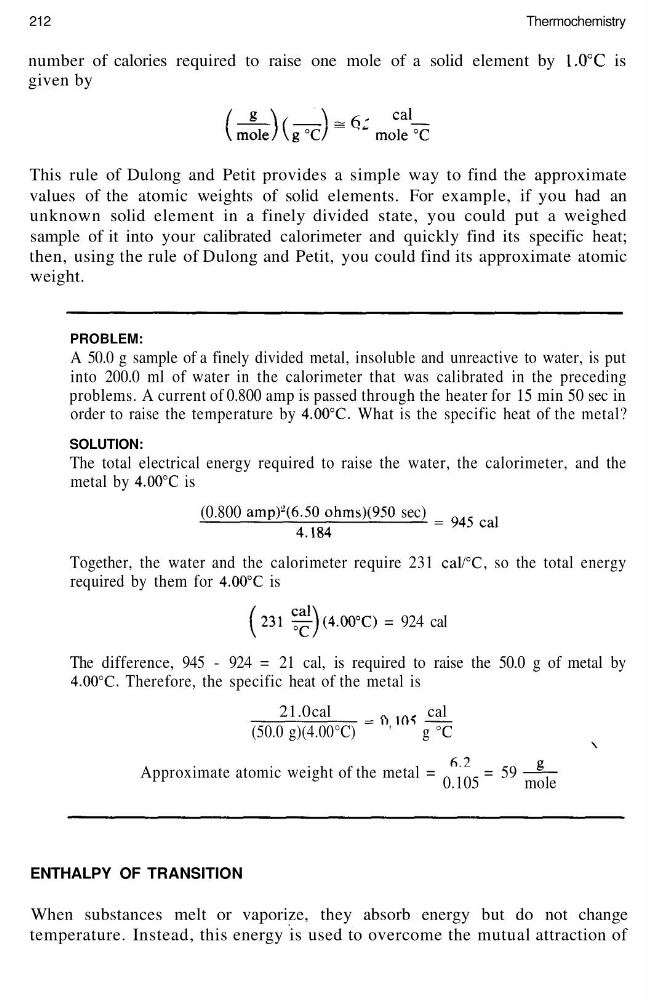
number of calories required to raise one mole of a solid element by l.O°C is
given by
} ( —
/\g°C
s 6 -
cal
'
Vmole/\g°C/
'"mole°C
This rule of Dulong and Petit provides a simple way to find the approximate
values of the atomic weights of solid elements. For example, if you had an
unknown solid element in a finely divided state, you could put a weighed
sample of it into your calibrated calorimeter and quickly find its specific heat;
then, using the rule of Dulong and Petit, you could find its approximate atomic
weight.
PROBLEM:
A 50.0 g sample of a finely divided metal, insoluble and unreactive to water, is put
into 200.0 ml of water in the calorimeter that was calibrated in the preceding
problems. A current of 0.800 amp is passed through the heater for 15 min 50 sec in
order to raise the temperature by 4.00°C. What is the specific heat of the metal?
SOLUTION:
The total electrical energy required to raise the water, the calorimeter, and the
metal by 4.00°C is
(0.800 amp)
2 (6.50 ohms)(950 sec)
Together, the water and the calorimeter require 231 cal/°C, so the total energy
required by them for 4.00°C is
4.00°C) = 924 cal
The difference, 945 - 924 = 21 cal, is required to raise the 50.0 g of metal by
4.00°C. Therefore, the specific heat of the metal is
21.0 cal
„ .„, cal
(50.0 g)(4.00°C)
'
g °C
Approximate atomic weight of the metal =
= 59
0.105
mole
ENTHALPY OF TRANSITION
When substances melt or vaporize, they absorb energy but do not change
temperature. Instead, this energy is used to overcome the mutual attraction of
Thermochemistry
number of calories required to raise one mole of a solid element by l.O°C is
given by
} ( —
/\g°C
s 6 -
cal
'
Vmole/\g°C/
'"mole°C
This rule of Dulong and Petit provides a simple way to find the approximate
values of the atomic weights of solid elements. For example, if you had an
unknown solid element in a finely divided state, you could put a weighed
sample of it into your calibrated calorimeter and quickly find its specific heat;
then, using the rule of Dulong and Petit, you could find its approximate atomic
weight.
PROBLEM:
A 50.0 g sample of a finely divided metal, insoluble and unreactive to water, is put
into 200.0 ml of water in the calorimeter that was calibrated in the preceding
problems. A current of 0.800 amp is passed through the heater for 15 min 50 sec in
order to raise the temperature by 4.00°C. What is the specific heat of the metal?
SOLUTION:
The total electrical energy required to raise the water, the calorimeter, and the
metal by 4.00°C is
(0.800 amp)
2 (6.50 ohms)(950 sec)
Together, the water and the calorimeter require 231 cal/°C, so the total energy
required by them for 4.00°C is
4.00°C) = 924 cal
The difference, 945 - 924 = 21 cal, is required to raise the 50.0 g of metal by
4.00°C. Therefore, the specific heat of the metal is
21.0 cal
„ .„, cal
(50.0 g)(4.00°C)
'
g °C
Approximate atomic weight of the metal =
= 59
0.105
mole
ENTHALPY OF TRANSITION
When substances melt or vaporize, they absorb energy but do not change
temperature. Instead, this energy is used to overcome the mutual attraction of