

The Rule of Dulong and Petit
211
2715 cal = 2210 cal + 22.lv cal
2715 - 2210
„ 0 cal
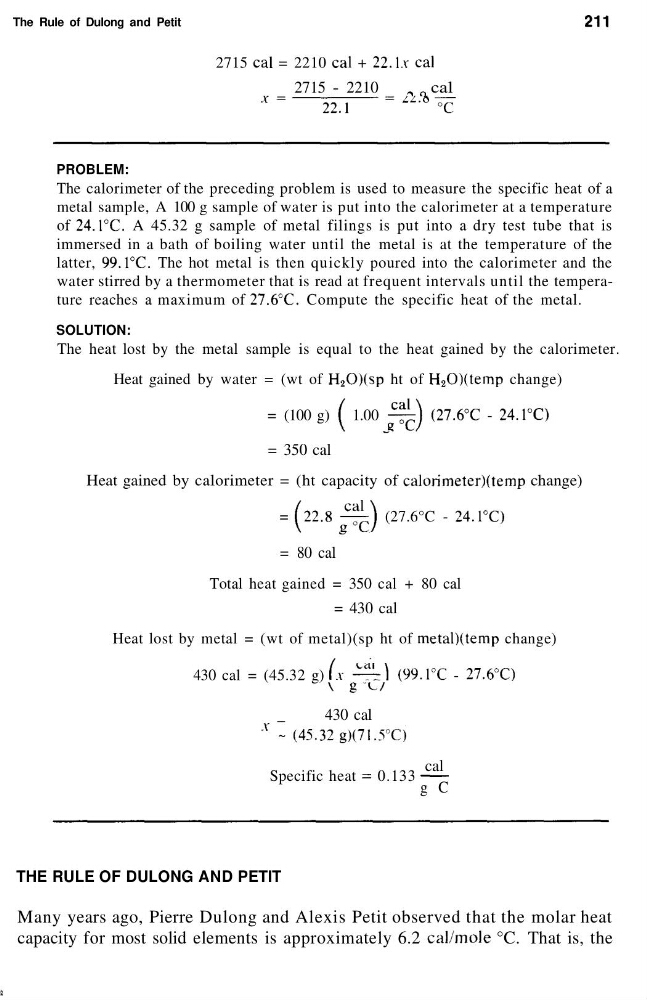
PROBLEM:
The calorimeter of the preceding problem is used to measure the specific heat of a
metal sample, A 100 g sample of water is put into the calorimeter at a temperature
of 24.1°C. A 45.32 g sample of metal filings is put into a dry test tube that is
immersed in a bath of boiling water until the metal is at the temperature of the
latter, 99.1°C. The hot metal is then quickly poured into the calorimeter and the
water stirred by a thermometer that is read at frequent intervals until the temperature reaches a maximum of 27.6°C. Compute the specific heat of the metal.
SOLUTION:
The heat lost by the metal sample is equal to the heat gained by the calorimeter.
Heat gained by water = (wt of H 2 O)(sp ht of H 2 O)(temp change)
= (100 g) ( 1.00 -^) (27.6°C - 24.TC)
= 350 cal
Heat gained by calorimeter = (ht capacity of calorimeter)(temp change)
= (22.8 ^^\ (27.6°C - 24.TC)
= 80 cal
Total heat gained = 350 cal + 80 cal
= 430 cal
Heat lost by metal = (wt of metal)(sp ht of metal)(temp change)
430 cal = (45.32 g) L ~\ (99.1°C - 27.6°C)
_
430 cal
'
V ~ (45.32g)(7!.5°C)
cal
Specific heat = 0.133 —g C
THE RULE OF DULONG AND PETIT
Many years ago, Pierre Dulong and Alexis Petit observed that the molar heat
capacity for most solid elements is approximately 6.2 cal/mole °C. That is, the
211
2715 cal = 2210 cal + 22.lv cal
2715 - 2210
„ 0 cal
PROBLEM:
The calorimeter of the preceding problem is used to measure the specific heat of a
metal sample, A 100 g sample of water is put into the calorimeter at a temperature
of 24.1°C. A 45.32 g sample of metal filings is put into a dry test tube that is
immersed in a bath of boiling water until the metal is at the temperature of the
latter, 99.1°C. The hot metal is then quickly poured into the calorimeter and the
water stirred by a thermometer that is read at frequent intervals until the temperature reaches a maximum of 27.6°C. Compute the specific heat of the metal.
SOLUTION:
The heat lost by the metal sample is equal to the heat gained by the calorimeter.
Heat gained by water = (wt of H 2 O)(sp ht of H 2 O)(temp change)
= (100 g) ( 1.00 -^) (27.6°C - 24.TC)
= 350 cal
Heat gained by calorimeter = (ht capacity of calorimeter)(temp change)
= (22.8 ^^\ (27.6°C - 24.TC)
= 80 cal
Total heat gained = 350 cal + 80 cal
= 430 cal
Heat lost by metal = (wt of metal)(sp ht of metal)(temp change)
430 cal = (45.32 g) L ~\ (99.1°C - 27.6°C)
_
430 cal
'
V ~ (45.32g)(7!.5°C)
cal
Specific heat = 0.133 —g C
THE RULE OF DULONG AND PETIT
Many years ago, Pierre Dulong and Alexis Petit observed that the molar heat
capacity for most solid elements is approximately 6.2 cal/mole °C. That is, the