

Dalton's Law of Partial Pressures
163
Average weight of one mole =
— = 29.0
g
100 moles
mole
= apparent molecular weight of air
PROBLEM:
How many molecules are there in 3.00 liters of a gas at a temperature of 500°C and
a pressure of 50.0 torr?
SOLUTION:
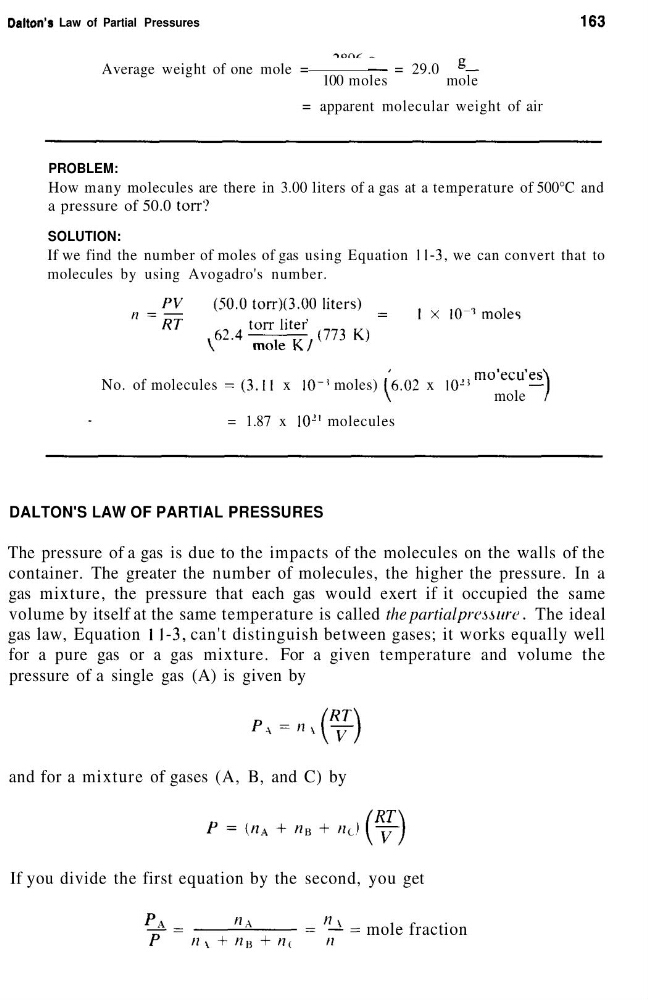
If we find the number of moles of gas using Equation 11-3, we can convert that to
molecules by using Avogadro's number.
n= PV
(50.0 t orr)(3.00 liters) =
, y
RT
62.4^-1^ (773 K)
V
mole K/
No. of molecules = (3.11 x 1Q-' moles) (6.02 x 10
J) mo ecu es )
\
mole /
= 1.87 x 10
J1 molecules
DALTON'S LAW OF PARTIAL PRESSURES
The pressure of a gas is due to the impacts of the molecules on the walls of the
container. The greater the number of molecules, the higher the pressure. In a
gas mixture, the pressure that each gas would exert if it occupied the same
volume by itself at the same temperature is called the partial pressure. The ideal
gas law, Equation 1 1-3, can't distinguish between gases; it works equally well
for a pure gas or a gas mixture. For a given temperature and volume the
pressure of a single gas (A) is given by
and for a mixture of gases (A, B, and C) by
(
RT
-yIf you divide the first equation by the second, you get
="-±= mole fraction
163
Average weight of one mole =
— = 29.0
g
100 moles
mole
= apparent molecular weight of air
PROBLEM:
How many molecules are there in 3.00 liters of a gas at a temperature of 500°C and
a pressure of 50.0 torr?
SOLUTION:
If we find the number of moles of gas using Equation 11-3, we can convert that to
molecules by using Avogadro's number.
n= PV
(50.0 t orr)(3.00 liters) =
, y
RT
62.4^-1^ (773 K)
V
mole K/
No. of molecules = (3.11 x 1Q-' moles) (6.02 x 10
J) mo ecu es )
\
mole /
= 1.87 x 10
J1 molecules
DALTON'S LAW OF PARTIAL PRESSURES
The pressure of a gas is due to the impacts of the molecules on the walls of the
container. The greater the number of molecules, the higher the pressure. In a
gas mixture, the pressure that each gas would exert if it occupied the same
volume by itself at the same temperature is called the partial pressure. The ideal
gas law, Equation 1 1-3, can't distinguish between gases; it works equally well
for a pure gas or a gas mixture. For a given temperature and volume the
pressure of a single gas (A) is given by
and for a mixture of gases (A, B, and C) by
(
RT
-yIf you divide the first equation by the second, you get
="-±= mole fraction