

162
Gases
If the empirical formula of this compound had been found to be (CH 2 F)j, this mole
weight determination could be used to find the true formula. The mole weight of
the CH 2 F unit is 33.0. The true mole weight must be some integral multiple (x) of
33.0:
66.0 _
33.0 ~
The true formula is C 2 H 4 F 2 .
PROBLEM:
What is the apparent molecular weight of air, assuming that it contains 78%
nitrogen, 21% oxygen, and 1% argon by volume?
SOLUTION:
The apparent molecular weight of a gas mixture will be the total weight of the
mixture divided by the total number of moles in the mixture (that is, the average
weight of one mole of molecules). The ideal gas law, Equation 11-3, can't distinguish between gases; it works equally well for a pure gas or a gas mixture. For a
given temperature and pressure the volume of a single gas (A) is given by
(RT
A = |U
(T,
and for a mixture of gases (A, B, and C) by
V = (/u + «B + «
If you divide the first equation by the second, you get
\
i r
•
= — = mole fraction
V
n^ + n B + /!(
n
and conclude that, at a given temperature and pressure, the fraction (or percentage) of the volume occupied by each component is just equal to its fraction (or
percentage) of the total moles present.
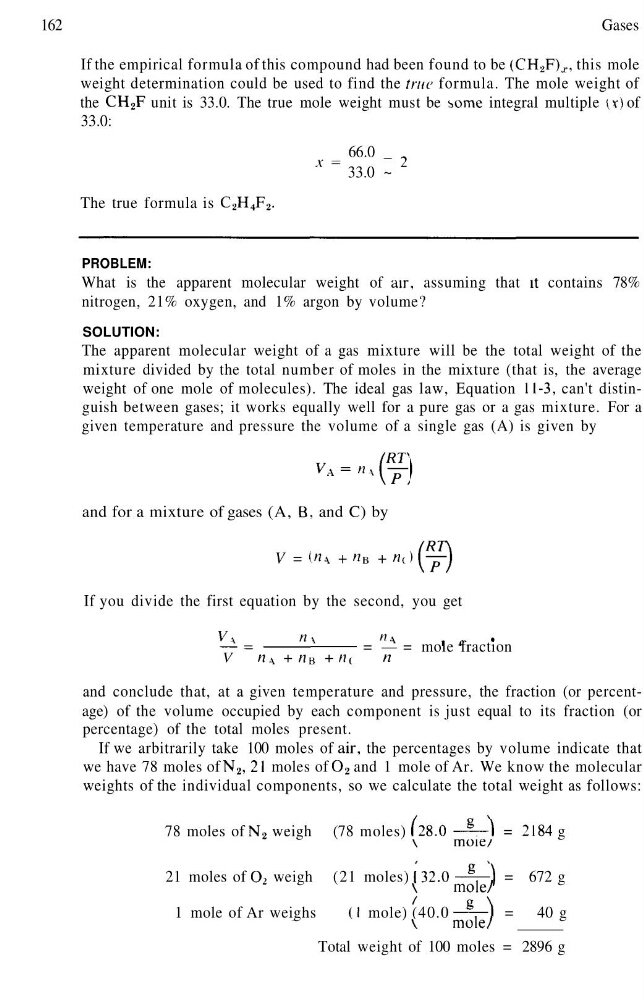
If we arbitrarily take 100 moles of air, the percentages by volume indicate that
we have 78 moles of N 2 , 21 moles of O 2 and 1 mole of Ar. We know the molecular
weights of the individual components, so we calculate the total weight as follows:
78 moles of N 2 weigh (78 moles) (28.0 -~-\ = 2184 g
21 moles of O 2 weigh (21 moles) (32.0 —^—) = 672 g
\
mole/
1 mole of Ar weighs
(I mole) (40.0 ——I = 40 g
\
mole/
Total weight of 100 moles = 2896 g
Gases
If the empirical formula of this compound had been found to be (CH 2 F)j, this mole
weight determination could be used to find the true formula. The mole weight of
the CH 2 F unit is 33.0. The true mole weight must be some integral multiple (x) of
33.0:
66.0 _
33.0 ~
The true formula is C 2 H 4 F 2 .
PROBLEM:
What is the apparent molecular weight of air, assuming that it contains 78%
nitrogen, 21% oxygen, and 1% argon by volume?
SOLUTION:
The apparent molecular weight of a gas mixture will be the total weight of the
mixture divided by the total number of moles in the mixture (that is, the average
weight of one mole of molecules). The ideal gas law, Equation 11-3, can't distinguish between gases; it works equally well for a pure gas or a gas mixture. For a
given temperature and pressure the volume of a single gas (A) is given by
(RT
A = |U
(T,
and for a mixture of gases (A, B, and C) by
V = (/u + «B + «
If you divide the first equation by the second, you get
\
i r
•
= — = mole fraction
V
n^ + n B + /!(
n
and conclude that, at a given temperature and pressure, the fraction (or percentage) of the volume occupied by each component is just equal to its fraction (or
percentage) of the total moles present.
If we arbitrarily take 100 moles of air, the percentages by volume indicate that
we have 78 moles of N 2 , 21 moles of O 2 and 1 mole of Ar. We know the molecular
weights of the individual components, so we calculate the total weight as follows:
78 moles of N 2 weigh (78 moles) (28.0 -~-\ = 2184 g
21 moles of O 2 weigh (21 moles) (32.0 —^—) = 672 g
\
mole/
1 mole of Ar weighs
(I mole) (40.0 ——I = 40 g
\
mole/
Total weight of 100 moles = 2896 g