

158
Gases
support a column of mercury exactly 1 mm in height at a temperature of 0°C. In
order to correct mercury manometer readings, H (in mm) taken at normal
laboratory temperatures (t in °C) to values P (in torr) that would have been
observed had the mercury temperature been 0°C, one can use the simple formula
P = H[\ - at]
(11-1)
where a = 1.63 x 10~
4 deg"
1 if the scale is made of brass, or a = 1.72 x 10~
4
deg"
1 if the scale is etched on glass. Conversions from one set of pressure units
to others are illustrated in the following problems.
PROBLEM:
Express a pressure of 1 atm in terms of the following units: (a) grams per
cm
2 ; (b) pounds per in
2 ; (c) dynes per cm
2 .
SOLUTION:
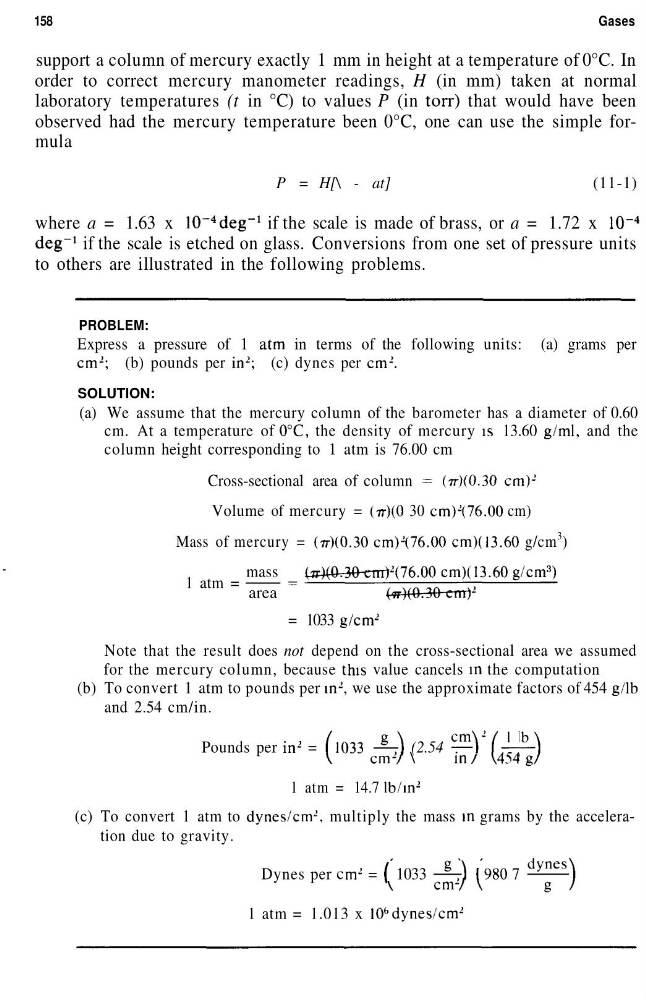
(a) We assume that the mercury column of the barometer has a diameter of 0.60
cm. At a temperature of 0°C, the density of mercury is 13.60 g/ml, and the
column height corresponding to 1 atm is 76.00 cm
Cross-sectional area of column = (7r)(0.30 cm)
2
Volume of mercury = (TT)(O 30 cm)
2 (76.00 cm)
Mass of mercury = (wKO.30 cm)
2 (76.00 cm)(13.60 g/cm
3 )
mass
43*X&-3&-eTir>
2 (76.00crn)(13.60g/cm
3 )
1 atm = area
= 1033 g/cm
2
Note that the result does not depend on the cross-sectional area we assumed
for the mercury column, because this value cancels in the computation
(b) To convert 1 atm to pounds per in
2 , we use the approximate factors of 454 g/lb
and 2.54 cm/in.
Pounds per in
2 = (1033 —} (2.54 ^V (-^
\
cm
2 / \
in / \454
1 atm = 14.7 lb/m
2
(c) To convert 1 atm to dynes/cm
2 , multiply the mass in grams by the acceleration due to gravity.
Dynes per cm
2 = ( 1033 -M (980 7
\
cm
2 / \
1 atm = 1.013 x 10
b dynes/cm
2
Gases
support a column of mercury exactly 1 mm in height at a temperature of 0°C. In
order to correct mercury manometer readings, H (in mm) taken at normal
laboratory temperatures (t in °C) to values P (in torr) that would have been
observed had the mercury temperature been 0°C, one can use the simple formula
P = H[\ - at]
(11-1)
where a = 1.63 x 10~
4 deg"
1 if the scale is made of brass, or a = 1.72 x 10~
4
deg"
1 if the scale is etched on glass. Conversions from one set of pressure units
to others are illustrated in the following problems.
PROBLEM:
Express a pressure of 1 atm in terms of the following units: (a) grams per
cm
2 ; (b) pounds per in
2 ; (c) dynes per cm
2 .
SOLUTION:
(a) We assume that the mercury column of the barometer has a diameter of 0.60
cm. At a temperature of 0°C, the density of mercury is 13.60 g/ml, and the
column height corresponding to 1 atm is 76.00 cm
Cross-sectional area of column = (7r)(0.30 cm)
2
Volume of mercury = (TT)(O 30 cm)
2 (76.00 cm)
Mass of mercury = (wKO.30 cm)
2 (76.00 cm)(13.60 g/cm
3 )
mass
43*X&-3&-eTir>
2 (76.00crn)(13.60g/cm
3 )
1 atm = area
= 1033 g/cm
2
Note that the result does not depend on the cross-sectional area we assumed
for the mercury column, because this value cancels in the computation
(b) To convert 1 atm to pounds per in
2 , we use the approximate factors of 454 g/lb
and 2.54 cm/in.
Pounds per in
2 = (1033 —} (2.54 ^V (-^
\
cm
2 / \
in / \454
1 atm = 14.7 lb/m
2
(c) To convert 1 atm to dynes/cm
2 , multiply the mass in grams by the acceleration due to gravity.
Dynes per cm
2 = ( 1033 -M (980 7
\
cm
2 / \
1 atm = 1.013 x 10
b dynes/cm
2