

157
(a)
(b)
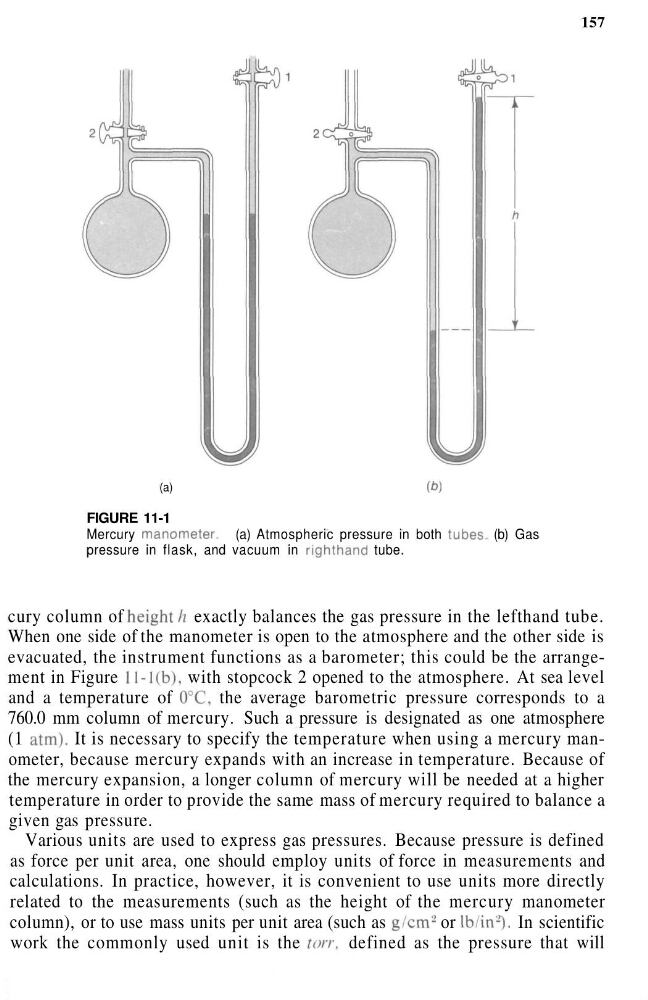
FIGURE 11-1
Mercury manometer, (a) Atmospheric pressure in both tubes, (b) Gas
pressure in flask, and vacuum in righthand tube.
cury column of height/; exactly balances the gas pressure in the lefthand tube.
When one side of the manometer is open to the atmosphere and the other side is
evacuated, the instrument functions as a barometer; this could be the arrangement in Figure I l-l(b), with stopcock 2 opened to the atmosphere. At sea level
and a temperature of 0°C, the average barometric pressure corresponds to a
760.0 mm column of mercury. Such a pressure is designated as one atmosphere
(1 atm). It is necessary to specify the temperature when using a mercury manometer, because mercury expands with an increase in temperature. Because of
the mercury expansion, a longer column of mercury will be needed at a higher
temperature in order to provide the same mass of mercury required to balance a
given gas pressure.
Various units are used to express gas pressures. Because pressure is defined
as force per unit area, one should employ units of force in measurements and
calculations. In practice, however, it is convenient to use units more directly
related to the measurements (such as the height of the mercury manometer
column), or to use mass units per unit area (such as g/cm
2 or Ib/in
2 ). In scientific
work the commonly used unit is the torr, defined as the pressure that will
(a)
(b)
FIGURE 11-1
Mercury manometer, (a) Atmospheric pressure in both tubes, (b) Gas
pressure in flask, and vacuum in righthand tube.
cury column of height/; exactly balances the gas pressure in the lefthand tube.
When one side of the manometer is open to the atmosphere and the other side is
evacuated, the instrument functions as a barometer; this could be the arrangement in Figure I l-l(b), with stopcock 2 opened to the atmosphere. At sea level
and a temperature of 0°C, the average barometric pressure corresponds to a
760.0 mm column of mercury. Such a pressure is designated as one atmosphere
(1 atm). It is necessary to specify the temperature when using a mercury manometer, because mercury expands with an increase in temperature. Because of
the mercury expansion, a longer column of mercury will be needed at a higher
temperature in order to provide the same mass of mercury required to balance a
given gas pressure.
Various units are used to express gas pressures. Because pressure is defined
as force per unit area, one should employ units of force in measurements and
calculations. In practice, however, it is convenient to use units more directly
related to the measurements (such as the height of the mercury manometer
column), or to use mass units per unit area (such as g/cm
2 or Ib/in
2 ). In scientific
work the commonly used unit is the torr, defined as the pressure that will