

142
H,N
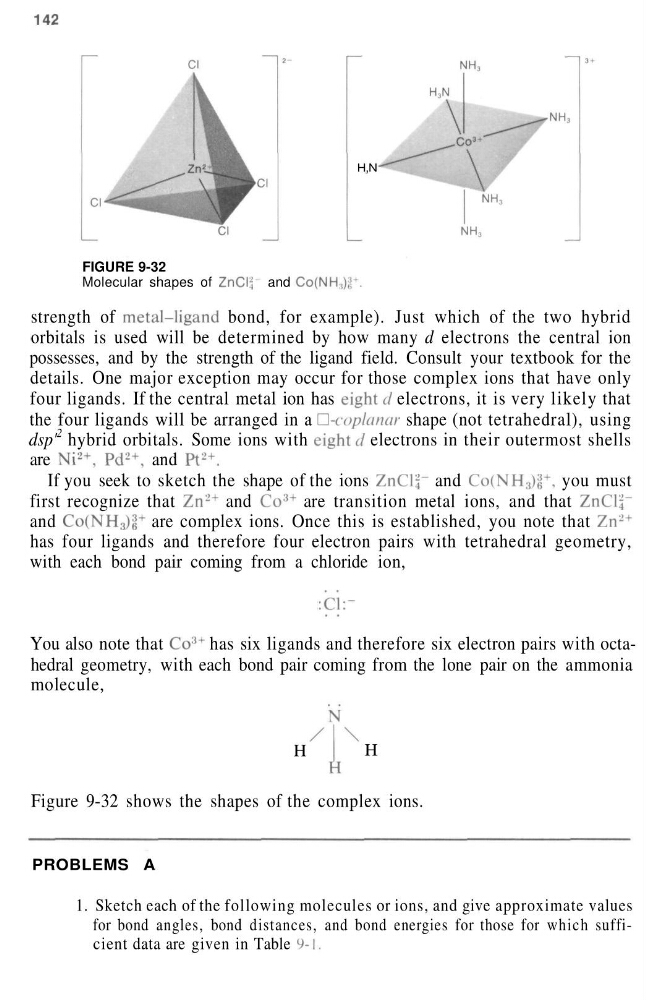
FIGURE 9-32
Molecular shapes of ZnCI^ and
strength of metal-ligand bond, for example). Just which of the two hybrid
orbitals is used will be determined by how many d electrons the central ion
possesses, and by the strength of the ligand field. Consult your textbook for the
details. One major exception may occur for those complex ions that have only
four ligands. If the central metal ion has eighth electrons, it is very likely that
the four ligands will be arranged in a D-coplanar shape (not tetrahedral), using
dsp'
2 hybrid orbitals. Some ions with eighth electrons in their outermost shells
are Ni
2+ , Pd
2+ , and R
2+ .
If you seek to sketch the shape of the ions ZnCl
2 ," and Co(NH 3 )jj
+ , you must
first recognize that Zn
2+ and Co
3+ are transition metal ions, and that ZnClrT
and CoCNHg)!"
1 " are complex ions. Once this is established, you note that Zn
2+
has four ligands and therefore four electron pairs with tetrahedral geometry,
with each bond pair coming from a chloride ion,
:CJ:You also note that Co
3+ has six ligands and therefore six electron pairs with octahedral geometry, with each bond pair coming from the lone pair on the ammonia
molecule,
N
H
H
Figure 9-32 shows the shapes of the complex ions.
PROBLEMS A
1. Sketch each of the following molecules or ions, and give approximate values
for bond angles, bond distances, and bond energies for those for which sufficient data are given in Table 9-1.
H,N
FIGURE 9-32
Molecular shapes of ZnCI^ and
strength of metal-ligand bond, for example). Just which of the two hybrid
orbitals is used will be determined by how many d electrons the central ion
possesses, and by the strength of the ligand field. Consult your textbook for the
details. One major exception may occur for those complex ions that have only
four ligands. If the central metal ion has eighth electrons, it is very likely that
the four ligands will be arranged in a D-coplanar shape (not tetrahedral), using
dsp'
2 hybrid orbitals. Some ions with eighth electrons in their outermost shells
are Ni
2+ , Pd
2+ , and R
2+ .
If you seek to sketch the shape of the ions ZnCl
2 ," and Co(NH 3 )jj
+ , you must
first recognize that Zn
2+ and Co
3+ are transition metal ions, and that ZnClrT
and CoCNHg)!"
1 " are complex ions. Once this is established, you note that Zn
2+
has four ligands and therefore four electron pairs with tetrahedral geometry,
with each bond pair coming from a chloride ion,
:CJ:You also note that Co
3+ has six ligands and therefore six electron pairs with octahedral geometry, with each bond pair coming from the lone pair on the ammonia
molecule,
N
H
H
Figure 9-32 shows the shapes of the complex ions.
PROBLEMS A
1. Sketch each of the following molecules or ions, and give approximate values
for bond angles, bond distances, and bond energies for those for which sufficient data are given in Table 9-1.