

Properties of Molecular Orbltals
141
all respects the molecule will be identical to the NO^T ion illustrated in Figure
9-28, except that the sp'
2 orbital on N that holds a lone pair in NO^r will have
only a single electron in NO 2 . This single electron will exert a repulsive effect on
the other bond pairs,'but much less so than a complete lone pair. You would
expect the O-N-O angle (134° by experiment) in NO 2 to be greater than the
0-N-O angle (115° by experiment) in NO^", for example. You can also see why
two NO 2 molecules will so readily react with each other to form N 2 O 4 ; the two
half-filled lone-pair orbitals will end-overlap to form an electron pair a- bond
between the two N atoms. In addition, the TT clouds of each NO 2 will sideoverlap to make one gigantic TT cloud delocalized over the whole plane of the
N 2 O 4 molecule.
Finally, we might comment on one other interesting property that is associated with a double or triple bond. The TT bond keeps the two halves of a
double bond from freely rotating about the cr bond axis that joins them. This
property is of the utmost importance in explaining the shape and properties of
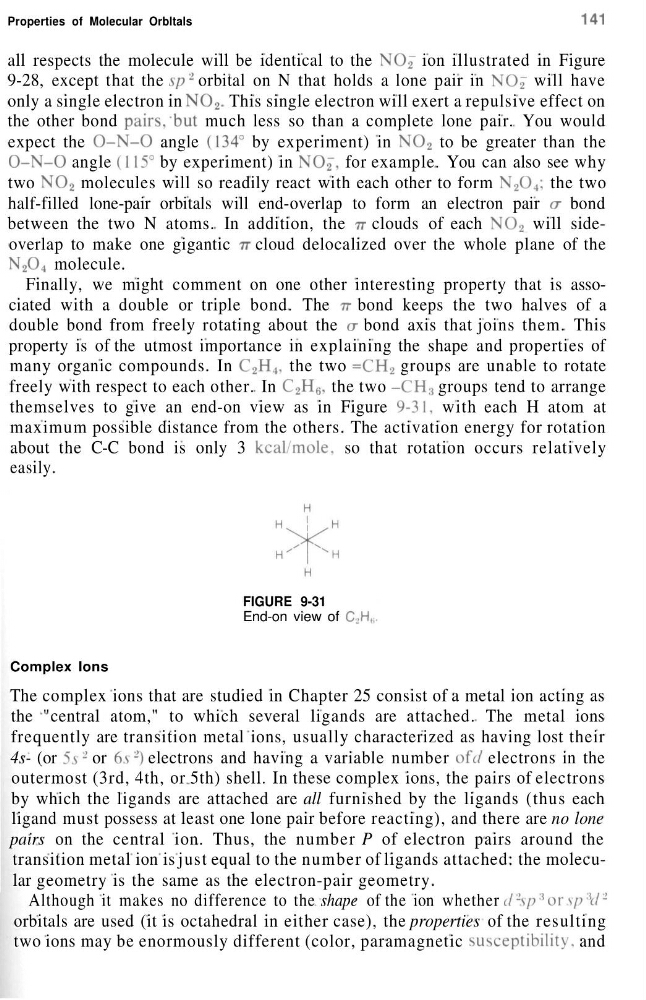
many organic compounds. In C 2 H 4 , the two =CH 2 groups are unable to rotate
freely with respect to each other. In C 2 H 6 , the two -CH 3 groups tend to arrange
themselves to give an end-on view as in Figure 9-31, with each H atom at
maximum possible distance from the others. The activation energy for rotation
about the C-C bond is only 3 kcal/mole, so that rotation occurs relatively
easily.
FIGURE 9-31
End-on view of C 2 H (i .
Complex Ions
The complex ions that are studied in Chapter 25 consist of a metal ion acting as
the "central atom," to which several ligands are attached. The metal ions
frequently are transition metal ions, usually characterized as having lost their
4s- (or 5s'
2 or 6s'
2 ) electrons and having a variable number of d electrons in the
outermost (3rd, 4th, or 5th) shell. In these complex ions, the pairs of electrons
by which the ligands are attached are all furnished by the ligands (thus each
ligand must possess at least one lone pair before reacting), and there are no lone
pairs on the central ion. Thus, the number P of electron pairs around the
transition metal ion is just equal to the number of ligands attached: the molecular geometry is the same as the electron-pair geometry.
Although it makes no difference to the shape of the ion whether d'
2 sp* or.v/7
3 c/
2
orbitals are used (it is octahedral in either case), the properties of the resulting
two ions may be enormously different (color, paramagnetic susceptibility, and
141
all respects the molecule will be identical to the NO^T ion illustrated in Figure
9-28, except that the sp'
2 orbital on N that holds a lone pair in NO^r will have
only a single electron in NO 2 . This single electron will exert a repulsive effect on
the other bond pairs,'but much less so than a complete lone pair. You would
expect the O-N-O angle (134° by experiment) in NO 2 to be greater than the
0-N-O angle (115° by experiment) in NO^", for example. You can also see why
two NO 2 molecules will so readily react with each other to form N 2 O 4 ; the two
half-filled lone-pair orbitals will end-overlap to form an electron pair a- bond
between the two N atoms. In addition, the TT clouds of each NO 2 will sideoverlap to make one gigantic TT cloud delocalized over the whole plane of the
N 2 O 4 molecule.
Finally, we might comment on one other interesting property that is associated with a double or triple bond. The TT bond keeps the two halves of a
double bond from freely rotating about the cr bond axis that joins them. This
property is of the utmost importance in explaining the shape and properties of
many organic compounds. In C 2 H 4 , the two =CH 2 groups are unable to rotate
freely with respect to each other. In C 2 H 6 , the two -CH 3 groups tend to arrange
themselves to give an end-on view as in Figure 9-31, with each H atom at
maximum possible distance from the others. The activation energy for rotation
about the C-C bond is only 3 kcal/mole, so that rotation occurs relatively
easily.
FIGURE 9-31
End-on view of C 2 H (i .
Complex Ions
The complex ions that are studied in Chapter 25 consist of a metal ion acting as
the "central atom," to which several ligands are attached. The metal ions
frequently are transition metal ions, usually characterized as having lost their
4s- (or 5s'
2 or 6s'
2 ) electrons and having a variable number of d electrons in the
outermost (3rd, 4th, or 5th) shell. In these complex ions, the pairs of electrons
by which the ligands are attached are all furnished by the ligands (thus each
ligand must possess at least one lone pair before reacting), and there are no lone
pairs on the central ion. Thus, the number P of electron pairs around the
transition metal ion is just equal to the number of ligands attached: the molecular geometry is the same as the electron-pair geometry.
Although it makes no difference to the shape of the ion whether d'
2 sp* or.v/7
3 c/
2
orbitals are used (it is octahedral in either case), the properties of the resulting
two ions may be enormously different (color, paramagnetic susceptibility, and