

14.20
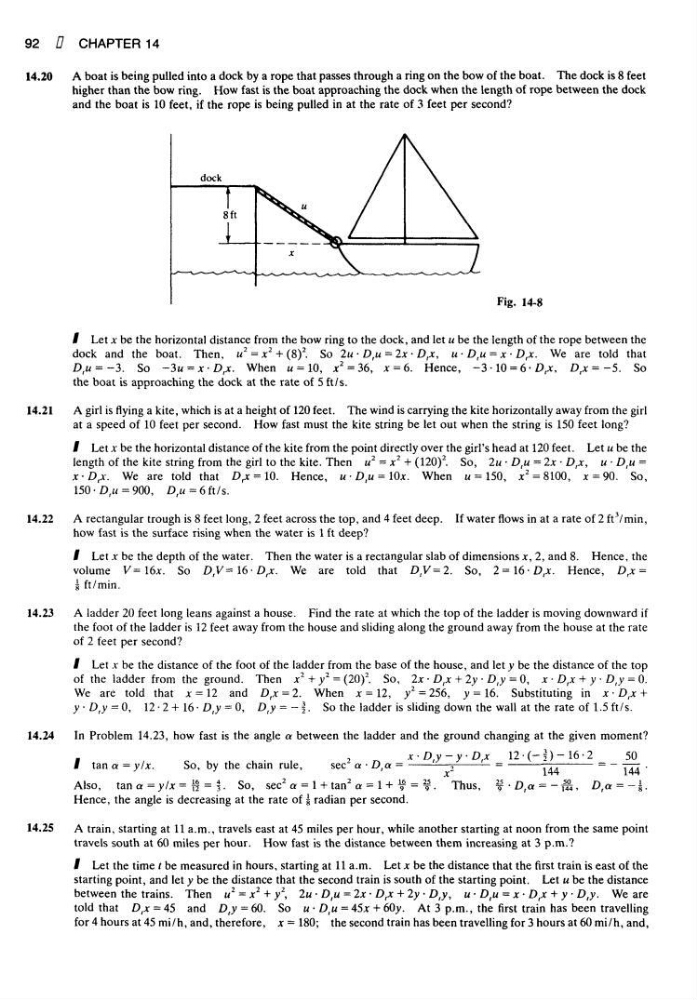
A boat is being pulled into a dock by a rope that passes through a ring on the bow of the boat. The dock is 8 feet
higher than the bow ring. How fast is the boat approaching the dock when the length of rope between the dock
and the boat is 10 feet, if the rope is being pulled in at the rate of 3 feet per second?
Fig. 14-8
14.21
14.22
14.23
14.24
f Let x be the horizontal distance from the bow ring to the dock, and let u be the length of the rope between the
dock and the boat. Then, u
2 = x
2 + (8)
2
. So 2u • D,u = 2x • D,x, u • D,u = x • D,x. We are told that
D,u = -3. So -3u = x-D,x. When u = 10, x
2 = 36, x = 6. Hence, -3 • 10 = 6 • D,x, D,x = -5. So
the boat is approaching the dock at the rate of 5 ft/s.
A girl is flying a kite, which is at a height of 120 feet. The wind is carrying the kite horizontally away from the girl
at a speed of 10 feet per second. How fast must the kite string be let out when the string is 150 feet long?
I Let x be the horizontal distance of the kite from the point directly over the girl's head at 120 feet. Let u be the
length of the kite string from the girl to the kite. Then u
2 = x
1 + (120)
2
. So, 2u • D,u = 2x • D r x, u-D,u =
x-D,x. We are told that D,* = 10. Hence, u • D,u = 10*. When w = 150, x
2 = 8100, x=90. So,
150 • Z>,M = 900, D,M=6ft/s.
A rectangular trough is 8 feet long, 2 feet across the top, and 4 feet deep. If water flows in at a rate of 2 ft
3 /min,
how fast is the surface rising when the water is 1 ft deep?
I Let A: be the depth of the water. Then the water is a rectangular slab of dimensions AT, 2, and 8. Hence, the
volume V= 16*. So D,V= 16- D,x. We are told that D t V=2. So, 2=16-D,*. Hence, D,x =
5 ft/min.
A ladder 20 feet long leans against a house. Find the rate at which the top of the ladder is moving downward if
the foot of the ladder is 12 feet away from the house and sliding along the ground away from the house at the rate
of 2 feet per second?
I Let x be the distance of the foot of the ladder from the base of the house, and let y be the distance of the top
of the ladder from the ground. Then x
2 + y
2 = (20)
2
. So, 2x • D t x + 2y • D t y = 0, x • D,x + y • D,y = 0.
We are told that x = 12 and D,x = 2. When * = 12, y
2 = 256, y = 16. Substituting in x-D,x +
y-D,y = Q, 12- 2 + 16- D,y = 0, D t y = -\.
So the ladder is sliding down the wall at the rate of 1.5 ft/s.
14.25
A train, starting at 11 a.m., travels east at 45 miles per hour, while another starting at noon from the same point
travels south at 60 miles per hour. How fast is the distance between them increasing at 3 p.m.?
I Let the time t be measured in hours, starting at 11 a.m. Let x be the distance that the first train is east of the
starting point, and let y be the distance that the second train is south of the starting point. Let u be the distance
between the trains. Then u
2 = x
2 + y
2 , 2u • D,u = 2x • D,x + 2y • D,y, u • D,u = x • D,x + y • D,y. We are
told that D,x = 45 and D,y = 60.
for 4 hours at 45 mi/h, and, therefore,
So u • D t u = 45x + 60y. At 3 p.m., the first train has been travelling
x = 180; the second train has been travelling for 3 hours at 60 mi/h, and,
92
CHAPTER 14
In Problem 14.23, how fast is the angle a between the ladder and the ground changing at the given moment?
tan a = y/x.
So, by the chain rule,
sec
2 a • D t a
Also, tan a =)>/*= if = f. So, sec a = 1 + tan o = 1 + f = ¥• Thus, f-D,a = -^, D,a = -|.
Hence, the angle is decreasing at the rate of § radian per second.
A boat is being pulled into a dock by a rope that passes through a ring on the bow of the boat. The dock is 8 feet
higher than the bow ring. How fast is the boat approaching the dock when the length of rope between the dock
and the boat is 10 feet, if the rope is being pulled in at the rate of 3 feet per second?
Fig. 14-8
14.21
14.22
14.23
14.24
f Let x be the horizontal distance from the bow ring to the dock, and let u be the length of the rope between the
dock and the boat. Then, u
2 = x
2 + (8)
2
. So 2u • D,u = 2x • D,x, u • D,u = x • D,x. We are told that
D,u = -3. So -3u = x-D,x. When u = 10, x
2 = 36, x = 6. Hence, -3 • 10 = 6 • D,x, D,x = -5. So
the boat is approaching the dock at the rate of 5 ft/s.
A girl is flying a kite, which is at a height of 120 feet. The wind is carrying the kite horizontally away from the girl
at a speed of 10 feet per second. How fast must the kite string be let out when the string is 150 feet long?
I Let x be the horizontal distance of the kite from the point directly over the girl's head at 120 feet. Let u be the
length of the kite string from the girl to the kite. Then u
2 = x
1 + (120)
2
. So, 2u • D,u = 2x • D r x, u-D,u =
x-D,x. We are told that D,* = 10. Hence, u • D,u = 10*. When w = 150, x
2 = 8100, x=90. So,
150 • Z>,M = 900, D,M=6ft/s.
A rectangular trough is 8 feet long, 2 feet across the top, and 4 feet deep. If water flows in at a rate of 2 ft
3 /min,
how fast is the surface rising when the water is 1 ft deep?
I Let A: be the depth of the water. Then the water is a rectangular slab of dimensions AT, 2, and 8. Hence, the
volume V= 16*. So D,V= 16- D,x. We are told that D t V=2. So, 2=16-D,*. Hence, D,x =
5 ft/min.
A ladder 20 feet long leans against a house. Find the rate at which the top of the ladder is moving downward if
the foot of the ladder is 12 feet away from the house and sliding along the ground away from the house at the rate
of 2 feet per second?
I Let x be the distance of the foot of the ladder from the base of the house, and let y be the distance of the top
of the ladder from the ground. Then x
2 + y
2 = (20)
2
. So, 2x • D t x + 2y • D t y = 0, x • D,x + y • D,y = 0.
We are told that x = 12 and D,x = 2. When * = 12, y
2 = 256, y = 16. Substituting in x-D,x +
y-D,y = Q, 12- 2 + 16- D,y = 0, D t y = -\.
So the ladder is sliding down the wall at the rate of 1.5 ft/s.
14.25
A train, starting at 11 a.m., travels east at 45 miles per hour, while another starting at noon from the same point
travels south at 60 miles per hour. How fast is the distance between them increasing at 3 p.m.?
I Let the time t be measured in hours, starting at 11 a.m. Let x be the distance that the first train is east of the
starting point, and let y be the distance that the second train is south of the starting point. Let u be the distance
between the trains. Then u
2 = x
2 + y
2 , 2u • D,u = 2x • D,x + 2y • D,y, u • D,u = x • D,x + y • D,y. We are
told that D,x = 45 and D,y = 60.
for 4 hours at 45 mi/h, and, therefore,
So u • D t u = 45x + 60y. At 3 p.m., the first train has been travelling
x = 180; the second train has been travelling for 3 hours at 60 mi/h, and,
92
CHAPTER 14
In Problem 14.23, how fast is the angle a between the ladder and the ground changing at the given moment?
tan a = y/x.
So, by the chain rule,
sec
2 a • D t a
Also, tan a =)>/*= if = f. So, sec a = 1 + tan o = 1 + f = ¥• Thus, f-D,a = -^, D,a = -|.
Hence, the angle is decreasing at the rate of § radian per second.