

RELATED RATES
therefore, y = 180. Then, u
2 = (ISO)
2 + (ISO)
2 , u = 180V2. Thus, 180V5 • D,M = 45 • 180 + 60 • 180,
! = 105V2/2mi/h.
14.26
A light is at the top of a pole 80 feet high. A ball is dropped from the same height (80 ft) from a point 20 feet
from the light. Assuming that the ball falls according to the law s = 16f
2
, how fast is the shadow of the ball
moving along the ground one second later?
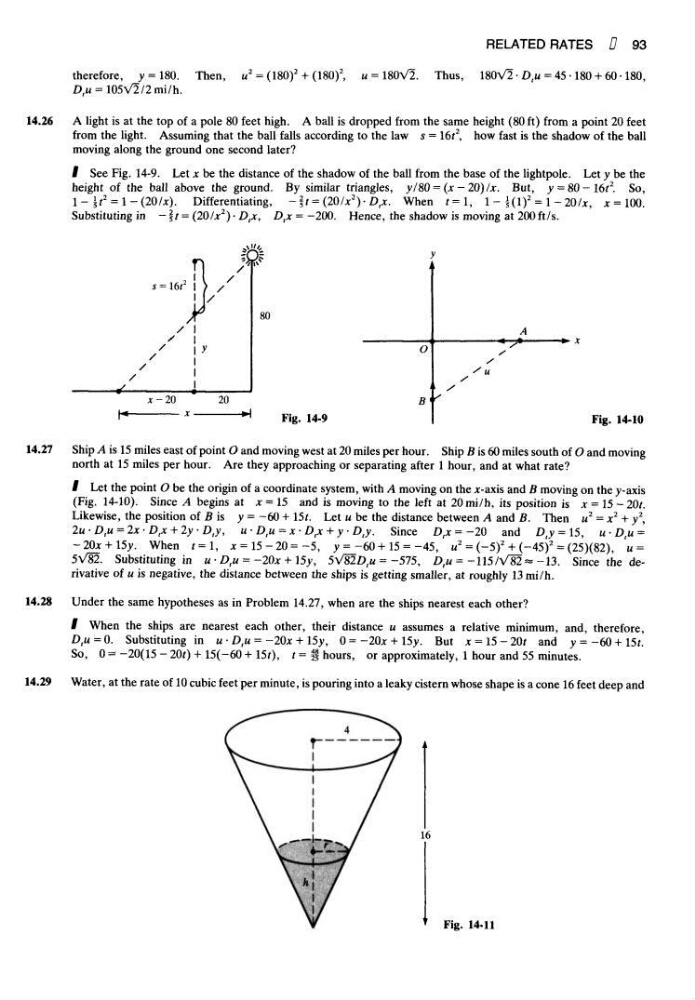
I See Fig. 14-9. Let x be the distance of the shadow of the ball from the base of the lightpole. Let y be the
height of the ball above the ground. By similar triangles, y/80 = (x-20)/x. But, y-8Q-l6t
2 . So,
l-^
2 = l-(20/jt). Differentiating, -fr= (20/Jt
2 )- D,x. When f=l, 1 - \(l)
2 = I -20/jc, x = 100.
Substituting in - f / = (20/*
2 ) • D,x, D,x = -200. Hence, the shadow is moving at 200 ft/s.
Fig. 14-9
Fig. 14-10
14.27
Ship A is 15 miles east of point O and moving west at 20 miles per hour. Ship B is 60 miles south of O and moving
north at 15 miles per hour. Are they approaching or separating after 1 hour, and at what rate?
I Let the point O be the origin of a coordinate system, with A moving on the Jt-axis and B moving on the y-axis
(Fig. 14-10). Since A begins at x = 15 and is moving to the left at 20 mi/h, its position is x = 15 - 20/.
Likewise, the position of B is y = -60 + I5t. Let u be the distance between A and B. Then u
2 = x
2 + y
2 ,
2u • D,u = 2x • D,x + 2y • D,y, u-D,u = x • D,x + y • D,y. Since D,x = -20
and D,y = 15, u-D,u =
-20x + 15y. When f = l, * = 15-20=-5, y = -60+ 15 = -45, u
2 = (-5)
2 + (-45)
2 = (25)(82), « =
5V82. Substituting in «•£>,« = -20* + 15y, 5V82Z>,« =-575, D,u = -115/V82* -13. Since the derivative of u is negative, the distance between the ships is getting smaller, at roughly 13 mi/h.
14.28
Under the same hypotheses as in Problem 14.27, when are the ships nearest each other?
I When the ships are nearest each other, their distance u assumes a relative minimum, and, therefore,
D,u = 0. Substituting in u-D,u = -20x + 15y, 0 = -20* + 15y. But jc = 15 - 20t and y = -60 + 15f.
So, 0 =' -20(15 - 200 + 15(-60 + 150, ' = i hours, or approximately, 1 hour and 55 minutes.
14.29
Water, at the rate of 10 cubic feet per minute, is pouring into a leaky cistern whose shape is a cone 16 feet deep and
Fig. 14-11
93
therefore, y = 180. Then, u
2 = (ISO)
2 + (ISO)
2 , u = 180V2. Thus, 180V5 • D,M = 45 • 180 + 60 • 180,
! = 105V2/2mi/h.
14.26
A light is at the top of a pole 80 feet high. A ball is dropped from the same height (80 ft) from a point 20 feet
from the light. Assuming that the ball falls according to the law s = 16f
2
, how fast is the shadow of the ball
moving along the ground one second later?
I See Fig. 14-9. Let x be the distance of the shadow of the ball from the base of the lightpole. Let y be the
height of the ball above the ground. By similar triangles, y/80 = (x-20)/x. But, y-8Q-l6t
2 . So,
l-^
2 = l-(20/jt). Differentiating, -fr= (20/Jt
2 )- D,x. When f=l, 1 - \(l)
2 = I -20/jc, x = 100.
Substituting in - f / = (20/*
2 ) • D,x, D,x = -200. Hence, the shadow is moving at 200 ft/s.
Fig. 14-9
Fig. 14-10
14.27
Ship A is 15 miles east of point O and moving west at 20 miles per hour. Ship B is 60 miles south of O and moving
north at 15 miles per hour. Are they approaching or separating after 1 hour, and at what rate?
I Let the point O be the origin of a coordinate system, with A moving on the Jt-axis and B moving on the y-axis
(Fig. 14-10). Since A begins at x = 15 and is moving to the left at 20 mi/h, its position is x = 15 - 20/.
Likewise, the position of B is y = -60 + I5t. Let u be the distance between A and B. Then u
2 = x
2 + y
2 ,
2u • D,u = 2x • D,x + 2y • D,y, u-D,u = x • D,x + y • D,y. Since D,x = -20
and D,y = 15, u-D,u =
-20x + 15y. When f = l, * = 15-20=-5, y = -60+ 15 = -45, u
2 = (-5)
2 + (-45)
2 = (25)(82), « =
5V82. Substituting in «•£>,« = -20* + 15y, 5V82Z>,« =-575, D,u = -115/V82* -13. Since the derivative of u is negative, the distance between the ships is getting smaller, at roughly 13 mi/h.
14.28
Under the same hypotheses as in Problem 14.27, when are the ships nearest each other?
I When the ships are nearest each other, their distance u assumes a relative minimum, and, therefore,
D,u = 0. Substituting in u-D,u = -20x + 15y, 0 = -20* + 15y. But jc = 15 - 20t and y = -60 + 15f.
So, 0 =' -20(15 - 200 + 15(-60 + 150, ' = i hours, or approximately, 1 hour and 55 minutes.
14.29
Water, at the rate of 10 cubic feet per minute, is pouring into a leaky cistern whose shape is a cone 16 feet deep and
Fig. 14-11
93