

CHAPTER 11
11.47
11.48
An important function in calculus (the exponential function) may be defined by the conditions
Prove that the zeros of sin x and cos x separate each other; that is, between any two zeros of sin x, there is a zero of
cos x, and vice versa.
Assume sina = 0 and sin 6=0 with a
74
/'(*) = /«
(~°° <*<+*)
and
/(0)=1
(1)
Show that this function is (a) strictly positive, and (b) strictly increasing.
(a) Let h(x) =f(x)f(-x); then, using the product rule, the chain rule, and (/), h'(x)=f'(x)f(-x) +
f(x)f'(-x)(-l)=f(x)f(-x)-f(x)f(-x) = 0. So by Problem 11.35, h(x) = const. = h(0) = 1-1 = 1; that is,
for all x,
/«/(-*) = !
By (2), f(x) is never zero. Furthermore, the continuous (because it is differentiable) function/(x) can never be
negative; for f(a) < 0 and /(O) = 1 > 0 would imply an intermediate zero value, which we have just seen to
be impossible. Hence f(x) is strictly positive. (b) /'(*) =/(*) >0; so (Problem 11.17), f(x) is strictly
increasing.
11.49
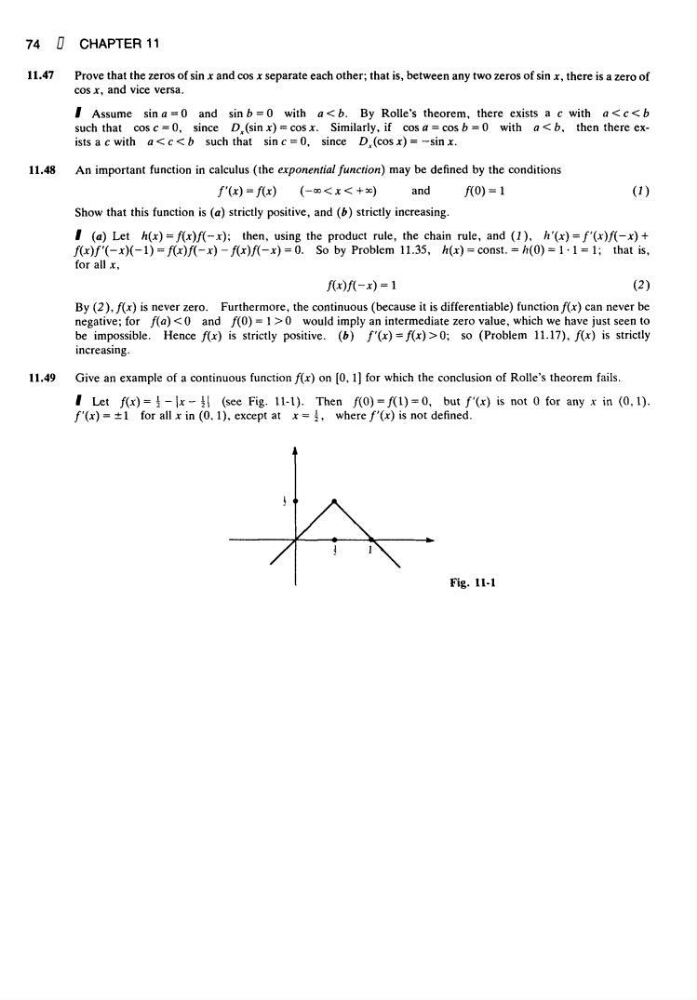
Give an example of a continuous function f(x) on fO, 11 for which the conclusion of Rolle's theorem fails.
Let f(x)={-\x-{\
(see Fig. 11-1). Then /(O) =/(!) = 0, but f'(x) is not 0 for any x in (0,1).
/'(*) = ±1 for all A: in (0,1), except at jc = {, where f'(x) is not defined.
(2)
11.47
11.48
An important function in calculus (the exponential function) may be defined by the conditions
Prove that the zeros of sin x and cos x separate each other; that is, between any two zeros of sin x, there is a zero of
cos x, and vice versa.
Assume sina = 0 and sin 6=0 with a
74
/'(*) = /«
(~°° <*<+*)
and
/(0)=1
(1)
Show that this function is (a) strictly positive, and (b) strictly increasing.
(a) Let h(x) =f(x)f(-x); then, using the product rule, the chain rule, and (/), h'(x)=f'(x)f(-x) +
f(x)f'(-x)(-l)=f(x)f(-x)-f(x)f(-x) = 0. So by Problem 11.35, h(x) = const. = h(0) = 1-1 = 1; that is,
for all x,
/«/(-*) = !
By (2), f(x) is never zero. Furthermore, the continuous (because it is differentiable) function/(x) can never be
negative; for f(a) < 0 and /(O) = 1 > 0 would imply an intermediate zero value, which we have just seen to
be impossible. Hence f(x) is strictly positive. (b) /'(*) =/(*) >0; so (Problem 11.17), f(x) is strictly
increasing.
11.49
Give an example of a continuous function f(x) on fO, 11 for which the conclusion of Rolle's theorem fails.
Let f(x)={-\x-{\
(see Fig. 11-1). Then /(O) =/(!) = 0, but f'(x) is not 0 for any x in (0,1).
/'(*) = ±1 for all A: in (0,1), except at jc = {, where f'(x) is not defined.
(2)