

ROLLE'S THEOREM, THE MEAN VALUE THEOREM, AND THE SIGN OF THE DERIVATIVE
11.39
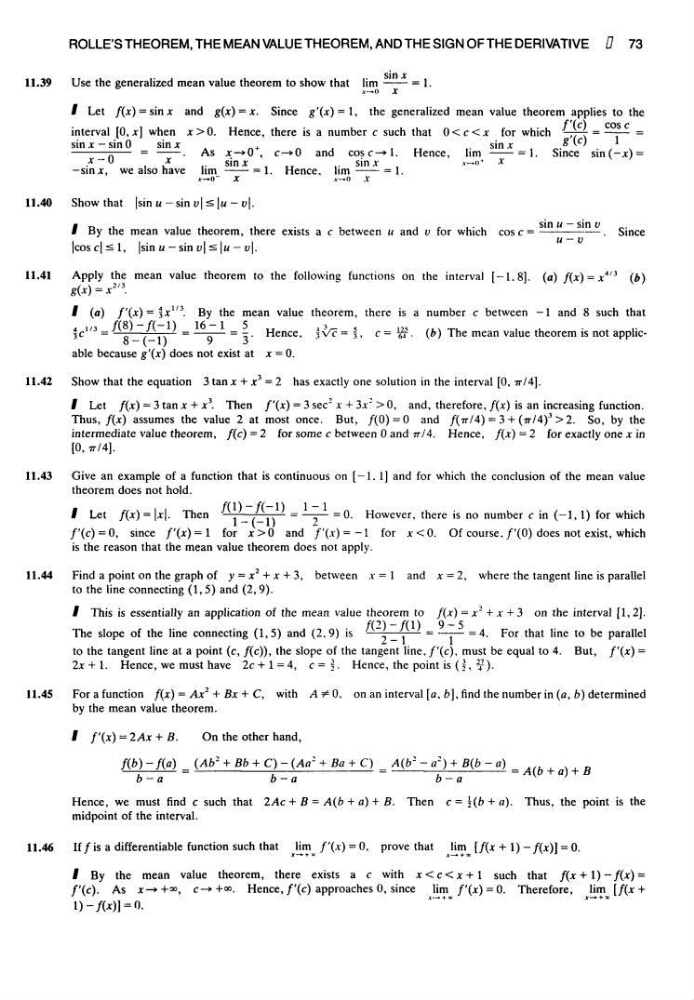
Use the generalized mean value theorem to show that
f Let f(x) = sinx and g(x) = x. Since e'(x) = l, the generalized mean value theorem applies to the
11.41
Apply the mean value theorem to the following functions on the interval [-1,8]. (a) f(x) = x
4 '
3
(b)
g(x) = x
2 '\
However, there is no number c in (-1,1) for which
f'(c) = 0, since /'(*) = 1 for x>0 and /'(.v)=-l for x<0. Of course,/'(O) does not exist, which
is the reason that the mean value theorem does not apply.
11.44
Find a point on the graph of y = x
2 +x + 3, between .v = 1 and x = 2, where the tangent line is parallel
to the line connecting (1,5) and (2,9).
Hence, we must find c such that 2Ac + B = A(b + a) + B. Then c = \(b + a). Thus, the point is the
midpoint of the interval.
73
Hence, there is a number c such that 0 < c < x for which
interval [0, x] when x>0.
11.40
Show that |sin u — sin v\ s |« — u|.
By the mean value theorem, there exists a c between u and v for which
Since
By the mean value theorem, there is a number c between -1 and 8 such that
(b) The mean value theorem is not applicable because g'(*) does not exist at x = 0.
11.42
Show that the equation 3 tan x + x* = 2 has exactly one solution in the interval [0, ir/4].
Let f(x) = 3 tan x + x
3 . Then /'(*)
= 3 sec" x + 3x~ > 0, and, therefore, f(x) is an increasing function.
Thus, f(x) assumes the value 2 at most once. But, /(0) = 0 and /(Tr/4) = 3 + (ir/4)
3 >2. So, by the
intermediate value theorem, f(c) = 2 for some c between 0 and rr/4. Hence, f(x) = 2 for exactly one x in
[0, 7T/4].
11.43
Give an example of a function that is continuous on [ —1. 1] and for which the conclusion of the mean value
theorem does not hold.
Then
This is essentially an application of the mean value theorem to f(x) = x~ + x + 3 on the interval [1, 21.
The slope of the line connecting (1,5) and (2,9) is
For that line to be parallel
to the tangent line at a point (c, /(c)), the slope of the tangent line, f'(c), must be equal to 4. But, /'(•*)
=
2x + 1. Hence, we must have 2c + l = 4, c=§. Hence, the point is (|, ").
11.45
For a function f(x) = Ax
2 + Bx + C, with A 7^0, on an interval [a, b], find the number in (a, b) determined
by the mean value theorem.
f'(x) = 2Ax + B.
On the other hand,
11.46
If/is a differentiable function such that lim /'(.v) = 0, prove that lim [f(x + 1) -/(*)] = 0.
By the mean value theorem, there exists a c with x
lim [f(x +
l)-/(jc)] = 0.
Let f( X ) = \x\.
As
we also have
and
Hence,
Hence,
Since
Hence,
Download
from Wow! eBook
11.39
Use the generalized mean value theorem to show that
f Let f(x) = sinx and g(x) = x. Since e'(x) = l, the generalized mean value theorem applies to the
11.41
Apply the mean value theorem to the following functions on the interval [-1,8]. (a) f(x) = x
4 '
3
(b)
g(x) = x
2 '\
However, there is no number c in (-1,1) for which
f'(c) = 0, since /'(*) = 1 for x>0 and /'(.v)=-l for x<0. Of course,/'(O) does not exist, which
is the reason that the mean value theorem does not apply.
11.44
Find a point on the graph of y = x
2 +x + 3, between .v = 1 and x = 2, where the tangent line is parallel
to the line connecting (1,5) and (2,9).
Hence, we must find c such that 2Ac + B = A(b + a) + B. Then c = \(b + a). Thus, the point is the
midpoint of the interval.
73
Hence, there is a number c such that 0 < c < x for which
interval [0, x] when x>0.
11.40
Show that |sin u — sin v\ s |« — u|.
By the mean value theorem, there exists a c between u and v for which
Since
By the mean value theorem, there is a number c between -1 and 8 such that
(b) The mean value theorem is not applicable because g'(*) does not exist at x = 0.
11.42
Show that the equation 3 tan x + x* = 2 has exactly one solution in the interval [0, ir/4].
Let f(x) = 3 tan x + x
3 . Then /'(*)
= 3 sec" x + 3x~ > 0, and, therefore, f(x) is an increasing function.
Thus, f(x) assumes the value 2 at most once. But, /(0) = 0 and /(Tr/4) = 3 + (ir/4)
3 >2. So, by the
intermediate value theorem, f(c) = 2 for some c between 0 and rr/4. Hence, f(x) = 2 for exactly one x in
[0, 7T/4].
11.43
Give an example of a function that is continuous on [ —1. 1] and for which the conclusion of the mean value
theorem does not hold.
Then
This is essentially an application of the mean value theorem to f(x) = x~ + x + 3 on the interval [1, 21.
The slope of the line connecting (1,5) and (2,9) is
For that line to be parallel
to the tangent line at a point (c, /(c)), the slope of the tangent line, f'(c), must be equal to 4. But, /'(•*)
=
2x + 1. Hence, we must have 2c + l = 4, c=§. Hence, the point is (|, ").
11.45
For a function f(x) = Ax
2 + Bx + C, with A 7^0, on an interval [a, b], find the number in (a, b) determined
by the mean value theorem.
f'(x) = 2Ax + B.
On the other hand,
11.46
If/is a differentiable function such that lim /'(.v) = 0, prove that lim [f(x + 1) -/(*)] = 0.
By the mean value theorem, there exists a c with x
lim [f(x +
l)-/(jc)] = 0.
Let f( X ) = \x\.
As
we also have
and
Hence,
Hence,
Since
Hence,
Download
from Wow! eBook