

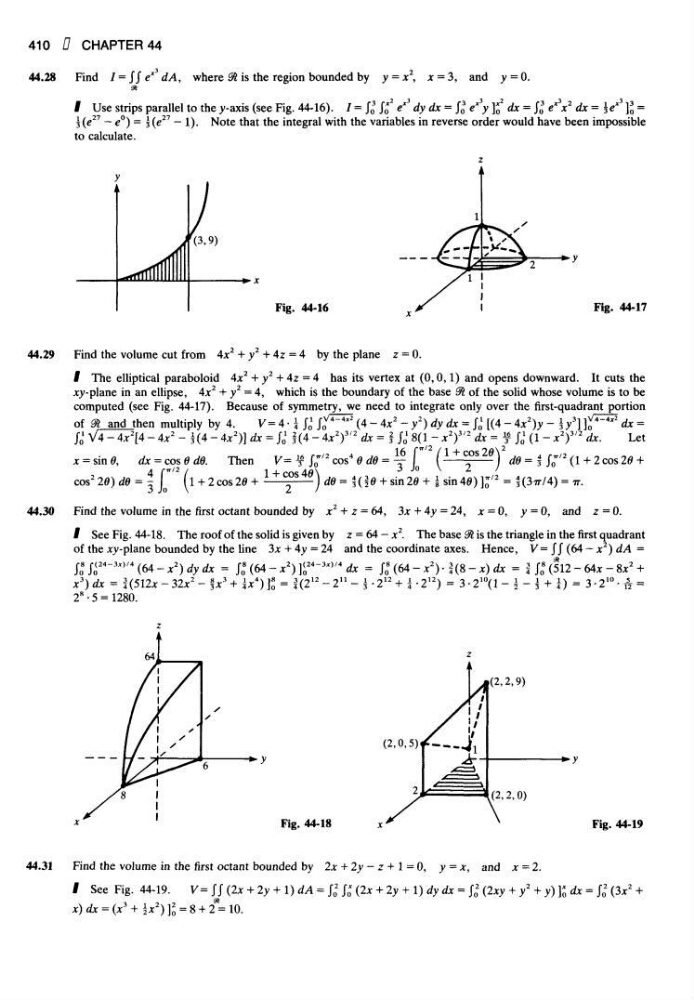
Fig. 44-18
Fig. 44-19
44.31
Find the volume in the first octant bounded by 2x + 2y — z + 1 = 0, y = x, and x = 2.
See Fig. 44-19.
410
CHAPTER 44
44.28
Find
where Si is the region bounded by y = x
2 , x = 3, and y = 0.
Use strips parallel to the y-axis (see Fig. 44-16).
Note that the integral with the variables in reverse order would have been impossible
to calculate.
Fig. 44-16
Fig. 44-17
44.29
Find the volume cut from 4x
2 + y
2 + 4z = 4 by the plane z = 0.
44.30
Find the volume in the first octant bounded by x
2 + z = 64, 3x +4y = 24, x = 0, y = 0, and z — 0.
See Fig. 44-18. The roof of the solid is given by z = 64 — x
2 . The base 91 is the triangle in the first quadrant
of the ry-plane bounded by the line 3x + 4y = 24 and the coordinate axes. Hence,
The elliptical paraboloid 4x
2 + y
2 + 4z = 4 has its vertex at (0,0,1) and opens downward. It cuts the
ry-plane in an ellipse, 4x
2 + y
2 = 4, which is the boundary of the base 5? of the solid whose volume is to be
computed (see Fig. 44-17). Because of symmetry, we need to integrate only over the first-quadrant portion
of Si and then multiply by 4.
Then
Let
x = sin 6, dx = cos 0 dB.
Fig. 44-19
44.31
Find the volume in the first octant bounded by 2x + 2y — z + 1 = 0, y = x, and x = 2.
See Fig. 44-19.
410
CHAPTER 44
44.28
Find
where Si is the region bounded by y = x
2 , x = 3, and y = 0.
Use strips parallel to the y-axis (see Fig. 44-16).
Note that the integral with the variables in reverse order would have been impossible
to calculate.
Fig. 44-16
Fig. 44-17
44.29
Find the volume cut from 4x
2 + y
2 + 4z = 4 by the plane z = 0.
44.30
Find the volume in the first octant bounded by x
2 + z = 64, 3x +4y = 24, x = 0, y = 0, and z — 0.
See Fig. 44-18. The roof of the solid is given by z = 64 — x
2 . The base 91 is the triangle in the first quadrant
of the ry-plane bounded by the line 3x + 4y = 24 and the coordinate axes. Hence,
The elliptical paraboloid 4x
2 + y
2 + 4z = 4 has its vertex at (0,0,1) and opens downward. It cuts the
ry-plane in an ellipse, 4x
2 + y
2 = 4, which is the boundary of the base 5? of the solid whose volume is to be
computed (see Fig. 44-17). Because of symmetry, we need to integrate only over the first-quadrant portion
of Si and then multiply by 4.
Then
Let
x = sin 6, dx = cos 0 dB.