

MULTIPLE INTEGRALS AND THEIR APPLICATIONS
409
Fig. 44-12
Fig. 44-11
44.24
44.25
Express the integral
as an integral with the order of integration reversed.
In the region of integration, the x-values for 0
Express the integral
as an integral with the order of integration reversed.
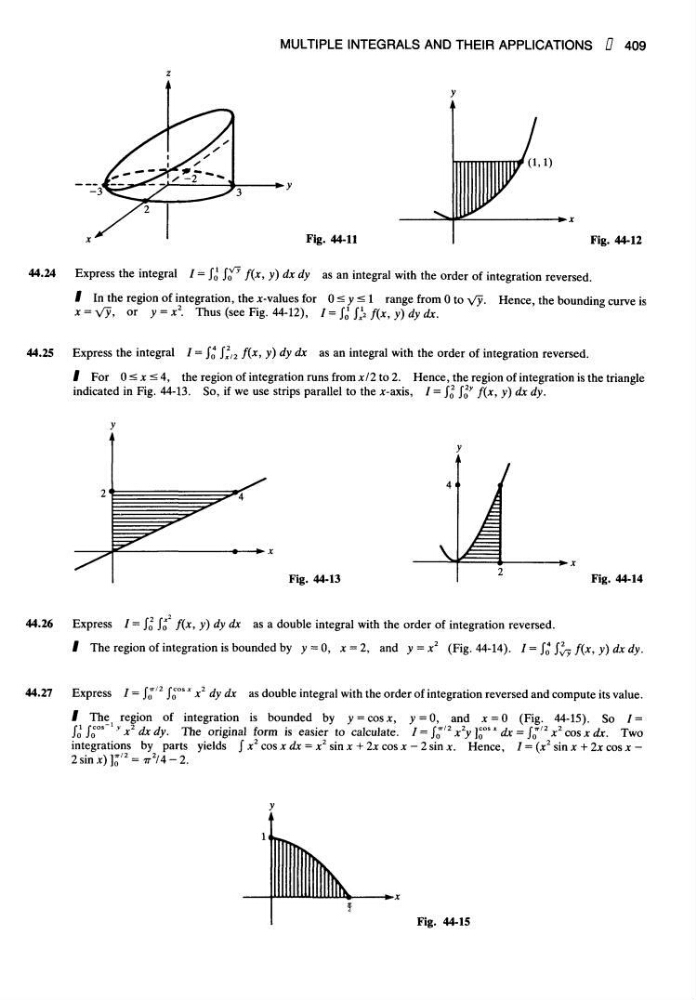
For 0 s jc < 4, the region of integration runs from x/2 to 2. Hence, the region of integration is the triangle
indicated in Fig. 44-13. So, if we use strips parallel to the *-axis,
Fig. 44-13
Fig. 44-14
44.26
44.27
Express
as a double integral with the order of integration reversed.
The region of integration is bounded by y — 0, x = 2, and y = x
2 (Fig. 44-14).
Express
as double integral with the order of integration reversed and compute its value.
The region of integration is bounded by y = cosx, y = 0, and x = 0 (Fig. 44-15). So
The original form is easier to calculate.
Two
integrations by parts yields f *
2 cos x dx = x
2 sin* + 2* cos x - 2 sin*. Hence, / = (x
2 sin x + 2x cos x -
2 sin x)
Fig. 44-15
409
Fig. 44-12
Fig. 44-11
44.24
44.25
Express the integral
as an integral with the order of integration reversed.
In the region of integration, the x-values for 0
Express the integral
as an integral with the order of integration reversed.
For 0 s jc < 4, the region of integration runs from x/2 to 2. Hence, the region of integration is the triangle
indicated in Fig. 44-13. So, if we use strips parallel to the *-axis,
Fig. 44-13
Fig. 44-14
44.26
44.27
Express
as a double integral with the order of integration reversed.
The region of integration is bounded by y — 0, x = 2, and y = x
2 (Fig. 44-14).
Express
as double integral with the order of integration reversed and compute its value.
The region of integration is bounded by y = cosx, y = 0, and x = 0 (Fig. 44-15). So
The original form is easier to calculate.
Two
integrations by parts yields f *
2 cos x dx = x
2 sin* + 2* cos x - 2 sin*. Hence, / = (x
2 sin x + 2x cos x -
2 sin x)
Fig. 44-15