

MULTIPLE INTEGRALS AND THEIR APPLICATIONS
407
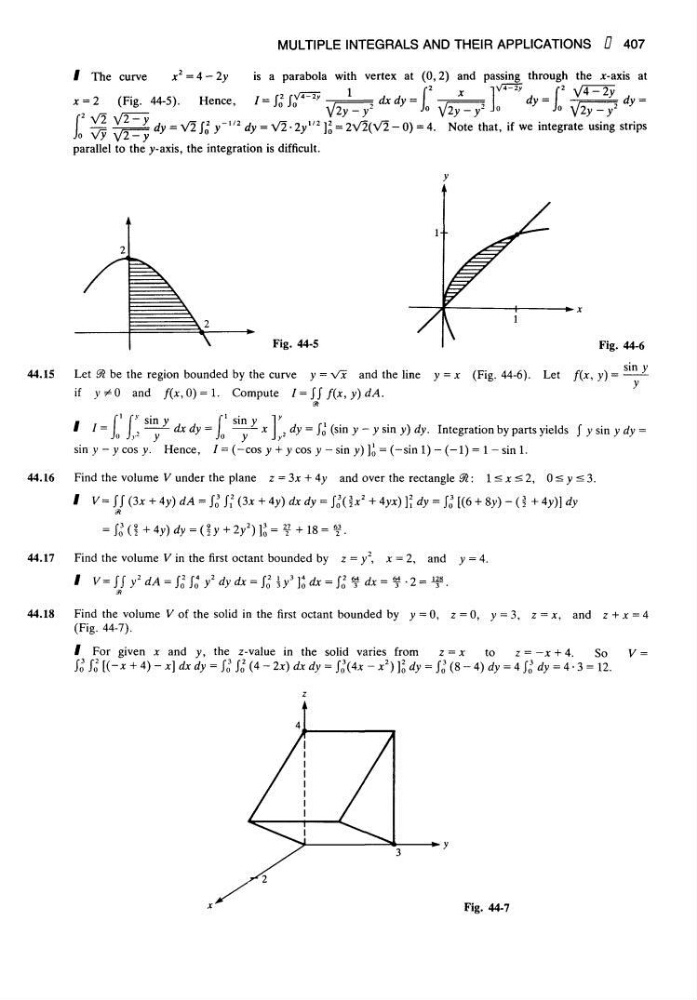
The curve
x
2 = 4 - 2y
is a parabola with vertex at (0, 2) and passing through the A:-axis at
x = 2 (Fig. 44-5).
Hence,
Note that, if we integrate using strips
parallel to the y-axis, the integration is difficult.
Fig. 44-5
Fig. 44-6
44.15
44.16
Let 91 be the region bounded by the curve y = Vic and the line y = x (Fig. 44-6). Let
if y^O and f(x, 0) = 1. Compute
dy. Integration by parts yields J y sin y dy =
sin y - y cos y. Hence, / = (-cos y + y cos y - sin y)
(-sin 1)-(-!) = !-sin 1.
Find the volume V under the plane z = 3x + 4y and over the rectangle 91: l
44.18
Find the volume V in the first octant bounded by z = y
2 , x = 2, and y = 4.
Find the volume V of the solid in the first octant bounded by y = 0, z = 0, y = 3, z = x, and z + x = 4
(Fig. 44-7).
For given x and y, the z-value in the solid varies from
z = x
to
z = — x + 4.
So
V =
Fig. 44-7
407
The curve
x
2 = 4 - 2y
is a parabola with vertex at (0, 2) and passing through the A:-axis at
x = 2 (Fig. 44-5).
Hence,
Note that, if we integrate using strips
parallel to the y-axis, the integration is difficult.
Fig. 44-5
Fig. 44-6
44.15
44.16
Let 91 be the region bounded by the curve y = Vic and the line y = x (Fig. 44-6). Let
if y^O and f(x, 0) = 1. Compute
dy. Integration by parts yields J y sin y dy =
sin y - y cos y. Hence, / = (-cos y + y cos y - sin y)
(-sin 1)-(-!) = !-sin 1.
Find the volume V under the plane z = 3x + 4y and over the rectangle 91: l
44.18
Find the volume V in the first octant bounded by z = y
2 , x = 2, and y = 4.
Find the volume V of the solid in the first octant bounded by y = 0, z = 0, y = 3, z = x, and z + x = 4
(Fig. 44-7).
For given x and y, the z-value in the solid varies from
z = x
to
z = — x + 4.
So
V =
Fig. 44-7