

406
CHAPTER 44
44.10
44.11
Evaluate
Evaluate
Therefore,
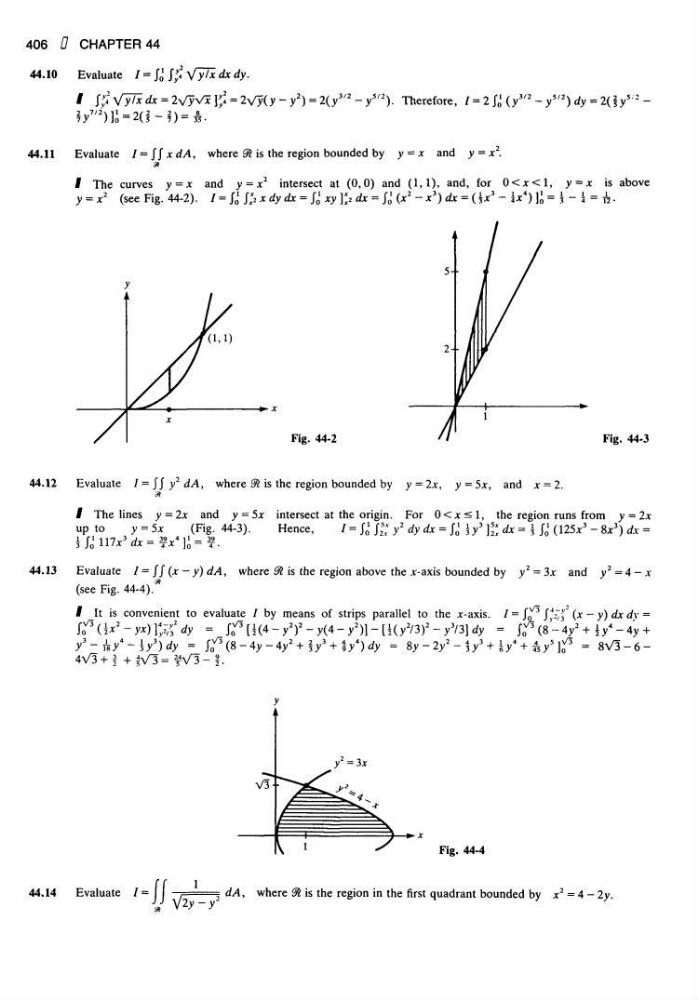
where 9? is the region bounded by y — x and y = x
2 .
The curves y = x and y = x
2
intersect at (0,0) and (1,1), and, for 0<*<1, y = x is above
y = x (see Fig. 44-2).
Fig. 44-2
Fig. 44-3
44.12
44.13
Evaluate
where 91 is the region bounded by y = 2x, y = 5x, and x = 2.
The lines y = 2x and y = 5x intersect at the origin. For 0
up to
y = 5x
(Fig. 44-3).
Hence,
Evaluate
where &i is the region above the x-axis bounded by y
2 = 3x and y
2 = 4 — x
(see Fig. 44-4).
It is convenient to evaluate / by means of strips parallel to the *-axis.
44.14
Evaluate
where £% is the region in the first quadrant bounded by x
2 = 4 - 2y.
Fig. 44-4
CHAPTER 44
44.10
44.11
Evaluate
Evaluate
Therefore,
where 9? is the region bounded by y — x and y = x
2 .
The curves y = x and y = x
2
intersect at (0,0) and (1,1), and, for 0<*<1, y = x is above
y = x (see Fig. 44-2).
Fig. 44-2
Fig. 44-3
44.12
44.13
Evaluate
where 91 is the region bounded by y = 2x, y = 5x, and x = 2.
The lines y = 2x and y = 5x intersect at the origin. For 0
y = 5x
(Fig. 44-3).
Hence,
Evaluate
where &i is the region above the x-axis bounded by y
2 = 3x and y
2 = 4 — x
(see Fig. 44-4).
It is convenient to evaluate / by means of strips parallel to the *-axis.
44.14
Evaluate
where £% is the region in the first quadrant bounded by x
2 = 4 - 2y.
Fig. 44-4