

PARTIAL DERIVATIVES
381
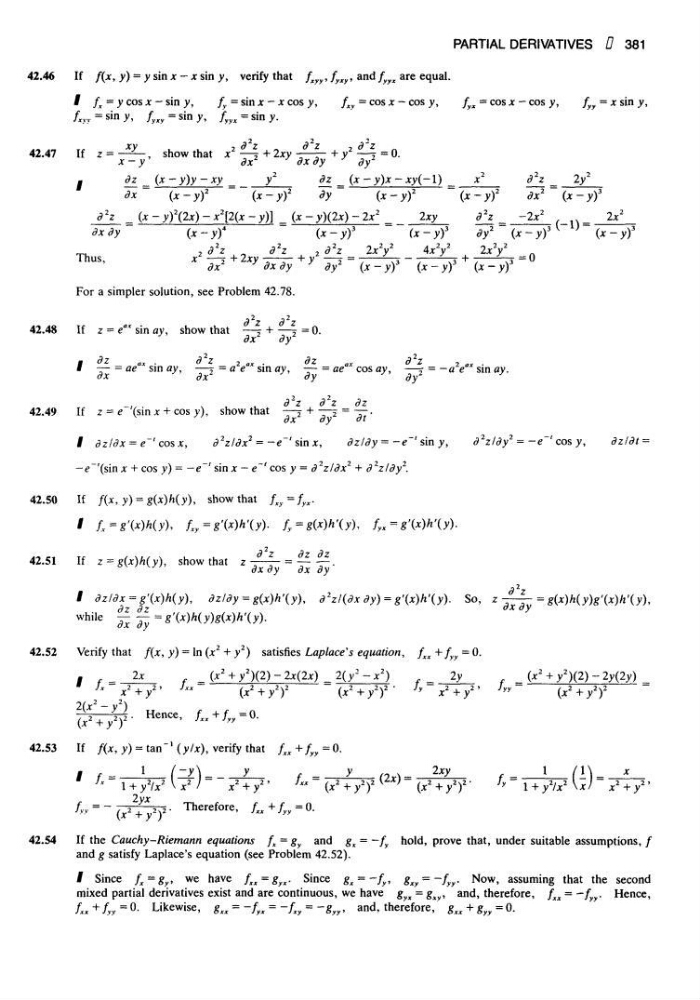
42.46
If f(x, y) = y sin x - x sin y, verify that ffyy, fyty, and fyyi are equal.
/*,..,. = si" >, />.,>. = sin y, /,,,, = sin y.
42.47
If z =
show that
Thus,
For a simpler solution, see Problem 42.78.
42.48
If z = e°* sin ay, show that
show that
42.49
If
42.50
If f(x, y) = g(x)h(y), show that £,=/„.
/^g'W&Cy), /„ =£'(*)>''(>')• /, = gWi'(y), fyi = g'(x)h'(y).
42.51
If z = gW^(y), show that
while
So,
42.52 Verify that f(x, y) = In (x2 + y2) satisfies Laplace's equation, fxx+fyy=0.
Hence,
42.53 If f(x, y) = tan"l (y/x), verify that fxx+fyy=0.
Therefore, fxx+fyy=0.
42.54
If the Cauchy-Riemann equations f x = g y and g x = —f y hold, prove that, under suitable assumptions, /
and g satisfy Laplace's equation (see Problem 42.52).
Since £=#,, we have f,x=gyx. Since gf = -fy, gxy = -fyy Now, assuming that the second
mixed partial derivatives exist and are continuous, we have gyjr = gxy, and, therefore, ffjc = ~fyy. Hence,
f*t+fyy=0- Likewise, gxx = -fy, = -fxy = -gyy, and, therefore, gxx + gyy=0.
f, ~ y cos x - sin y, fy=sinx-x cos y, fxy = cos x - cos y, />x = cos x - cos y, fyy = x sin y,
381
42.46
If f(x, y) = y sin x - x sin y, verify that ffyy, fyty, and fyyi are equal.
/*,..,. = si" >, />.,>. = sin y, /,,,, = sin y.
42.47
If z =
show that
Thus,
For a simpler solution, see Problem 42.78.
42.48
If z = e°* sin ay, show that
show that
42.49
If
42.50
If f(x, y) = g(x)h(y), show that £,=/„.
/^g'W&Cy), /„ =£'(*)>''(>')• /, = gWi'(y), fyi = g'(x)h'(y).
42.51
If z = gW^(y), show that
while
So,
42.52 Verify that f(x, y) = In (x2 + y2) satisfies Laplace's equation, fxx+fyy=0.
Hence,
42.53 If f(x, y) = tan"l (y/x), verify that fxx+fyy=0.
Therefore, fxx+fyy=0.
42.54
If the Cauchy-Riemann equations f x = g y and g x = —f y hold, prove that, under suitable assumptions, /
and g satisfy Laplace's equation (see Problem 42.52).
Since £=#,, we have f,x=gyx. Since gf = -fy, gxy = -fyy Now, assuming that the second
mixed partial derivatives exist and are continuous, we have gyjr = gxy, and, therefore, ffjc = ~fyy. Hence,
f*t+fyy=0- Likewise, gxx = -fy, = -fxy = -gyy, and, therefore, gxx + gyy=0.
f, ~ y cos x - sin y, fy=sinx-x cos y, fxy = cos x - cos y, />x = cos x - cos y, fyy = x sin y,