

380
CHAPTER 42
42.37 For f(x, y) = e* cos y, verify that fxy = fyx.
f, = e'cosy f,y = -e*siny fy = -e'siny fyt = -e" sin y
42.38 If f(x, y) = 3x2 - 2xy + 5y3, verify that fxy=fylc.
fx=6x-2y fxy = -2 fy = -2x + l5y2 /„ = -2
42.39
If f(x, y) = x
2 cos y + y
2 sin x, verify that £, = fyx.
f x = 2x cos y + y2 cos x, fxy =-2xsin y+ 2ycosx. fv - -x2 sin y + 2y sin x, fyx = -2x sin y + 2y cos AT.
42.40
For /(*, y) = 3x4 - 2*3y2 + 7y, find /„, fxy, fyx, and fyy.
f f = Ux3-6x2y2, £ = -4jc3y + 7, /„ = 36^2 - 12xy2, /„, = -4*3, /Vv = -12x2y, /yjt = -12*2y.
42.41 If f(x,y) = e"y2 + l find/„,/„,/„, and/,,.
42.42
If /<>, >-, z) = x2y + y2z - 2xz, find fxy,fyf, /„,/„, /,z,/zy.
/, = 2*>>-2z, /, = x2 + 2yz, f, = y2-2x. fxy=2x, fyi = 2x, /„ =-2, /„ =-2, /vr=2y,
/,v=2y.
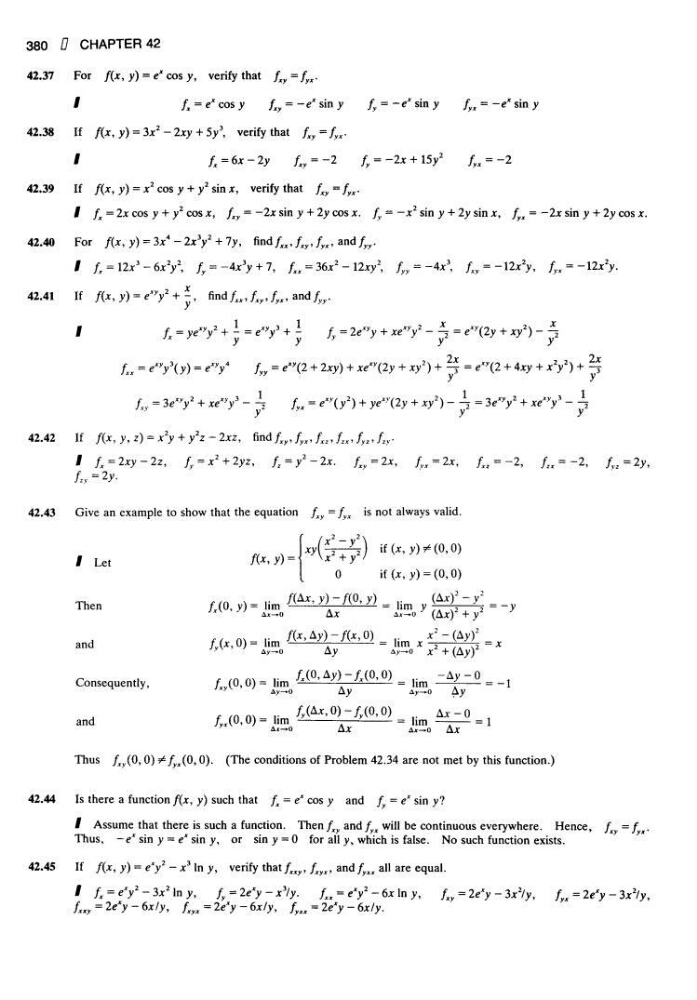
42.43 Give an example to show that the equation fiy=fyx is not always valid.
Let
Then
and
Consequently,
and
Thus /^.(0,0) ^fy,(0,0). (The conditions of Problem 42.34 are not met by this function.)
42.44
Is there a function f(x, y) such that £ = e* cos y and /, = e* sin y?
Assume that there is such a function. Then f fy and/ yj[ will be continuous everywhere. Hence, /,,=/.
Thus, - e* sin _y = e" sin y, or siny = 0 for all y, which is false. No such function exists.
42.45
If f(x, y) = e'y
2 - x
3 In y, verify that /„,, f xyx , and /,„ all are equal.
f f = e'y2-3x2lny, fy=2e*y-x*ly. /„ = e'y2 -6x In y, / = 2e'y -3j«:2/y, / = 2e*y -3^2/y,
f,,y=2e'y-6x/y, ffyx=2e'y-f>xly, fy,, = 2e'y-6x/y.
CHAPTER 42
42.37 For f(x, y) = e* cos y, verify that fxy = fyx.
f, = e'cosy f,y = -e*siny fy = -e'siny fyt = -e" sin y
42.38 If f(x, y) = 3x2 - 2xy + 5y3, verify that fxy=fylc.
fx=6x-2y fxy = -2 fy = -2x + l5y2 /„ = -2
42.39
If f(x, y) = x
2 cos y + y
2 sin x, verify that £, = fyx.
f x = 2x cos y + y2 cos x, fxy =-2xsin y+ 2ycosx. fv - -x2 sin y + 2y sin x, fyx = -2x sin y + 2y cos AT.
42.40
For /(*, y) = 3x4 - 2*3y2 + 7y, find /„, fxy, fyx, and fyy.
f f = Ux3-6x2y2, £ = -4jc3y + 7, /„ = 36^2 - 12xy2, /„, = -4*3, /Vv = -12x2y, /yjt = -12*2y.
42.41 If f(x,y) = e"y2 + l find/„,/„,/„, and/,,.
42.42
If /<>, >-, z) = x2y + y2z - 2xz, find fxy,fyf, /„,/„, /,z,/zy.
/, = 2*>>-2z, /, = x2 + 2yz, f, = y2-2x. fxy=2x, fyi = 2x, /„ =-2, /„ =-2, /vr=2y,
/,v=2y.
42.43 Give an example to show that the equation fiy=fyx is not always valid.
Let
Then
and
Consequently,
and
Thus /^.(0,0) ^fy,(0,0). (The conditions of Problem 42.34 are not met by this function.)
42.44
Is there a function f(x, y) such that £ = e* cos y and /, = e* sin y?
Assume that there is such a function. Then f fy and/ yj[ will be continuous everywhere. Hence, /,,=/.
Thus, - e* sin _y = e" sin y, or siny = 0 for all y, which is false. No such function exists.
42.45
If f(x, y) = e'y
2 - x
3 In y, verify that /„,, f xyx , and /,„ all are equal.
f f = e'y2-3x2lny, fy=2e*y-x*ly. /„ = e'y2 -6x In y, / = 2e'y -3j«:2/y, / = 2e*y -3^2/y,
f,,y=2e'y-6x/y, ffyx=2e'y-f>xly, fy,, = 2e'y-6x/y.