

358
CHAPTER 40
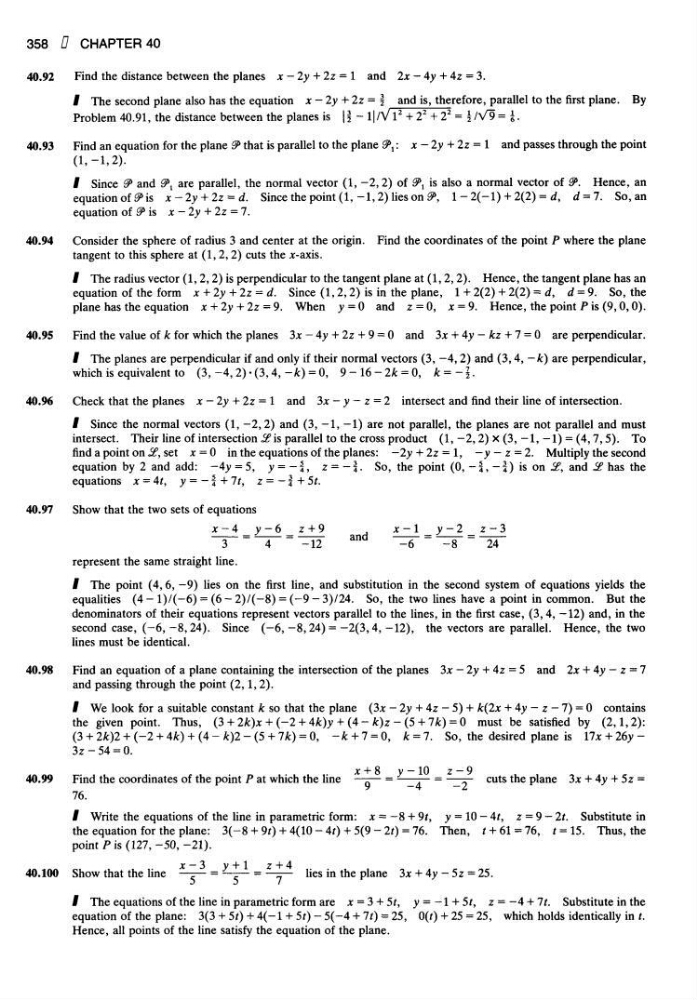
Find the distance between the planes x - 2y + 2z = 1 and 2x — 4y + 4z = 3.
The second plane also has the equation x - 2y + 2z = 2 and is, therefore, parallel to the first plane. By
Problem 40.91, the distance between the planes is
Find an equation for the plane & that is parallel to the plane 0*,: x - 2y + 2z = 1 and passes through the point
(1.-1.2).
40.92
40.93
40.94
40.95
40.96
40.97
40.98
40.99
40.100
Since & and 0\ are parallel, the normal vector (1, -2,2) of 0\ is also a normal vector of 0". Hence, an
equation of 9 is x-2y + 2z = d. Since the point (1, -1,2) lies on 9, l-2(-l) + 2(2) = d, d = l. So, an
equation of S^ is x - 2y + 2z = 7.
Consider the sphere of radius 3 and center at the origin. Find the coordinates of the point P where the plane
tangent to this sphere at (1, 2,2) cuts the x-axis.
The radius vector (1,2, 2) is perpendicular to the tangent plane at (1, 2,2). Hence, the tangent plane has an
equation of the form x + 2y + 2z = d. Since (1,2,2) is in the plane, 1 + 2(2) + 2(2) = d, d = 9. So, the
plane has the equation x + 2y + 2z = 9. When y=0 and z = 0, x = 9. Hence, the point Pis (9,0,0).
Find the value of k for which the planes 3x — 4v + 2z + 9 = 0 and 3x + 4y — kz + 7 = 0 are perpendicular.
The planes are perpendicular if and only if their normal vectors (3, —4, 2) and (3,4, — fc) are perpendicular
which is equivalent to (3, -4, 2) -(3,4, -k) = 0, 9-16-2fc = 0, k=-\.
Check that the planes x — 2y + 2z = 1 and 3* - y — z = 2 intersect and find their line of intersection.
Since the normal vectors (1, -2,2) and (3, -1, —1) are not parallel, the planes are not parallel and must
intersect. Their line of intersection 3! is parallel to the cross product (1,-2,2) x (3,-1,-1) = (4,7,5). To
find a point on ££, set x = 0 in the equations of the planes: -2y + 2z = 1, -y - z = 2. Multiply the second
equation by 2 and add: -4y = 5, y = -i, z = -1. So, the point (0, -\, -f) is on .2", and £ has the
equations x = 4t, y = — f + It, z = — f + 5t.
Show that the two sets of equations
and
represent the same straight line.
The point (4,6, —9) lies on the first line, and substitution in the second system of equations yields the
equalities (4 - l)/(-6) = (6 - 2)/(-8) = (-9 - 3)/24. So, the two lines have a point in common. But the
denominators of their equations represent vectors parallel to the lines, in the first case, (3,4, -12) and, in the
second case, (-6, -8,24). Since (-6, -8,24)= -2(3,4, -12), the vectors are parallel. Hence, the two
lines must be identical.
Find an equation of a plane containing the intersection of the planes 3x — 2y + 4z = 5 and 2x + 4y — z = 7
and passing through the point (2,1,2).
We look for a suitable constant k so that the plane (3x - 2y + 4z - 5) + k(2x + 4y - z - 7) = 0 contains
the given point. Thus, (3 + 2k)x + (-2 + 4k)y + (4 - k)z - (5 + 7k) = 0 must be satisfied by (2,1,2):
(3 + 2fe)2 + (-2 + 4k) + (4 - k)2 - (5 + Ik) = 0, - k +1 = 0, k = 7. So, the desired plane is 17* + 26y -
3z-54 = 0.
Find the coordinates of the point P at which the line
76.
cuts the plane 3* + 4y + 5z =
Write the equations of the line in parametric form: x = -8 + 9t, y = 10 - 4t, z = 9 - 2t. Substitute in
me equation for the plane: 3(-8 + 9t) + 4(10 - 4f) + 5(9 - 2t) = 76. Then, t + 61 = 76, t = 15. Thus, the
point P is (127, -50, -21).
Show that the line
lies in the plane 3x + 4y -5z = 25.
The equations of the line in parametric form are x = 3 + 5t, y = — 1 + 5t, z = — 4 + It. Substitute in the
equation of the plane: 3(3 + 5t) + 4(-1 + 5t) - 5(-4 + It) = 25, 0(t) + 25 = 25, which holds identically in t.
Hence, all points of the line satisfy the equation of the plane.
CHAPTER 40
Find the distance between the planes x - 2y + 2z = 1 and 2x — 4y + 4z = 3.
The second plane also has the equation x - 2y + 2z = 2 and is, therefore, parallel to the first plane. By
Problem 40.91, the distance between the planes is
Find an equation for the plane & that is parallel to the plane 0*,: x - 2y + 2z = 1 and passes through the point
(1.-1.2).
40.92
40.93
40.94
40.95
40.96
40.97
40.98
40.99
40.100
Since & and 0\ are parallel, the normal vector (1, -2,2) of 0\ is also a normal vector of 0". Hence, an
equation of 9 is x-2y + 2z = d. Since the point (1, -1,2) lies on 9, l-2(-l) + 2(2) = d, d = l. So, an
equation of S^ is x - 2y + 2z = 7.
Consider the sphere of radius 3 and center at the origin. Find the coordinates of the point P where the plane
tangent to this sphere at (1, 2,2) cuts the x-axis.
The radius vector (1,2, 2) is perpendicular to the tangent plane at (1, 2,2). Hence, the tangent plane has an
equation of the form x + 2y + 2z = d. Since (1,2,2) is in the plane, 1 + 2(2) + 2(2) = d, d = 9. So, the
plane has the equation x + 2y + 2z = 9. When y=0 and z = 0, x = 9. Hence, the point Pis (9,0,0).
Find the value of k for which the planes 3x — 4v + 2z + 9 = 0 and 3x + 4y — kz + 7 = 0 are perpendicular.
The planes are perpendicular if and only if their normal vectors (3, —4, 2) and (3,4, — fc) are perpendicular
which is equivalent to (3, -4, 2) -(3,4, -k) = 0, 9-16-2fc = 0, k=-\.
Check that the planes x — 2y + 2z = 1 and 3* - y — z = 2 intersect and find their line of intersection.
Since the normal vectors (1, -2,2) and (3, -1, —1) are not parallel, the planes are not parallel and must
intersect. Their line of intersection 3! is parallel to the cross product (1,-2,2) x (3,-1,-1) = (4,7,5). To
find a point on ££, set x = 0 in the equations of the planes: -2y + 2z = 1, -y - z = 2. Multiply the second
equation by 2 and add: -4y = 5, y = -i, z = -1. So, the point (0, -\, -f) is on .2", and £ has the
equations x = 4t, y = — f + It, z = — f + 5t.
Show that the two sets of equations
and
represent the same straight line.
The point (4,6, —9) lies on the first line, and substitution in the second system of equations yields the
equalities (4 - l)/(-6) = (6 - 2)/(-8) = (-9 - 3)/24. So, the two lines have a point in common. But the
denominators of their equations represent vectors parallel to the lines, in the first case, (3,4, -12) and, in the
second case, (-6, -8,24). Since (-6, -8,24)= -2(3,4, -12), the vectors are parallel. Hence, the two
lines must be identical.
Find an equation of a plane containing the intersection of the planes 3x — 2y + 4z = 5 and 2x + 4y — z = 7
and passing through the point (2,1,2).
We look for a suitable constant k so that the plane (3x - 2y + 4z - 5) + k(2x + 4y - z - 7) = 0 contains
the given point. Thus, (3 + 2k)x + (-2 + 4k)y + (4 - k)z - (5 + 7k) = 0 must be satisfied by (2,1,2):
(3 + 2fe)2 + (-2 + 4k) + (4 - k)2 - (5 + Ik) = 0, - k +1 = 0, k = 7. So, the desired plane is 17* + 26y -
3z-54 = 0.
Find the coordinates of the point P at which the line
76.
cuts the plane 3* + 4y + 5z =
Write the equations of the line in parametric form: x = -8 + 9t, y = 10 - 4t, z = 9 - 2t. Substitute in
me equation for the plane: 3(-8 + 9t) + 4(10 - 4f) + 5(9 - 2t) = 76. Then, t + 61 = 76, t = 15. Thus, the
point P is (127, -50, -21).
Show that the line
lies in the plane 3x + 4y -5z = 25.
The equations of the line in parametric form are x = 3 + 5t, y = — 1 + 5t, z = — 4 + It. Substitute in the
equation of the plane: 3(3 + 5t) + 4(-1 + 5t) - 5(-4 + It) = 25, 0(t) + 25 = 25, which holds identically in t.
Hence, all points of the line satisfy the equation of the plane.