

VECTORS IN SPACE. LINES AND PLANES
357
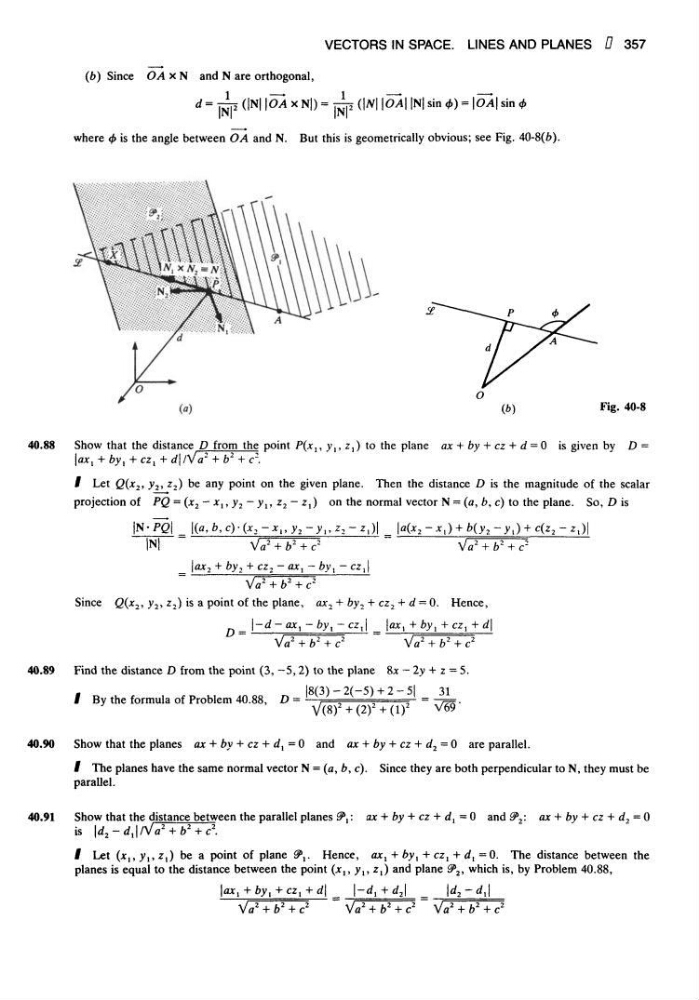
(b) Since OA x N and N are orthogonal,
where is the angle between OA and N. But this is geometrically obvious; see Fig. 40-8(6).
Fig. 40-8
(«)
(b)
40.88
Show that the distance D from the point P(x,, y,, z.) to the plane ax + by + cz + d = 0 is given bv D =
Let Q(x,, v,, z,) be any point on the given plane. Then the distance D is the magnitude of the scalar
on the normal vector N = (a, b, c) to the plane. So, D is
projection of PQ = (x 2 - x lf y 2 - y lr z 2 - z t )
Since Q(x 2 , y 2 , z 2 ) is a point of the plane, ox, + by 2 + cz 2 + d = 0. Hence.
Find the distance D from the point (3, -5,2) to the plane 8x — 2y + z = 5.
40.89
40.90
40.91
By the formula of Problem 40.88,
Show that the planes ax + by + cz + d l = 0 and ax + by + cz + d 2 = 0 are parallel.
The planes have the same normal vector N = (a, b, c). Since they are both perpendicular to N, they must be
parallel.
Show that the distance between the parallel planes 0*.: ax + by + cz + d. = 0 and 0*,: ax + by + cz + d-, = 0
is
Let (*,, j>,, z,) be a point of plane 0\. Hence, a*, + 6y, + cz l + d t =0. The distance between the
planes is equal to the distance between the point (*,, y lt z,) and plane $>,, which is, by Problem 40.88,
357
(b) Since OA x N and N are orthogonal,
where
Fig. 40-8
(«)
(b)
40.88
Show that the distance D from the point P(x,, y,, z.) to the plane ax + by + cz + d = 0 is given bv D =
Let Q(x,, v,, z,) be any point on the given plane. Then the distance D is the magnitude of the scalar
on the normal vector N = (a, b, c) to the plane. So, D is
projection of PQ = (x 2 - x lf y 2 - y lr z 2 - z t )
Since Q(x 2 , y 2 , z 2 ) is a point of the plane, ox, + by 2 + cz 2 + d = 0. Hence.
Find the distance D from the point (3, -5,2) to the plane 8x — 2y + z = 5.
40.89
40.90
40.91
By the formula of Problem 40.88,
Show that the planes ax + by + cz + d l = 0 and ax + by + cz + d 2 = 0 are parallel.
The planes have the same normal vector N = (a, b, c). Since they are both perpendicular to N, they must be
parallel.
Show that the distance between the parallel planes 0*.: ax + by + cz + d. = 0 and 0*,: ax + by + cz + d-, = 0
is
Let (*,, j>,, z,) be a point of plane 0\. Hence, a*, + 6y, + cz l + d t =0. The distance between the
planes is equal to the distance between the point (*,, y lt z,) and plane $>,, which is, by Problem 40.88,