

28
5.32
Let
= x - 4 = /(x) if Jt^-4. Since /(-4) = -8, we must set k=-8.
/is not defined when x = 0, but g is defined when x = 0.
In Problems 5.34-5.37, define one function having set @ as its domain and set i% as its range.
2> = (0,1) and $=(0,2).
Let f(x) = 2x for 0<*<1.
2> = [0,1) and & = [-!, 4).
Look for a linear function /(*) = mx + b, taking 0 into -1 and 1 into 4. Then b = -\, and
4=m-l, m=5. Hence, /(x) = 5x-l.
® = [0,+°°) and $ = {0,1}.
/(0) = 0, and /(*) = ! for *>0.
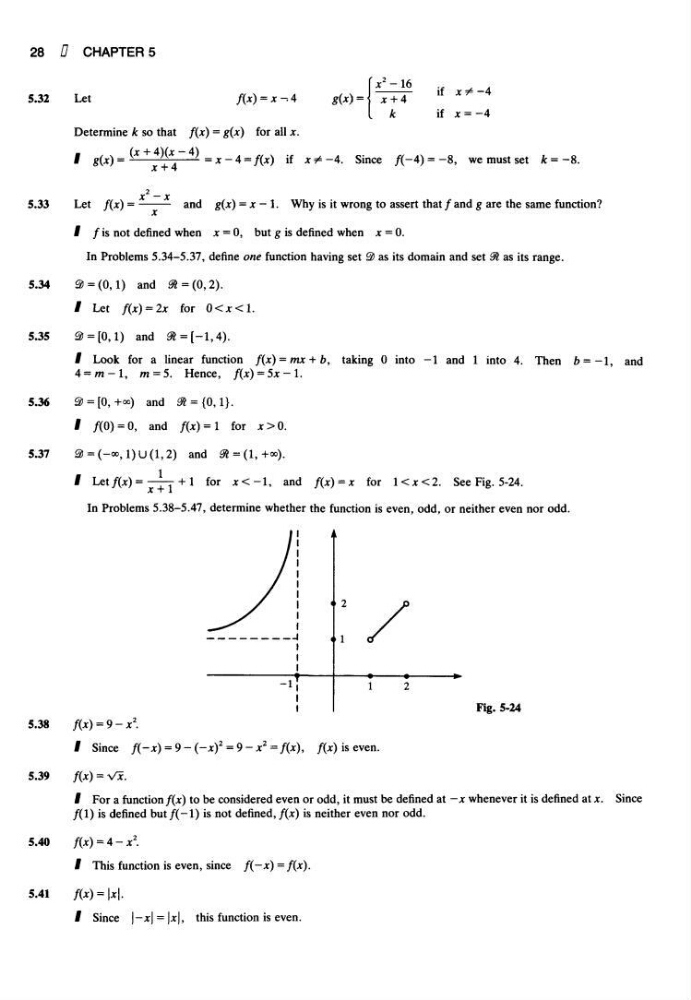
2i = (-», l)u(l,2) and $ = (!,+»).
In Problems 5.38-5.47, determine whether the function is even, odd, or neither even nor odd.
Fig. 5-24
/« = 9-x
2 .
ce /(-*) = 9 - (-*)2 = 9 - *2 = /(*), /W is even.I Since /(-*) = 9 - (-*)2 = 9 - *2 = /(*), /W is even.
A*) = V3t.
For a function/(x) to be considered even or odd, it must be defined at -x whenever it is defined at x. Since
/(I) is defined but/(-I) is not defined, f(x) is neither even nor odd.
/(*) = 4-*
2 .
This function is even, since /(-*)=/(*).
Since |-x| = |;e|, this function is even.
Determine k so that f(x) = g(*) for all x.
5.33
5.34
5.35
5.36
5.37
5.38
5.39
5.40
5.41
/W = WLet
and g(x) = x — 1. Why is it wrong to assert that / and g are the same function?
Let
for
and
for
See Fig. 5-24.
CHAPTER 5
f(x)=x-4
if
if
5.32
Let
= x - 4 = /(x) if Jt^-4. Since /(-4) = -8, we must set k=-8.
/is not defined when x = 0, but g is defined when x = 0.
In Problems 5.34-5.37, define one function having set @ as its domain and set i% as its range.
2> = (0,1) and $=(0,2).
Let f(x) = 2x for 0<*<1.
2> = [0,1) and & = [-!, 4).
Look for a linear function /(*) = mx + b, taking 0 into -1 and 1 into 4. Then b = -\, and
4=m-l, m=5. Hence, /(x) = 5x-l.
® = [0,+°°) and $ = {0,1}.
/(0) = 0, and /(*) = ! for *>0.
2i = (-», l)u(l,2) and $ = (!,+»).
In Problems 5.38-5.47, determine whether the function is even, odd, or neither even nor odd.
Fig. 5-24
/« = 9-x
2 .
ce /(-*) = 9 - (-*)2 = 9 - *2 = /(*), /W is even.I Since /(-*) = 9 - (-*)2 = 9 - *2 = /(*), /W is even.
A*) = V3t.
For a function/(x) to be considered even or odd, it must be defined at -x whenever it is defined at x. Since
/(I) is defined but/(-I) is not defined, f(x) is neither even nor odd.
/(*) = 4-*
2 .
This function is even, since /(-*)=/(*).
Since |-x| = |;e|, this function is even.
Determine k so that f(x) = g(*) for all x.
5.33
5.34
5.35
5.36
5.37
5.38
5.39
5.40
5.41
/W = WLet
and g(x) = x — 1. Why is it wrong to assert that / and g are the same function?
Let
for
and
for
See Fig. 5-24.
CHAPTER 5
f(x)=x-4
if
if