

5.23
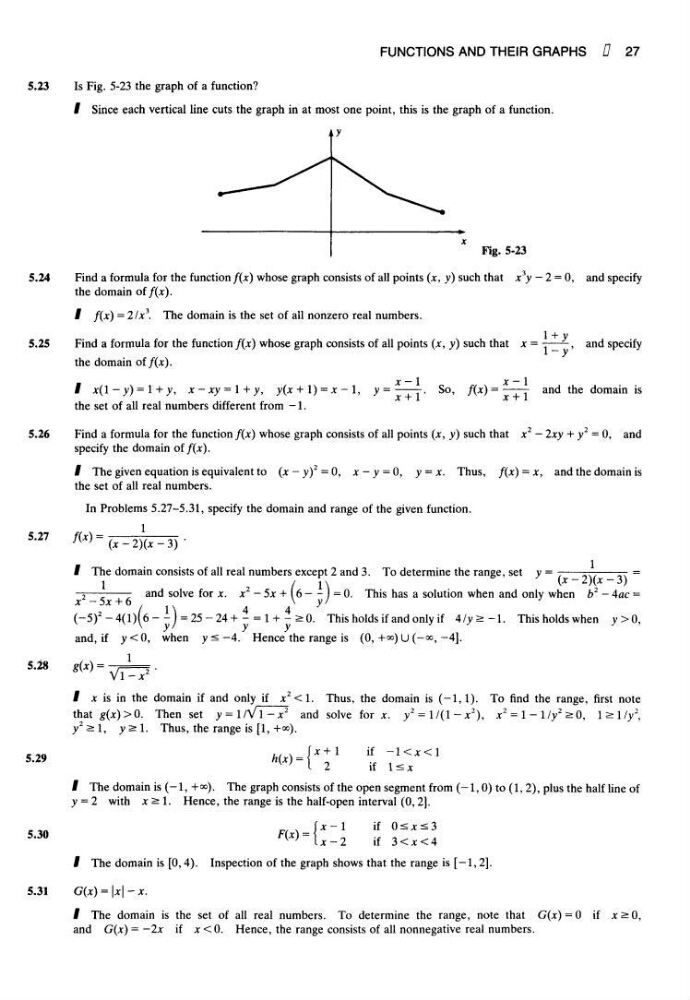
Is Fig. 5-23 the graph of a function?
Since each vertical line cuts the graph in at most one point, this is the graph of a function.
5.24
5.25
5.26
Find a formula for the function f(x) whose graph consists of all points (x, y) such that x*y — 2 = 0, and specify
the domain of f(x).
f(x) = 2/x
3 . The domain is the set of all nonzero real numbers.
Find a formula for the function/(x) whose graph consists of all points (x, y) such that
the domain of f(x).
x(\ - y) = 1 + y, x-xy = l + y, y(x + l) = x-l,
the set of all real numbers different from -1.
Find a formula for the function f(x) whose graph consists of all points (x, y) such that x
2 - 2xy + y
2 = 0, and
specify the domain of f(x).
The given equation is equivalent to (x - y)
2 = 0, x - y = 0, y = x. Thus, f(x) = x, and the domain is
the set of all real numbers.
In Problems 5.27-5.31, specify the domain and range of the given function.
5.31
The domain consists of all real numbers except 2 and 3. To determine the range, set v =
x is in the domain if and only if x
2 <1. Thus, the domain is (-1,1). To find the range, first note
that g(x)>0. Then set y = 1 /V1 - x
2
and solve for A:, y
2 = 1/(1 - x
2 ), x
2 = 1 - lly
2 >0, lal/y
2 ,
y
2 2:l, ysl. Thus, the range is [1,+00).
The domain is (-1, +00). The graph consists of the open segment from (-1,0) to (1, 2), plus the half line of
y = 2 with x > 1. Hence, the range is the half-open interval (0, 2].
The domain is [0,4). Inspection of the graph shows that the range is [-1,2].
G(x) = \x\-x.
The domain is the set of all real numbers. To determine the range, note that G(x) = 0 if * > 0,
and G(x) = — 2x if x<0. Hence, the range consists of all nonnegative real numbers.
FUNCTIONS AND THEIR GRAPHS
27
Fig. 5-23
and solve for
This has a solution when and only when
This holds if and only if
This holds when
and, if
when
Hence the range is
and specify
and the domain is
So
5.27
5.28
5.29
5.30
if
if
if
if
Is Fig. 5-23 the graph of a function?
Since each vertical line cuts the graph in at most one point, this is the graph of a function.
5.24
5.25
5.26
Find a formula for the function f(x) whose graph consists of all points (x, y) such that x*y — 2 = 0, and specify
the domain of f(x).
f(x) = 2/x
3 . The domain is the set of all nonzero real numbers.
Find a formula for the function/(x) whose graph consists of all points (x, y) such that
the domain of f(x).
x(\ - y) = 1 + y, x-xy = l + y, y(x + l) = x-l,
the set of all real numbers different from -1.
Find a formula for the function f(x) whose graph consists of all points (x, y) such that x
2 - 2xy + y
2 = 0, and
specify the domain of f(x).
The given equation is equivalent to (x - y)
2 = 0, x - y = 0, y = x. Thus, f(x) = x, and the domain is
the set of all real numbers.
In Problems 5.27-5.31, specify the domain and range of the given function.
5.31
The domain consists of all real numbers except 2 and 3. To determine the range, set v =
x is in the domain if and only if x
2 <1. Thus, the domain is (-1,1). To find the range, first note
that g(x)>0. Then set y = 1 /V1 - x
2
and solve for A:, y
2 = 1/(1 - x
2 ), x
2 = 1 - lly
2 >0, lal/y
2 ,
y
2 2:l, ysl. Thus, the range is [1,+00).
The domain is (-1, +00). The graph consists of the open segment from (-1,0) to (1, 2), plus the half line of
y = 2 with x > 1. Hence, the range is the half-open interval (0, 2].
The domain is [0,4). Inspection of the graph shows that the range is [-1,2].
G(x) = \x\-x.
The domain is the set of all real numbers. To determine the range, note that G(x) = 0 if * > 0,
and G(x) = — 2x if x<0. Hence, the range consists of all nonnegative real numbers.
FUNCTIONS AND THEIR GRAPHS
27
Fig. 5-23
and solve for
This has a solution when and only when
This holds if and only if
This holds when
and, if
when
Hence the range is
and specify
and the domain is
So
5.27
5.28
5.29
5.30
if
if
if
if