

328
CHAPTER 38
38.18
£ x
n /n5".
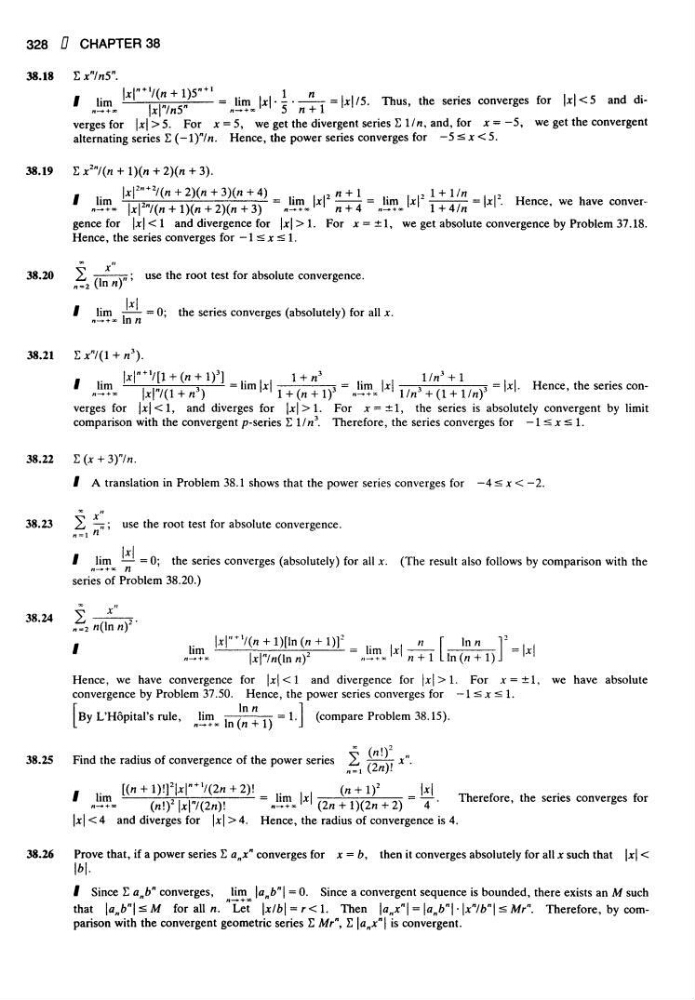
Thus, the series converges for |*|<5 and diverges for |*| > 5. For x = 5, we get the divergent series £ 1/n, and, for x=-5, we get the convergent
alternating series £ (-!)"/«. Hence, the power series converges for -5 < x < 5.
38.19
E*
2 7(n + l)(rt + 2)(« + 3).
Hence, we have convergence for |x|1. For x = ±1, we get absolute convergence by Problem 37.18.
Hence, the series converges for — 1 < je < 1.
38.20
use the root test for absolute convergence.
the series converges (absolutely) for all x.
38.21
£ *"/(! + n
3 ).
Hence, the series converges for |A:| <1, and diverges for |jc|>l. For x = ±1, the series is absolutely convergent by limit
comparison with the convergent p-series £ 1/n
3 . Therefore, the series converges for — 1 s x £ 1.
38.22
£(* +3)7/7.
A translation in Problem 38.1 shows that the power series converges for — 4 < x < -2.
38.23
use the root test for absolute convergence.
the series converges (absolutely) for all x. (The result also follows by comparison with the
series of Problem 38.20.)
38.24
Hence, we have convergence for \x\ < 1 and divergence for |x|>l. For x = ±l, we have absolute
convergence by Problem 37.50. Hence, the power series converges for — 1 s* s 1.
(compare Problem 38.15).
By L'HopitaFs rule,
38.25
Find the radius of convergence of the power series
Therefore, the series converges for
|x|<4 and diverges for |x|>4. Hence, the radius of convergence is 4.
38.26
Prove that, if a power series £ a n x" converges for x = b, then it converges absolutely for all x such that |jc| <
\b\.
Since £ a n b" converges, lim |a n i>"|=0. Since a convergent sequence is bounded, there exists an M such
that \a a b"\
CHAPTER 38
38.18
£ x
n /n5".
Thus, the series converges for |*|<5 and diverges for |*| > 5. For x = 5, we get the divergent series £ 1/n, and, for x=-5, we get the convergent
alternating series £ (-!)"/«. Hence, the power series converges for -5 < x < 5.
38.19
E*
2 7(n + l)(rt + 2)(« + 3).
Hence, we have convergence for |x|
Hence, the series converges for — 1 < je < 1.
38.20
use the root test for absolute convergence.
the series converges (absolutely) for all x.
38.21
£ *"/(! + n
3 ).
Hence, the series converges for |A:| <1, and diverges for |jc|>l. For x = ±1, the series is absolutely convergent by limit
comparison with the convergent p-series £ 1/n
3 . Therefore, the series converges for — 1 s x £ 1.
38.22
£(* +3)7/7.
A translation in Problem 38.1 shows that the power series converges for — 4 < x < -2.
38.23
use the root test for absolute convergence.
the series converges (absolutely) for all x. (The result also follows by comparison with the
series of Problem 38.20.)
38.24
Hence, we have convergence for \x\ < 1 and divergence for |x|>l. For x = ±l, we have absolute
convergence by Problem 37.50. Hence, the power series converges for — 1 s* s 1.
(compare Problem 38.15).
By L'HopitaFs rule,
38.25
Find the radius of convergence of the power series
Therefore, the series converges for
|x|<4 and diverges for |x|>4. Hence, the radius of convergence is 4.
38.26
Prove that, if a power series £ a n x" converges for x = b, then it converges absolutely for all x such that |jc| <
\b\.
Since £ a n b" converges, lim |a n i>"|=0. Since a convergent sequence is bounded, there exists an M such
that \a a b"\