

POWER SERIES
327
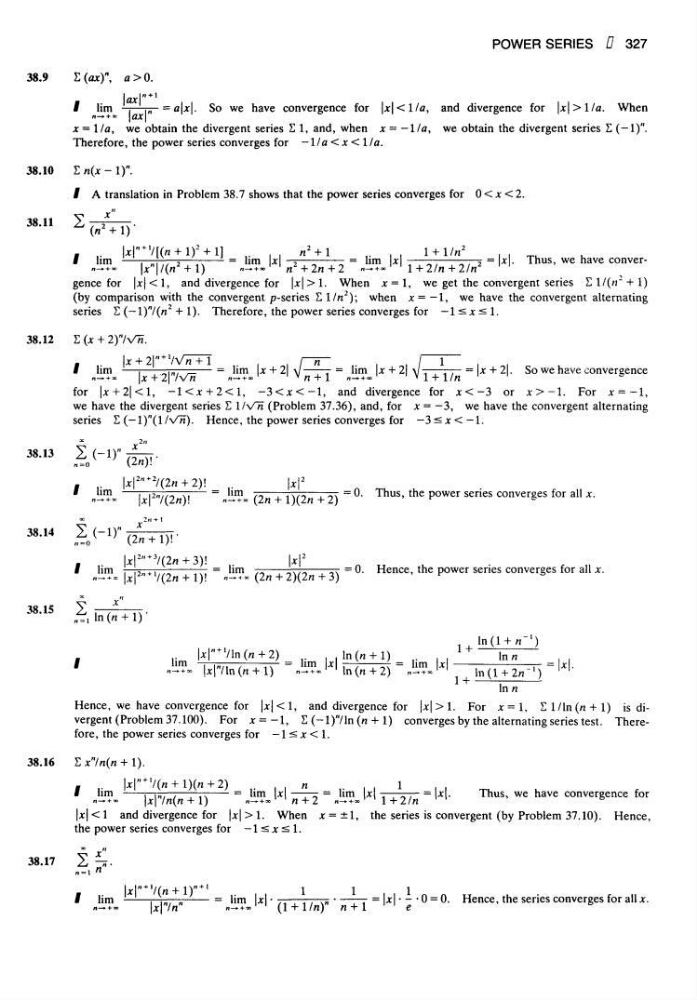
38.9
E (ax)", a > 0.
So we have convergence for |*| < 1 fa, and divergence for |*| > 1 la. When
x = I/a, we obtain the divergent series E 1, and, when x = —I/a, we obtain the divergent series E (-1)".
Therefore, the power series converges for — l/a
E n(x - I)".
A translation in Problem 38.7 shows that the power series converges for 0 < x < 2.
38.11
Thus, we have conver
gence for \x\ < 1, and divergence for |jc| > 1. When x = 1, we get the convergent series E l/(/r + 1)
(by comparison with the convergent p-series E 1/n
2 ); when x = —l, we have the convergent alternating
series E (—l)7(n
2 + 1). Therefore, the power series converges for — 1 s x < 1.
38.12
E (x 4- 2)7Vn.
So we have convergence
for |x + 2|-l. For x =-I,
we have the divergent series E 1/Vn (Problem 37.36), and, for x = -3, we have the convergent alternating
series E (—l)"(l/Vn). Hence, the power series converges for — 3==:e<-l.
38.13
38.14
Thus, the power series converges for all x.
Hence, the power series converges for all x.
38.15
Hence, we have convergence for |*|<1, and divergence for \x\ > 1. For x=l, El/ln(rc + l) is divergent (Problem 37.100). For x = -I, E (-l)'Vln (n + 1) converges by the alternating series test. Therefore, the power series converges for — 1 < x < 1.
38.16
E x"ln(n + 1).
Thus, we have convergence for
\x\ < 1 and divergence for \x\ > 1. When x = ±1, the series is convergent (by Problem 37.10). Hence,
the power series converges for — 1 < x ^ 1.
38.17
Hence, the series converges for all x.
327
38.9
E (ax)", a > 0.
So we have convergence for |*| < 1 fa, and divergence for |*| > 1 la. When
x = I/a, we obtain the divergent series E 1, and, when x = —I/a, we obtain the divergent series E (-1)".
Therefore, the power series converges for — l/a
E n(x - I)".
A translation in Problem 38.7 shows that the power series converges for 0 < x < 2.
38.11
Thus, we have conver
gence for \x\ < 1, and divergence for |jc| > 1. When x = 1, we get the convergent series E l/(/r + 1)
(by comparison with the convergent p-series E 1/n
2 ); when x = —l, we have the convergent alternating
series E (—l)7(n
2 + 1). Therefore, the power series converges for — 1 s x < 1.
38.12
E (x 4- 2)7Vn.
So we have convergence
for |x + 2|
we have the divergent series E 1/Vn (Problem 37.36), and, for x = -3, we have the convergent alternating
series E (—l)"(l/Vn). Hence, the power series converges for — 3==:e<-l.
38.13
38.14
Thus, the power series converges for all x.
Hence, the power series converges for all x.
38.15
Hence, we have convergence for |*|<1, and divergence for \x\ > 1. For x=l, El/ln(rc + l) is divergent (Problem 37.100). For x = -I, E (-l)'Vln (n + 1) converges by the alternating series test. Therefore, the power series converges for — 1 < x < 1.
38.16
E x"ln(n + 1).
Thus, we have convergence for
\x\ < 1 and divergence for \x\ > 1. When x = ±1, the series is convergent (by Problem 37.10). Hence,
the power series converges for — 1 < x ^ 1.
38.17
Hence, the series converges for all x.