

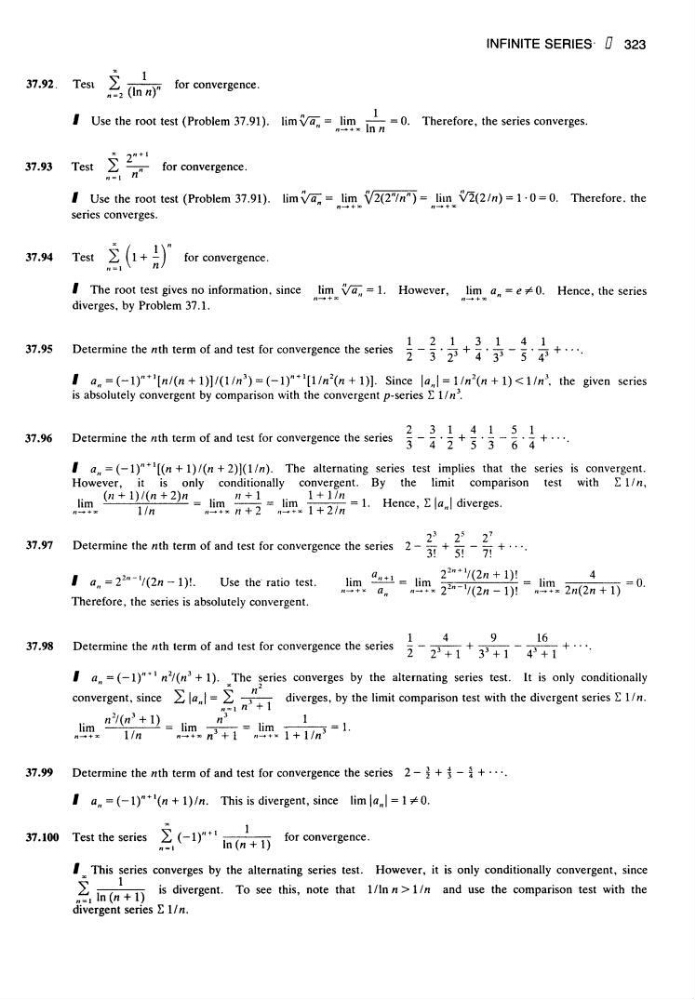
INFINITE SERIES
323
37.92. Tesi
for convergence.
Use the root test (Problem 37.91).
Therefore, the series converges.
37.93
Test
for convergence.
Use the root test (Problem 37.91).
Therefore, the
series converges.
37.94
Test
for convergence.
The root test gives no information, since
However,
Hence, the series
diverges, by Problem 37.1.
37.95
Determine the nth term of and test for convergence the series
a B = (-l)"
+ 1 [n/(n + l)]/(l/«
3 ) = (-l)'
1 + 1 [l/n
2 (n + l)]. Since \a n \ = \ln\n + 1) < 1 ln\ the given series
is absolutely convergent by comparison with the convergent p-series E 1/n
3 .
37.96
Determine the nth term of and test for convergence the series
a n = (-l)"
+ 1 [(n + l)/(n + 2)](l/n). The alternating series test implies that the series is convergent.
However, it is only conditionally convergent. By the limit comparison test with E 1/n,
Hence, E |a,,| diverges.
37.97
Determine the nth term of and test for convergence the series
Therefore, the series is absolutely convergent.
a,, = 2
2 "~V(2n - 1)!.
Use the ratio test.
37.98
Determine the nth term of and test for convergence the series
a.. = (-1)"
+ 1 n
2 /(n + 1). The series converges bv the alternating series test. It is onlv conditionally
convergent, since
diverges, by the limit comparison test with the divergent series E 1/n.
37.99 Determine the nth term of and test for convergence the series
a,, = (-l)"*'(n + l)/n. This is divergent, since lim|a n | = 1^0.
37.100 Test the series
for convergence.
This series converges by the alternating series test. However, it is only conditionally convergent, since
is divergent. To see this, note that l/lnn>l/n and use the comparison test with the
divergent series E 1/n.
323
37.92. Tesi
for convergence.
Use the root test (Problem 37.91).
Therefore, the series converges.
37.93
Test
for convergence.
Use the root test (Problem 37.91).
Therefore, the
series converges.
37.94
Test
for convergence.
The root test gives no information, since
However,
Hence, the series
diverges, by Problem 37.1.
37.95
Determine the nth term of and test for convergence the series
a B = (-l)"
+ 1 [n/(n + l)]/(l/«
3 ) = (-l)'
1 + 1 [l/n
2 (n + l)]. Since \a n \ = \ln\n + 1) < 1 ln\ the given series
is absolutely convergent by comparison with the convergent p-series E 1/n
3 .
37.96
Determine the nth term of and test for convergence the series
a n = (-l)"
+ 1 [(n + l)/(n + 2)](l/n). The alternating series test implies that the series is convergent.
However, it is only conditionally convergent. By the limit comparison test with E 1/n,
Hence, E |a,,| diverges.
37.97
Determine the nth term of and test for convergence the series
Therefore, the series is absolutely convergent.
a,, = 2
2 "~V(2n - 1)!.
Use the ratio test.
37.98
Determine the nth term of and test for convergence the series
a.. = (-1)"
+ 1 n
2 /(n + 1). The series converges bv the alternating series test. It is onlv conditionally
convergent, since
diverges, by the limit comparison test with the divergent series E 1/n.
37.99 Determine the nth term of and test for convergence the series
a,, = (-l)"*'(n + l)/n. This is divergent, since lim|a n | = 1^0.
37.100 Test the series
for convergence.
This series converges by the alternating series test. However, it is only conditionally convergent, since
is divergent. To see this, note that l/lnn>l/n and use the comparison test with the
divergent series E 1/n.