

322
CHAPTER 37
37.84
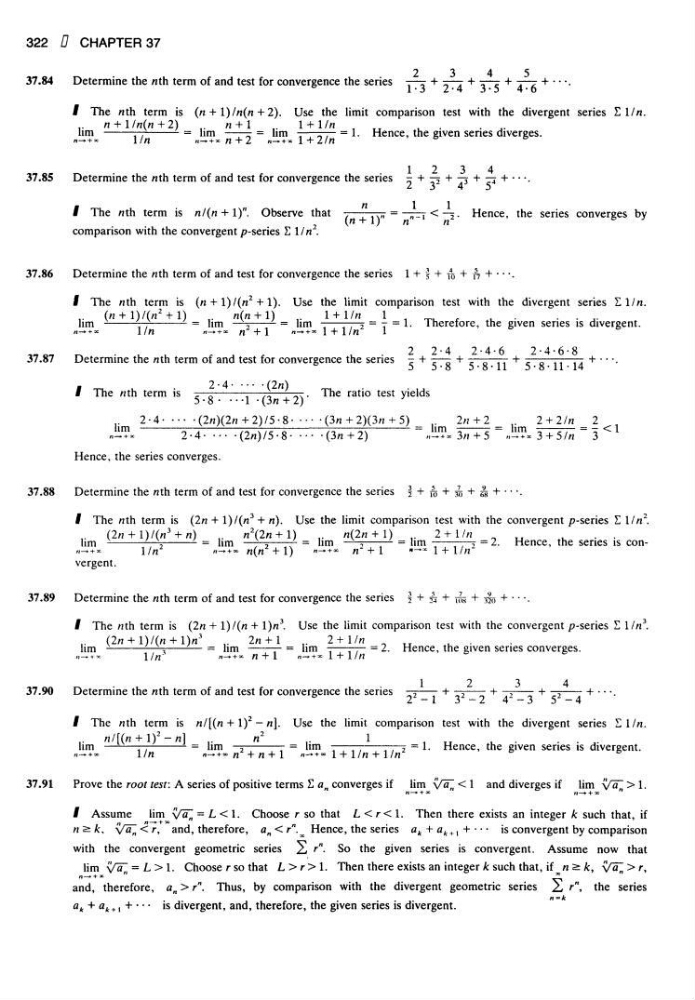
Determine the nth term of and test for convergence the series
The nth term is
Use the limit comparison test with the divergent series E 1/n.
Hence, the given series diverges.
37.85
Determine the nth term of and test for convergence the series
The nth term is n/(n + 1)". Observe that
Hence, the series converges by
comparison with the convergent p-series £ 1/n
2 .
37.86
Determine the nth term of and test for convergence the series
The nth term is (n + l)/(n
2 + 1). Use the limit comparison test with the divergent series E 1/n.
Therefore, the given series is divergent.
37.87
Determine the nth term of and test for convergence the series
The nth term is
The ratio test yields
Hence, the series converges.
37.88
Determine the nth term of and test for convergence the series
The nth term is (In + l)/(n
3 + n). Use the limit comparison test with the convergent p-series E 1/n
2 .
vergent.
Hence, the series is con37.89
Determine the nth term of and test for convergence the series
The nth term is (2n + l)/(n + l)n
3 . Use the limit comparison test with the convergent p-series E 1 /n
3 .
Hence, the given series converges.
37.90
Determine the nth term of and test for convergence the series
The nth term is n/[(n + I)
2 - n]. Use the limit comparison test with the divergent series E 1/n.
Hence, the given series is divergent.
37.91
Prove the root test: A series of positive terms £ a n converges if
and diverges if
Assume
Choose r so that L < r < 1. Then there exists an integer k such that, if
and, therefore, a n
So the given series is convergent. Assume now that
Choose r so that L>r>\. Then there exists an integer k such that, if
and, therefore, a n > r". Thus, by comparison with the divergent geometric series
the series
k + a/<+1 + ''' 's divergent, and, therefore, the given series is divergent.
CHAPTER 37
37.84
Determine the nth term of and test for convergence the series
The nth term is
Use the limit comparison test with the divergent series E 1/n.
Hence, the given series diverges.
37.85
Determine the nth term of and test for convergence the series
The nth term is n/(n + 1)". Observe that
Hence, the series converges by
comparison with the convergent p-series £ 1/n
2 .
37.86
Determine the nth term of and test for convergence the series
The nth term is (n + l)/(n
2 + 1). Use the limit comparison test with the divergent series E 1/n.
Therefore, the given series is divergent.
37.87
Determine the nth term of and test for convergence the series
The nth term is
The ratio test yields
Hence, the series converges.
37.88
Determine the nth term of and test for convergence the series
The nth term is (In + l)/(n
3 + n). Use the limit comparison test with the convergent p-series E 1/n
2 .
vergent.
Hence, the series is con37.89
Determine the nth term of and test for convergence the series
The nth term is (2n + l)/(n + l)n
3 . Use the limit comparison test with the convergent p-series E 1 /n
3 .
Hence, the given series converges.
37.90
Determine the nth term of and test for convergence the series
The nth term is n/[(n + I)
2 - n]. Use the limit comparison test with the divergent series E 1/n.
Hence, the given series is divergent.
37.91
Prove the root test: A series of positive terms £ a n converges if
and diverges if
Assume
Choose r so that L < r < 1. Then there exists an integer k such that, if
and, therefore, a n
So the given series is convergent. Assume now that
Choose r so that L>r>\. Then there exists an integer k such that, if
and, therefore, a n > r". Thus, by comparison with the divergent geometric series
the series
k + a/<+1 + ''' 's divergent, and, therefore, the given series is divergent.