

310
CHAPTER 36
36.52
36.53
36.54
36.55
36.56
36.57
36.58
36.59
36.60
36.61
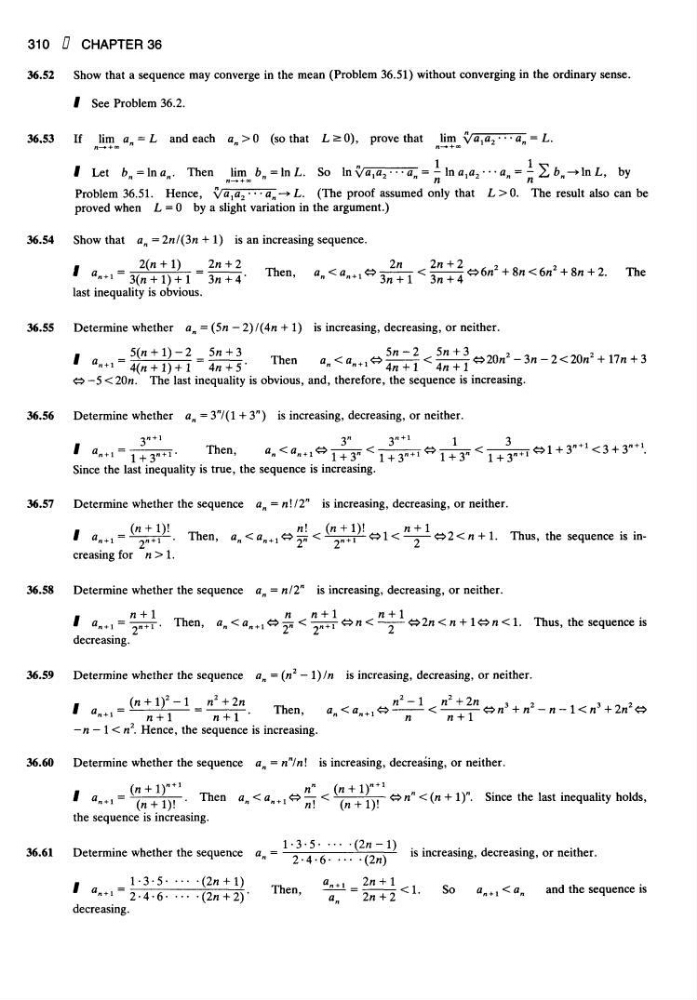
Show that a sequence may converge in the mean (Problem 36.51) without converging in the ordinary sense.
See Problem 36.2.
If
a n = L and each a > 0 (so that L > 0), prove that
Let b n = \na n . Then
So
by
Problem 36.51. Hence,
(The proof assumed only that L > 0. The result also can be
proved when L = 0 by a slight variation in the argument.)
Show that a n = 2n/(3n + 1) is an increasing sequence.
Then,
The
last inequality is obvious.
Determine whether «„ = (5n — 2)/(4n + 1) is increasing, decreasing, or neither.
Then
The last inequality is obvious, and, therefore, the sequence is increasing.
Determine whether a n =3"/(l + 3") is increasing, decreasing, or neither.
Then,
Since the last inequality is true, the sequence is increasing
Determine whether the sequence a n = n\!2" is increasing, decreasing, or neither.
Then,
Thus, the sequence is increasing for M > 1.
Determine whether the sequence a n = nil" is increasing, decreasing, or neither.
Then,
Thus, the sequence is
decreasing.
Determine whether the sequence a n = (n
2 - \)/n is increasing, decreasing, or neither.
Then,
Hence, the sequence is increasing.
Determine whether the sequence a n = n"ln\ is increasing, decreasing, or neither.
Then
Since the last inequality holds,
the sequence is increasing.
Determine whether the sequence
is increasing, decreasing, or neither.
Then,
So
and the sequence is
decreasing.
CHAPTER 36
36.52
36.53
36.54
36.55
36.56
36.57
36.58
36.59
36.60
36.61
Show that a sequence may converge in the mean (Problem 36.51) without converging in the ordinary sense.
See Problem 36.2.
If
a n = L and each a > 0 (so that L > 0), prove that
Let b n = \na n . Then
So
by
Problem 36.51. Hence,
(The proof assumed only that L > 0. The result also can be
proved when L = 0 by a slight variation in the argument.)
Show that a n = 2n/(3n + 1) is an increasing sequence.
Then,
The
last inequality is obvious.
Determine whether «„ = (5n — 2)/(4n + 1) is increasing, decreasing, or neither.
Then
The last inequality is obvious, and, therefore, the sequence is increasing.
Determine whether a n =3"/(l + 3") is increasing, decreasing, or neither.
Then,
Since the last inequality is true, the sequence is increasing
Determine whether the sequence a n = n\!2" is increasing, decreasing, or neither.
Then,
Thus, the sequence is increasing for M > 1.
Determine whether the sequence a n = nil" is increasing, decreasing, or neither.
Then,
Thus, the sequence is
decreasing.
Determine whether the sequence a n = (n
2 - \)/n is increasing, decreasing, or neither.
Then,
Hence, the sequence is increasing.
Determine whether the sequence a n = n"ln\ is increasing, decreasing, or neither.
Then
Since the last inequality holds,
the sequence is increasing.
Determine whether the sequence
is increasing, decreasing, or neither.
Then,
So
and the sequence is
decreasing.