

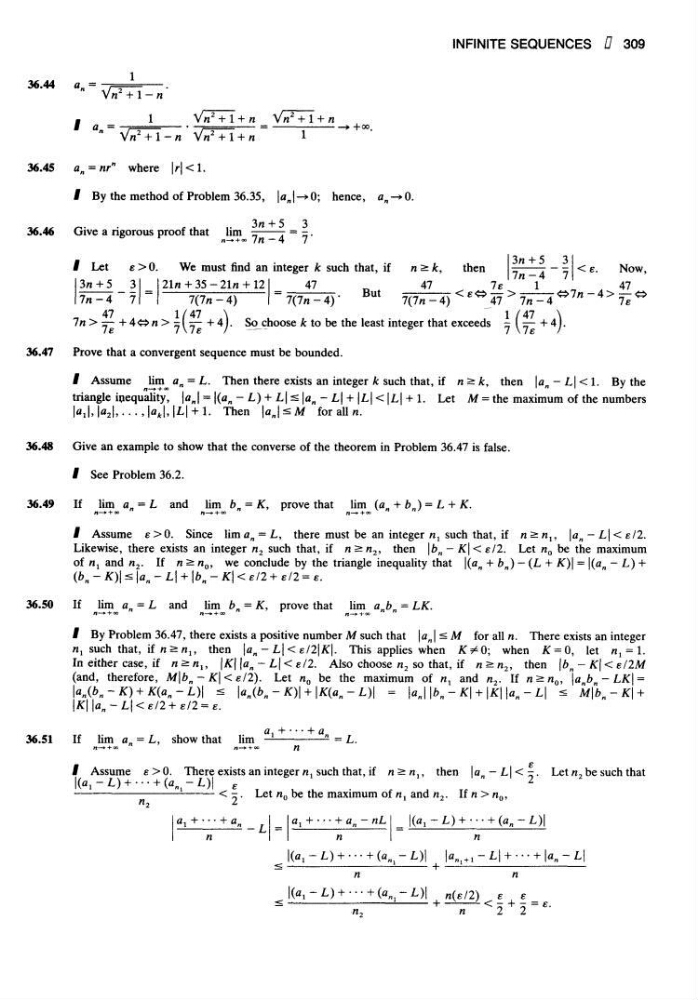
36.44
36.45
36.46
36.47
36.48
36.49
36.50
36.51
a n = nr" where |r|
hence, a n —»0.
INFINITE SEQUENCES
309
Give a rigorous proof that
Let
We must find an integer k such that, if
then
Now,
So^choose k to be the least integer that exceeds
Prove that a convergent sequence must be bounded.
Assume
Then there exists an integer k such that, if
then
By the
triangle inequality.
Let M = the maximum of the numbers
Give an example to show that the converse of the theorem in Problem 36.47 is false.
See Problem 36.2.
I Assume e>0. Since lim a n = L, there must be an integer «j such that, if n>n 1? \a n -L\
(b n - K)\ < \a n -L\ + \b n - K\< e!2 + e/2 = e.
If
and
"n=L
b n = K, prove that
By Problem 36.47, there exists a positive number M such that |aj < M for all n. There exists an integer
rtj such that, if nSrtj, then \a n - L\ < el2\K\. This applies when K^O; when K = Q, let n 1 = l.
In either case, if n>n l , \K\ \a n - L\n 2 , then \b n - K\ < e/2M
(and, therefore, M\b n - K\ < e/2). Let n a be the maximum of n^ and n 2 . If n>« 0 , |a b - LK\ =
\a n (b n -K) + K(a n -L)\ < \a n (b n - K)\ + \K(a n - L)\ = |aj \b n - K\ + \K\ \a n - L\ < M\b n - K\ +
\K\\a n -L\
show that
Assume
There exists an integer n l such that, if n s: n,, then
Let « 2 be such that
Let n 0 be the maximum of n l and n 2 .
prove that
and
If
Then
for all n.
If
But
36.45
36.46
36.47
36.48
36.49
36.50
36.51
a n = nr" where |r|
hence, a n —»0.
INFINITE SEQUENCES
309
Give a rigorous proof that
Let
We must find an integer k such that, if
then
Now,
So^choose k to be the least integer that exceeds
Prove that a convergent sequence must be bounded.
Assume
Then there exists an integer k such that, if
then
By the
triangle inequality.
Let M = the maximum of the numbers
Give an example to show that the converse of the theorem in Problem 36.47 is false.
See Problem 36.2.
I Assume e>0. Since lim a n = L, there must be an integer «j such that, if n>n 1? \a n -L\
(b n - K)\ < \a n -L\ + \b n - K\< e!2 + e/2 = e.
If
and
"n=L
b n = K, prove that
By Problem 36.47, there exists a positive number M such that |aj < M for all n. There exists an integer
rtj such that, if nSrtj, then \a n - L\ < el2\K\. This applies when K^O; when K = Q, let n 1 = l.
In either case, if n>n l , \K\ \a n - L\
(and, therefore, M\b n - K\ < e/2). Let n a be the maximum of n^ and n 2 . If n>« 0 , |a b - LK\ =
\a n (b n -K) + K(a n -L)\ < \a n (b n - K)\ + \K(a n - L)\ = |aj \b n - K\ + \K\ \a n - L\ < M\b n - K\ +
\K\\a n -L\
show that
Assume
There exists an integer n l such that, if n s: n,, then
Let « 2 be such that
Let n 0 be the maximum of n l and n 2 .
prove that
and
If
Then
for all n.
If
But