

CHAPTER 35
Polar Coordinates
35.1
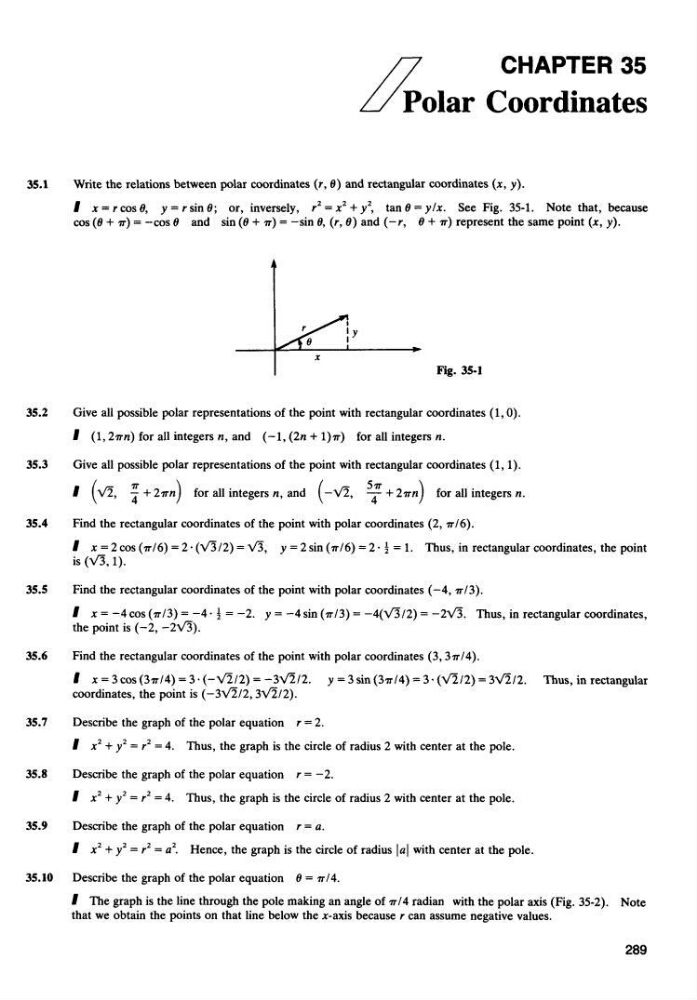
Write the relations between polar coordinates (r, 0) and rectangular coordinates (x, y).
x = rcos0, y = rsin0; or, inversely, r
2 = x
2 + y
2 , ta.nO = y/x. See Fig. 35-1. Note that, because
cos (6 + ir) = -cos $ and sin (0 + ir) = -sin 0, (r, 0) and (-r, 0 + ir) represent the same point (jc, y).
Fig. 35-1
35.2
Give all possible polar representations of the point with rectangular coordinates (1,0).
(1,2irn) for all integers n, and (—1, (2n + I)TT) for all integers n.
35.3
Give all possible polar representations of the point with rectangular coordinates (1,1).
for all integers n, and
for all integers n.
35.4
Find the rectangular coordinates of the point with polar coordinates (2, 77/6).
Thus, in rectangular coordinates, the point
35.5
Find the rectangular coordinates of the point with polar coordinates (—4, ir/3).
Thus, in rectangular coordinates,
the point is (-2, -2V5).
35.6
Find the rectangular coordinates of the point with polar coordinates (3,3ir/4).
Thus, in rectangular
coordinates, the point is
35.7
Describe the graph of the polar equation r = 2.
x
2 + y
2 = r
2 = 4. Thus, the graph is the circle of radius 2 with center at the pole.
35.8
Describe the graph of the polar equation r = -2.
x
2 + y
2 = r
2 - 4. Thus, the graph is the circle of radius 2 with center at the pole.
35.9
Describe the graph of the polar equation r = a.
x
2 + y
2 = r
2 = a
2 . Hence, the graph is the circle of radius |a| with center at the pole.
35.10
Describe the graph of the polar equation 6 = trl4.
The graph is the line through the pole making an angle of ir/4 radian with the polar axis (Fig. 35-2). Note
that we obtain the points on that line below the *-axis because r can assume negative values.
289
Polar Coordinates
35.1
Write the relations between polar coordinates (r, 0) and rectangular coordinates (x, y).
x = rcos0, y = rsin0; or, inversely, r
2 = x
2 + y
2 , ta.nO = y/x. See Fig. 35-1. Note that, because
cos (6 + ir) = -cos $ and sin (0 + ir) = -sin 0, (r, 0) and (-r, 0 + ir) represent the same point (jc, y).
Fig. 35-1
35.2
Give all possible polar representations of the point with rectangular coordinates (1,0).
(1,2irn) for all integers n, and (—1, (2n + I)TT) for all integers n.
35.3
Give all possible polar representations of the point with rectangular coordinates (1,1).
for all integers n, and
for all integers n.
35.4
Find the rectangular coordinates of the point with polar coordinates (2, 77/6).
Thus, in rectangular coordinates, the point
35.5
Find the rectangular coordinates of the point with polar coordinates (—4, ir/3).
Thus, in rectangular coordinates,
the point is (-2, -2V5).
35.6
Find the rectangular coordinates of the point with polar coordinates (3,3ir/4).
Thus, in rectangular
coordinates, the point is
35.7
Describe the graph of the polar equation r = 2.
x
2 + y
2 = r
2 = 4. Thus, the graph is the circle of radius 2 with center at the pole.
35.8
Describe the graph of the polar equation r = -2.
x
2 + y
2 = r
2 - 4. Thus, the graph is the circle of radius 2 with center at the pole.
35.9
Describe the graph of the polar equation r = a.
x
2 + y
2 = r
2 = a
2 . Hence, the graph is the circle of radius |a| with center at the pole.
35.10
Describe the graph of the polar equation 6 = trl4.
The graph is the line through the pole making an angle of ir/4 radian with the polar axis (Fig. 35-2). Note
that we obtain the points on that line below the *-axis because r can assume negative values.
289