

282
CHAPTER 34
34.65 At r=-l, G(f) = (3,0) and G'(/) = (2,3). Find
[r
3 G(f)]at r=-l.
By Problem 34.54,
[f
3 G(f)] = f
3 G'(/) + 3f
2 G(0. At f=-l,
[r
3 G(r)]=-(2,3) + 3(3,0) = (7,-3).
34.66 Prove the converse of Problem 34.59.
By Problem 34.57,
[R(0-R(0] = 2R(0'R'(0- Hence, R(/)-R'(/) = 0 implies R(r)-R(f) = c
2 for
some positive constant c. Then |R(/)| =
— c.
34.67 Give an example to show that if R(f) is a unit vector, then R'(0 need not be a unit vector (nor even a vector of
constant length).
Consider R(t) = (cos t
2
, sin t
2 ). Then
|R(f)| = l. However, R'(f) = (-2t sin t
2 , 2t cos t
2 ) and |R'(Ol =
= 2\t\.
34.68 If F(w) = A for all u, show that F'(«) = 0, and, conversely, if F'(«) = 0 for all u, then F(«) is a constant
vector.
Let F(ii) = (/(«), g(«)). If A«) = «i and g(u) = a 2 for all a, then F'(«) = (/'(«), g'(«)) =
(0,0) = 0. Conversely, if F'(«) = 0 for all u, then /'(«) = 0 and g'(u) = 0 for all u, and, therefore,
/(w) and g(u) are constants, and, thus, F(«) is constant.
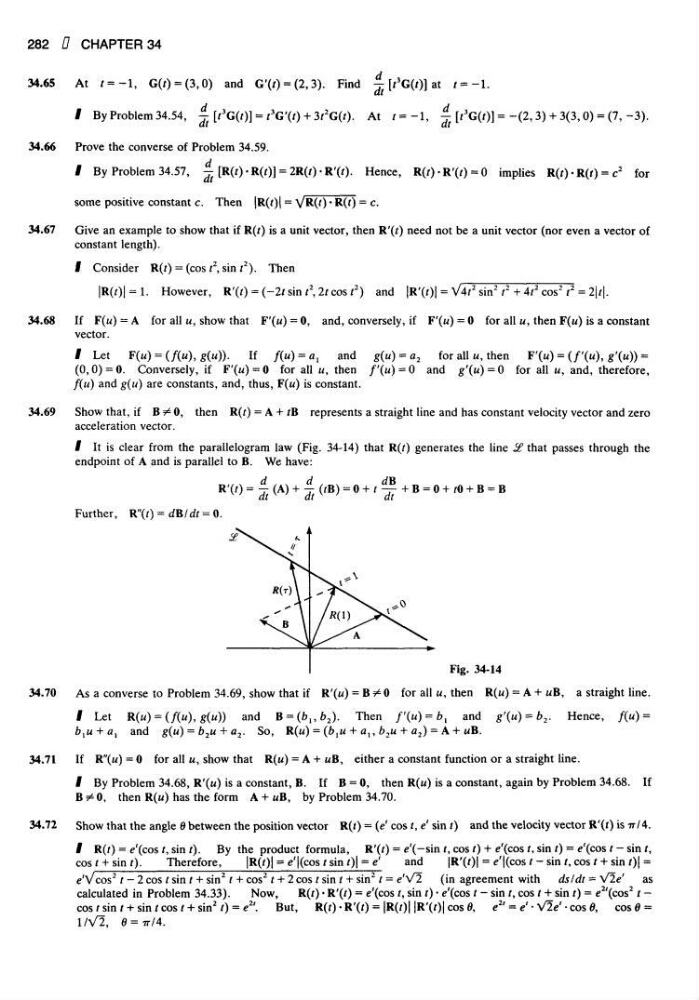
34.69 Show that, if E^Q, then R(f) = A + tE represents a straight line and has constant velocity vector and zero
acceleration vector.
It is clear from the parallelogram law (Fig. 34-14) that R(t) generates the line «S? that passes through the
endpoint of A and is parallel to B. We have:
Further, R"(t) = dE/dt = 0.
Fig. 34-14
34.70 As a converse to Problem 34.69, show that if R'(«) = B ^ 0 for all «, then R(u) = A + uE, a straight line.
Let R(w) = (/(«), g(u)) and B = (b l ,b 2 ). Then f'(u) = b l and g'(u) = b 2 . Hence, /(«) =
fetM + a, and g(u) = b2u + a2. So, R(M) = (&,« + a,, 62w + a2) = A+ «B.
34.71
If R"(
M
) = 0 for all u, show that R(M) = A + uE, either a constant function or a straight line.
By Problem 34.68, R'(«) is a constant, B. If B = 0, then R(w) is a constant, again by Problem 34.68. If
B * 0, then R(M) has the form A + uE, by Problem 34.70.
34.72 Show that the angle 0 between the position vector R(0 = (e
1 cos t, e' sin /) and the velocity vector R'(0 is ir/4.
I R(/) = e'(cost, sin t). By the product formula, R'(') = e'(-sin t, cos 0 + e'(cos t, sin t) = e'(cos t - sin /,
cosf + sinr)Therefore,
|R(f)| = e'\(cos t sin /)| = e'
and
|R'(OI = e'\(cos t - sin /, cos t + sin f)| =
(in agreement with dsldt = V2e'
as
calculated in Problem 34.33).
Now, R(r) • R'(0 = e'(cos t, sin f) • e'(cos t - sin t, cos r + sin /) = e
2 '(cos
2 1 -
cos t sin / + sin / cos t + sin
2 f) = e
2
'. But, R(f)-R'C) = |R(Ol |R'(Ol cos 0, e
2 '= e'• V2e'• cos 0, cos0 =
i/V5, e = 7r/4.
CHAPTER 34
34.65 At r=-l, G(f) = (3,0) and G'(/) = (2,3). Find
[r
3 G(f)]at r=-l.
By Problem 34.54,
[f
3 G(f)] = f
3 G'(/) + 3f
2 G(0. At f=-l,
[r
3 G(r)]=-(2,3) + 3(3,0) = (7,-3).
34.66 Prove the converse of Problem 34.59.
By Problem 34.57,
[R(0-R(0] = 2R(0'R'(0- Hence, R(/)-R'(/) = 0 implies R(r)-R(f) = c
2 for
some positive constant c. Then |R(/)| =
— c.
34.67 Give an example to show that if R(f) is a unit vector, then R'(0 need not be a unit vector (nor even a vector of
constant length).
Consider R(t) = (cos t
2
, sin t
2 ). Then
|R(f)| = l. However, R'(f) = (-2t sin t
2 , 2t cos t
2 ) and |R'(Ol =
= 2\t\.
34.68 If F(w) = A for all u, show that F'(«) = 0, and, conversely, if F'(«) = 0 for all u, then F(«) is a constant
vector.
Let F(ii) = (/(«), g(«)). If A«) = «i and g(u) = a 2 for all a, then F'(«) = (/'(«), g'(«)) =
(0,0) = 0. Conversely, if F'(«) = 0 for all u, then /'(«) = 0 and g'(u) = 0 for all u, and, therefore,
/(w) and g(u) are constants, and, thus, F(«) is constant.
34.69 Show that, if E^Q, then R(f) = A + tE represents a straight line and has constant velocity vector and zero
acceleration vector.
It is clear from the parallelogram law (Fig. 34-14) that R(t) generates the line «S? that passes through the
endpoint of A and is parallel to B. We have:
Further, R"(t) = dE/dt = 0.
Fig. 34-14
34.70 As a converse to Problem 34.69, show that if R'(«) = B ^ 0 for all «, then R(u) = A + uE, a straight line.
Let R(w) = (/(«), g(u)) and B = (b l ,b 2 ). Then f'(u) = b l and g'(u) = b 2 . Hence, /(«) =
fetM + a, and g(u) = b2u + a2. So, R(M) = (&,« + a,, 62w + a2) = A+ «B.
34.71
If R"(
M
) = 0 for all u, show that R(M) = A + uE, either a constant function or a straight line.
By Problem 34.68, R'(«) is a constant, B. If B = 0, then R(w) is a constant, again by Problem 34.68. If
B * 0, then R(M) has the form A + uE, by Problem 34.70.
34.72 Show that the angle 0 between the position vector R(0 = (e
1 cos t, e' sin /) and the velocity vector R'(0 is ir/4.
I R(/) = e'(cost, sin t). By the product formula, R'(') = e'(-sin t, cos 0 + e'(cos t, sin t) = e'(cos t - sin /,
cosf + sinr)Therefore,
|R(f)| = e'\(cos t sin /)| = e'
and
|R'(OI = e'\(cos t - sin /, cos t + sin f)| =
(in agreement with dsldt = V2e'
as
calculated in Problem 34.33).
Now, R(r) • R'(0 = e'(cos t, sin f) • e'(cos t - sin t, cos r + sin /) = e
2 '(cos
2 1 -
cos t sin / + sin / cos t + sin
2 f) = e
2
'. But, R(f)-R'C) = |R(Ol |R'(Ol cos 0, e
2 '= e'• V2e'• cos 0, cos0 =
i/V5, e = 7r/4.