

PARAMETRIC EQUATIONS, VECTOR FUNCTIONS, CURVILINEAR MOTION
281
Hence,
as
34.55
If R(0 = t
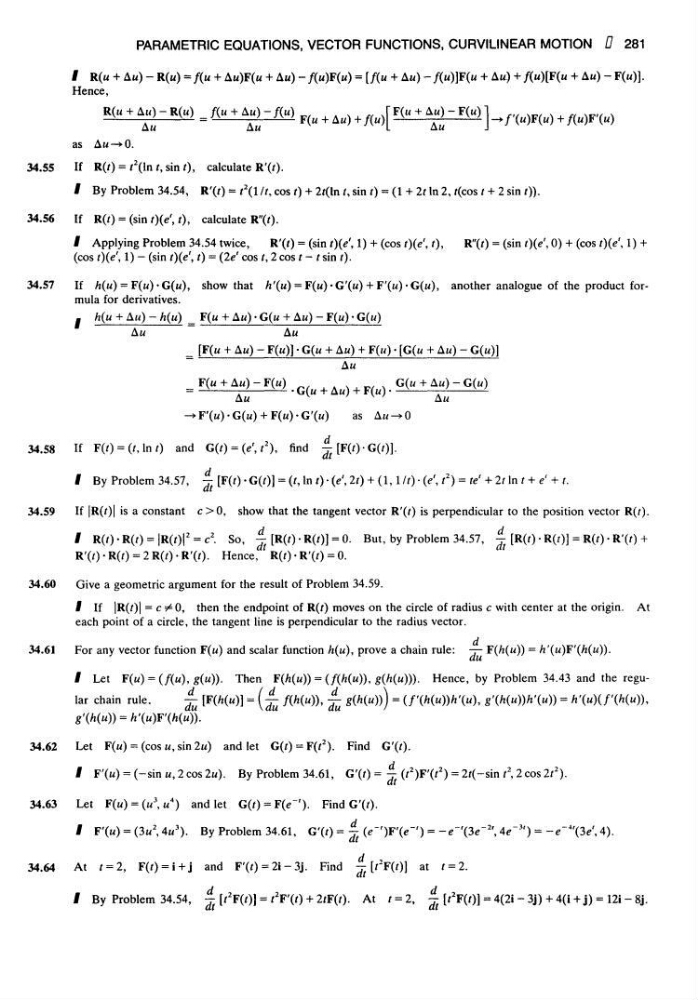
2 (\n t, sin 0, calculate R'(0By Problem 34.54, R'(0 = t\l It, cos t) + 2t(\n t, sin t) = (1 + 2t In 2, /(cos t + 2 sin ())•
34.56
If R(t) = (sin t)(e', t), calculate R"(0Applying Problem 34.54 twice,
R'(0 = (sin t)(e', 1) + (cos t)(e', t),
R"(0 = (sin t)(e', 0) + (cos t)(e\ 1) +
(cos t)(e', 1) - (sin t)(e', t) = (2e
r cos t, 2 cos t - t sin t).
34.57
If h(u) = F(«) • G(w), show that A'(«) = F(«)-G'(«) + F'(M) 'G(w), another analogue of the product formula for derivatives.
34.58 If F(/) = (Mnf) and G(f) = (e',r
2 ), find
By Problem 34.57,
[F(0 • G(0] = (t, In 0 • (e
1 ,2t) + (l,\lt)- (e\ t
2 ) = te' + 2t In t + e' + t.
as
34.59
If |R(Ol '
s a constant c>0, show that the tangent vector R'(0 is perpendicular to the position vector R(r).
Hence,
R(0-R(/) = |R(0|
2 = c
2
- So,
[R(f) • R(0] = 0. But, by Problem 34.57,
[R(f)-R(r)] = R(0'R'(0 +
R'(0-R(0 = 2R(0-R'(0.
R(0-R'(0 = 0.
34.60
Give a geometric argument for the result of Problem 34.59.
If |R(/)| = c?^0, then the endpoint of R(f) moves on the circle of radius c with center at the origin. At
each point of a circle, the tangent line is perpendicular to the radius vector.
34.61
For any vector function F(w) and scalar function h(u), prove a chain rule:
¥(h(u)) = h'(u)V'(h(u)).
Let F(u) = (f(u),g(u)). Then F(h(u)) = (f(h(u)), g(h(u))). Hence, by Problem 34.43 and the regular chain rule.
= (f'(h(u))h'(u), g'(h(u))h'(")) = *'(«)(/'(*(«)),
(¥(h(u)] =
g'(h(u)) = h'(u)¥'(h(u)).
34.62 Let F(«) = (cos u, sin 2u) and let G(f) = F(t
2 ). Find G'(0¥'(u) = (-sin u, 2 cos 2«). By Problem 34.61, G'(0 =
(t
2 )¥'(t
2 ) = 2t(-sin t
2 , 2 cos 2t
2 ).
34.63 Let ¥(u) = (u\ w
4 ) and let G(t) = ¥(e~'). Find G'(0F'(«) = (3w
2 , 4w
3 ). By Problem 34.61, G'(/) =
(e")¥'(e~') = -e~'(3e'
2 \ 4e~
}l ) = -e'"(3e\ 4)
34.64 At t = 2, F(f) = i+j and F'(0 = 2'~3J- Find[rF(r)l at t = 2.
By Problem 34.54,
[/
2 F(0] = t
2 ¥'(t) + 2t¥(t). At / = 2,
[r
2 F(r)] = 4(21 - 3j) + 4(1 + j) = 121 - 8j.
281
Hence,
as
34.55
If R(0 = t
2 (\n t, sin 0, calculate R'(0By Problem 34.54, R'(0 = t\l It, cos t) + 2t(\n t, sin t) = (1 + 2t In 2, /(cos t + 2 sin ())•
34.56
If R(t) = (sin t)(e', t), calculate R"(0Applying Problem 34.54 twice,
R'(0 = (sin t)(e', 1) + (cos t)(e', t),
R"(0 = (sin t)(e', 0) + (cos t)(e\ 1) +
(cos t)(e', 1) - (sin t)(e', t) = (2e
r cos t, 2 cos t - t sin t).
34.57
If h(u) = F(«) • G(w), show that A'(«) = F(«)-G'(«) + F'(M) 'G(w), another analogue of the product formula for derivatives.
34.58 If F(/) = (Mnf) and G(f) = (e',r
2 ), find
By Problem 34.57,
[F(0 • G(0] = (t, In 0 • (e
1 ,2t) + (l,\lt)- (e\ t
2 ) = te' + 2t In t + e' + t.
as
34.59
If |R(Ol '
s a constant c>0, show that the tangent vector R'(0 is perpendicular to the position vector R(r).
Hence,
R(0-R(/) = |R(0|
2 = c
2
- So,
[R(f) • R(0] = 0. But, by Problem 34.57,
[R(f)-R(r)] = R(0'R'(0 +
R'(0-R(0 = 2R(0-R'(0.
R(0-R'(0 = 0.
34.60
Give a geometric argument for the result of Problem 34.59.
If |R(/)| = c?^0, then the endpoint of R(f) moves on the circle of radius c with center at the origin. At
each point of a circle, the tangent line is perpendicular to the radius vector.
34.61
For any vector function F(w) and scalar function h(u), prove a chain rule:
¥(h(u)) = h'(u)V'(h(u)).
Let F(u) = (f(u),g(u)). Then F(h(u)) = (f(h(u)), g(h(u))). Hence, by Problem 34.43 and the regular chain rule.
= (f'(h(u))h'(u), g'(h(u))h'(")) = *'(«)(/'(*(«)),
(¥(h(u)] =
g'(h(u)) = h'(u)¥'(h(u)).
34.62 Let F(«) = (cos u, sin 2u) and let G(f) = F(t
2 ). Find G'(0¥'(u) = (-sin u, 2 cos 2«). By Problem 34.61, G'(0 =
(t
2 )¥'(t
2 ) = 2t(-sin t
2 , 2 cos 2t
2 ).
34.63 Let ¥(u) = (u\ w
4 ) and let G(t) = ¥(e~'). Find G'(0F'(«) = (3w
2 , 4w
3 ). By Problem 34.61, G'(/) =
(e")¥'(e~') = -e~'(3e'
2 \ 4e~
}l ) = -e'"(3e\ 4)
34.64 At t = 2, F(f) = i+j and F'(0 = 2'~3J- Find[rF(r)l at t = 2.
By Problem 34.54,
[/
2 F(0] = t
2 ¥'(t) + 2t¥(t). At / = 2,
[r
2 F(r)] = 4(21 - 3j) + 4(1 + j) = 121 - 8j.