

Then
CHAPTER 30
248
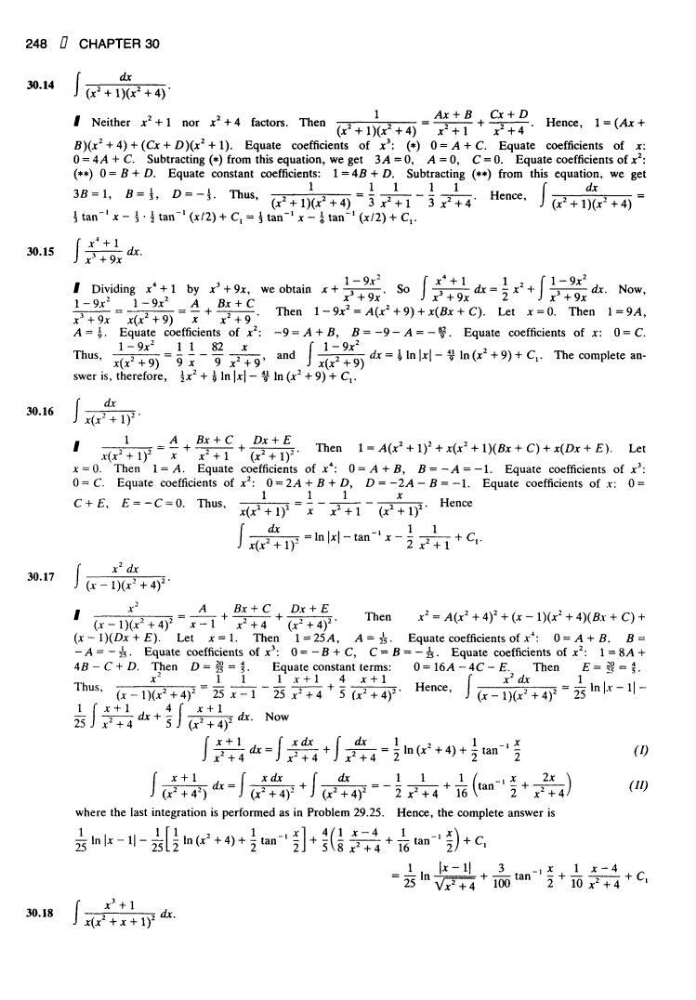
30.14
Neither x
2 + 1 nor x
2 + 4 factors. Then
Hence, 1 = (Ax +
Equate coefficients of jc
3 : (*) 0=A + C. Equate coefficients of x:
Subtracting (*) from this equation, we get 3A = 0, A = 0, C = 0. Equate coefficients of x
2 :
Subtracting (**) from this equation, we get
Equate constant coefficients: 1 = 4B + D,
Thus,
Hence,
30.15
Dividing x
4 + 1 by x
3 + 9x, we obtain
Now,
Equate coefficients of x
2 : -9 = A + B, B=-9->i = -f. Equate coefficients of A:: 0=C
Then 1=9/1,
Then 1 -9x
2 = A(x
2 + 9) + x(Bx + C).
Thus,
and
The complete answer is, therefore, \x
2 + § In \x\ - ^ In (JT + 9) + C,.
Let jc = 0.
So
30.16
Then 1 = A(x
1 + I)
2 + x(x
2 + l)(fo + C) + x(Dx + £). Let
Then 1 = A. Equate coefficients of x
4 : 0 = A + B, B = -A = -l. Equate coefficients of x
3 :
Equate coefficients of .v: 0 =
Equate coefficients of x
2 : 0 = 2A + B + D, D = -2A - B =-I.
Thus,
Hence
30.17
Equate coefficients of A'
4 : 0 = A + B. B =
Equate coefficients of
Then
£=§ = £.
In
Hence,
Equate constant terms:
0 = 16A - 4C - E.
Equate coefficients of x
3 : 0 = - B + C, C = B = - ^.
Thus,
Now
In
Then 1 = 25,4, A =5.
Then
(I)
(It)
where the last integration is performed as in Problem 29.25. Hence, the complete answer is
In
In
In
30.18
S)(jc
2 + 4) + (Cx + D)(x
2 + 1).
Q = 4A + C.
(**) o = B + D.
3B = 1, fi=L D = -^.
A=kx = 0.
0=C
C+E, E=-C = 0.
In
4B- C+ D.
x
2 = A(x
2 + 4)
2 + (x - l)(x
2 + 4)(B.v + C) +
(x - l)(Dx + E). Let jt = l.
-X = -A.
dx = lln\x\-$ln(x
2 + 9)+C l .
CHAPTER 30
248
30.14
Neither x
2 + 1 nor x
2 + 4 factors. Then
Hence, 1 = (Ax +
Equate coefficients of jc
3 : (*) 0=A + C. Equate coefficients of x:
Subtracting (*) from this equation, we get 3A = 0, A = 0, C = 0. Equate coefficients of x
2 :
Subtracting (**) from this equation, we get
Equate constant coefficients: 1 = 4B + D,
Thus,
Hence,
30.15
Dividing x
4 + 1 by x
3 + 9x, we obtain
Now,
Equate coefficients of x
2 : -9 = A + B, B=-9->i = -f. Equate coefficients of A:: 0=C
Then 1=9/1,
Then 1 -9x
2 = A(x
2 + 9) + x(Bx + C).
Thus,
and
The complete answer is, therefore, \x
2 + § In \x\ - ^ In (JT + 9) + C,.
Let jc = 0.
So
30.16
Then 1 = A(x
1 + I)
2 + x(x
2 + l)(fo + C) + x(Dx + £). Let
Then 1 = A. Equate coefficients of x
4 : 0 = A + B, B = -A = -l. Equate coefficients of x
3 :
Equate coefficients of .v: 0 =
Equate coefficients of x
2 : 0 = 2A + B + D, D = -2A - B =-I.
Thus,
Hence
30.17
Equate coefficients of A'
4 : 0 = A + B. B =
Equate coefficients of
Then
£=§ = £.
In
Hence,
Equate constant terms:
0 = 16A - 4C - E.
Equate coefficients of x
3 : 0 = - B + C, C = B = - ^.
Thus,
Now
In
Then 1 = 25,4, A =5.
Then
(I)
(It)
where the last integration is performed as in Problem 29.25. Hence, the complete answer is
In
In
In
30.18
S)(jc
2 + 4) + (Cx + D)(x
2 + 1).
Q = 4A + C.
(**) o = B + D.
3B = 1, fi=L D = -^.
A=kx = 0.
0=C
C+E, E=-C = 0.
In
4B- C+ D.
x
2 = A(x
2 + 4)
2 + (x - l)(x
2 + 4)(B.v + C) +
(x - l)(Dx + E). Let jt = l.
-X = -A.
dx = lln\x\-$ln(x
2 + 9)+C l .