

INTEGRATION OF RATIONAL FUNCTIONS: THE METHOD OF PARTIAL FRACTIONS
30.11
Hence, llx
2 + 18* + 8 = A(x + I)
2 +
Fig. 30-1
247
Then
x + 4 = A(x + 3)
2 + Bx(x + 3) + Cx.
Let
To find B, equate coefficients
Then 1 =-3C, C=-£.
Thus,
Let x = -3,
jc = 0. Then 4 = 9/1, A=g.
of A:
2 :
0 = A + B,
B = -A = -$.
and
In
In |
In
First we divide the numerator by the denominator, obtaining
Hence,
Now we seek to factor the denominator. Looking
for its roots, we examine the integral factors of the constant term. We find that is a root of the
denominator, and, dividing the latter by x + l yields x
2 - 3x - 4 = (x - 4)(x + 1). Thus, the denominator
Let x = -l. Then 1=-5C, C =
Thus,
In
In
and
Thus, the complete answer is
In
In
30.12
Equate coefficients of x
2 :
0 = A + B,
B = -A = -?.
So 1 = /l(x
2 + 5) + Bx
2 + Cx. Let x = 0
Then
1 = 5/4, A=\.
Hence,
Equate coefficients of x:
0 = C.
and
In
In
In
30.13
is irreducible, since its discriminant 6
2 -4ac=-4<0. Thus,
Let x = \. Then 1 = 10/1, /!=•&.
Equate coefficients ofjc
2 :
1 = /I + B,
B = 1 - /I = -^.
Equate constant coefficients:
0 = 5A - C,
So
or x
2 = A(x
2 + 4x + 5) + (Bx + C)(x - I)
Hence,
In
To compute the latter integral, complete the
square:
Let
* + 2 = tan 6,
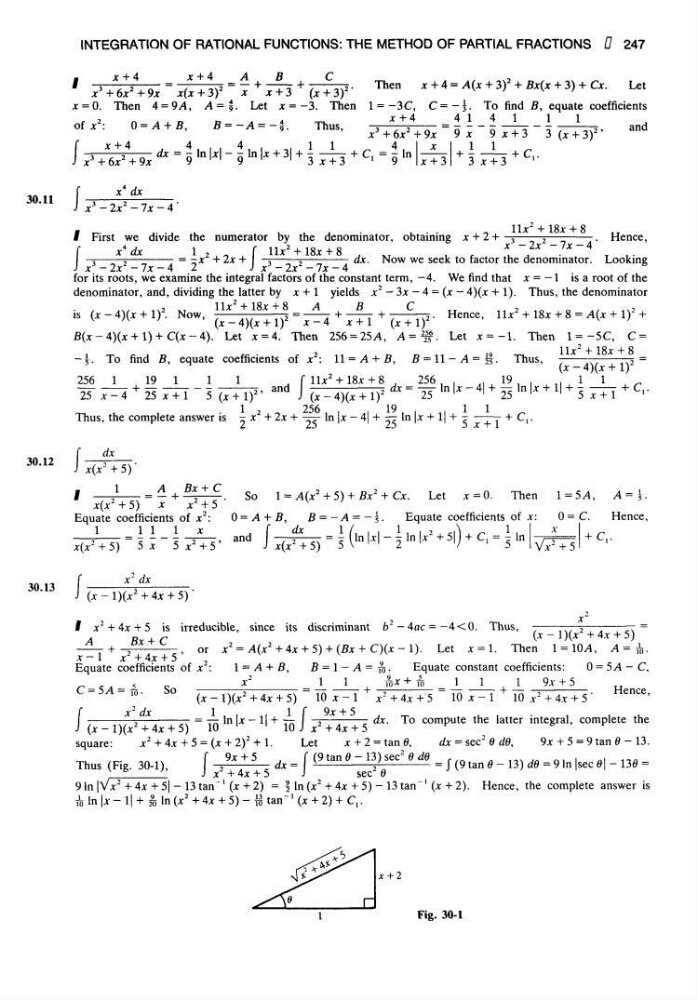
Thus (Fig. 30-1),
Hence, the complete answer is
is (x - 4)(x + I)
2
. Now,
B(x - 4)(x + 1) + C(x - 4). Let x = 4. Then 256 = 25/1, A = ^
-5. To find B, equate coefficients of x
2 : 11 = A + B, B = 11-^4 =3.
x
2 + 4x + 5
C=5^=ib.
x
2 +4x + 5 = (x + '2)
2 + \.
dx = sec
2 e dO,
9x + 5 = 9 tan 0 - 13.
In
In
In
30.11
Hence, llx
2 + 18* + 8 = A(x + I)
2 +
Fig. 30-1
247
Then
x + 4 = A(x + 3)
2 + Bx(x + 3) + Cx.
Let
To find B, equate coefficients
Then 1 =-3C, C=-£.
Thus,
Let x = -3,
jc = 0. Then 4 = 9/1, A=g.
of A:
2 :
0 = A + B,
B = -A = -$.
and
In
In |
In
First we divide the numerator by the denominator, obtaining
Hence,
Now we seek to factor the denominator. Looking
for its roots, we examine the integral factors of the constant term. We find that is a root of the
denominator, and, dividing the latter by x + l yields x
2 - 3x - 4 = (x - 4)(x + 1). Thus, the denominator
Let x = -l. Then 1=-5C, C =
Thus,
In
In
and
Thus, the complete answer is
In
In
30.12
Equate coefficients of x
2 :
0 = A + B,
B = -A = -?.
So 1 = /l(x
2 + 5) + Bx
2 + Cx. Let x = 0
Then
1 = 5/4, A=\.
Hence,
Equate coefficients of x:
0 = C.
and
In
In
In
30.13
is irreducible, since its discriminant 6
2 -4ac=-4<0. Thus,
Let x = \. Then 1 = 10/1, /!=•&.
Equate coefficients ofjc
2 :
1 = /I + B,
B = 1 - /I = -^.
Equate constant coefficients:
0 = 5A - C,
So
or x
2 = A(x
2 + 4x + 5) + (Bx + C)(x - I)
Hence,
In
To compute the latter integral, complete the
square:
Let
* + 2 = tan 6,
Thus (Fig. 30-1),
Hence, the complete answer is
is (x - 4)(x + I)
2
. Now,
B(x - 4)(x + 1) + C(x - 4). Let x = 4. Then 256 = 25/1, A = ^
-5. To find B, equate coefficients of x
2 : 11 = A + B, B = 11-^4 =3.
x
2 + 4x + 5
C=5^=ib.
x
2 +4x + 5 = (x + '2)
2 + \.
dx = sec
2 e dO,
9x + 5 = 9 tan 0 - 13.
In
In
In