

190
CHAPTER 23
Fig. 23-5
Fig. 23-6
23.47
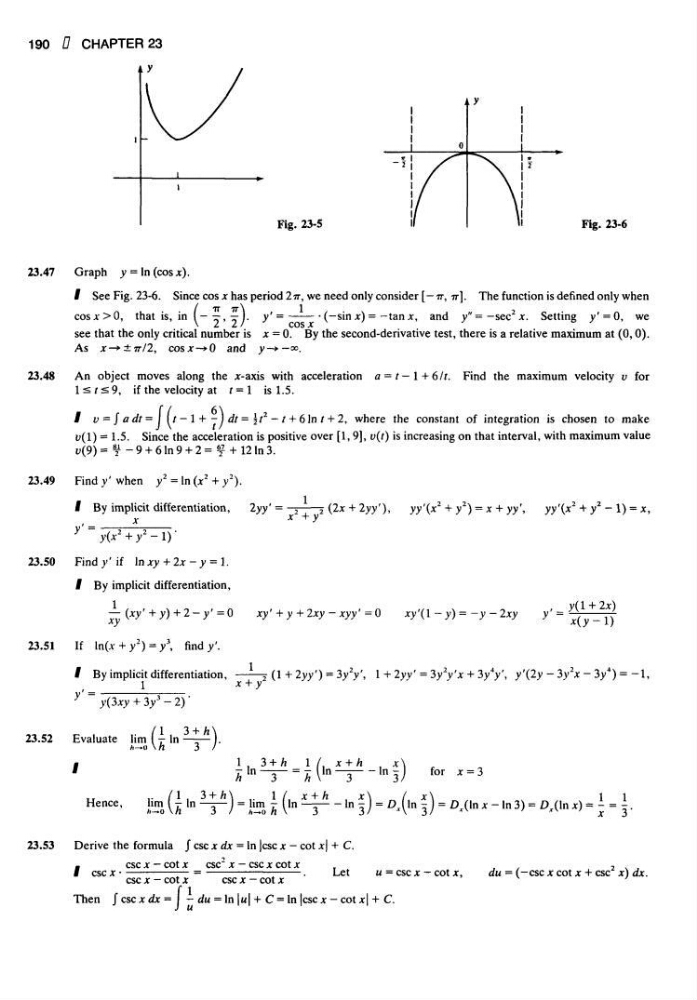
Graph y = In (cos x).
See Fig. 23-6. Since cos x has period ITT, we need only consider [—IT, IT]. The function is defined only when
cos x > 0, that is, in
• (—sin *) = —tanx, and y"=-sec
2 *. Setting y'=0, we
see that the only critical number is x = 0.
As x—*±Tr/2, cos*—»0 and y—> — °
By the second-derivative test, there is a relative maximum at (0,0).
23.48
An object moves along the *-axis with acceleration a = f — 1+6/f. Find the maximum velocity v for
1 < / < 9, if the velocity at r = 1 is 1.5.
i> = J adt =
dt= j/
2 — / + 6 In t + 2, where the constant of integration is chosen to make
v(l) = 1.5. Since the acceleration is positive over [1, 9], v(t) is increasing on that interval, with maximum value
v(9) =^-9 + 61n9 + 2=f + 121n3.
23.49
Find y' when y
2 = In (x
2 + y
2 ).
By implicit differentiation,
2yy' =
(2x + 2yy'),
yy'(x
2 + y
2 ) = x + yy', yy'(x
2 + y
2 - 1) = x,
23.50
Find}''if In ry + 2* - .y = 1.
By implicit differentiation,
23.51
If ln(.v+ /) = /, find/.
By implicit differentiation,
23.52
Evaluate
Hence,
for x = 3
23.53
Derive the formula / esc x dx = In |csc x - cot x\ + C.
Then / esc x dx =
Let
In \u\ + C = In |csc x - cot x\ + C.
y' =
y' =
(xy1 + y) + 2-y'=0 xy' + y + 2xy - xyy' =0 xy'(l - y) = -y -2xy y'=
(l + 2yy') = 3y2y', 1 + 2yy' = 3y1y'x + 3y4y', y'(2y-3y2x-3y4)=-l,
y' =
cscx •
u = csc x - cot x, du = (—csc x cot x + csc
2 x) dx.
— du =
u
CHAPTER 23
Fig. 23-5
Fig. 23-6
23.47
Graph y = In (cos x).
See Fig. 23-6. Since cos x has period ITT, we need only consider [—IT, IT]. The function is defined only when
cos x > 0, that is, in
• (—sin *) = —tanx, and y"=-sec
2 *. Setting y'=0, we
see that the only critical number is x = 0.
As x—*±Tr/2, cos*—»0 and y—> — °
By the second-derivative test, there is a relative maximum at (0,0).
23.48
An object moves along the *-axis with acceleration a = f — 1+6/f. Find the maximum velocity v for
1 < / < 9, if the velocity at r = 1 is 1.5.
i> = J adt =
dt= j/
2 — / + 6 In t + 2, where the constant of integration is chosen to make
v(l) = 1.5. Since the acceleration is positive over [1, 9], v(t) is increasing on that interval, with maximum value
v(9) =^-9 + 61n9 + 2=f + 121n3.
23.49
Find y' when y
2 = In (x
2 + y
2 ).
By implicit differentiation,
2yy' =
(2x + 2yy'),
yy'(x
2 + y
2 ) = x + yy', yy'(x
2 + y
2 - 1) = x,
23.50
Find}''if In ry + 2* - .y = 1.
By implicit differentiation,
23.51
If ln(.v+ /) = /, find/.
By implicit differentiation,
23.52
Evaluate
Hence,
for x = 3
23.53
Derive the formula / esc x dx = In |csc x - cot x\ + C.
Then / esc x dx =
Let
In \u\ + C = In |csc x - cot x\ + C.
y' =
y' =
(xy1 + y) + 2-y'=0 xy' + y + 2xy - xyy' =0 xy'(l - y) = -y -2xy y'=
(l + 2yy') = 3y2y', 1 + 2yy' = 3y1y'x + 3y4y', y'(2y-3y2x-3y4)=-l,
y' =
cscx •
u = csc x - cot x, du = (—csc x cot x + csc
2 x) dx.
— du =
u