

THE NATURAL LOGARITHM
189
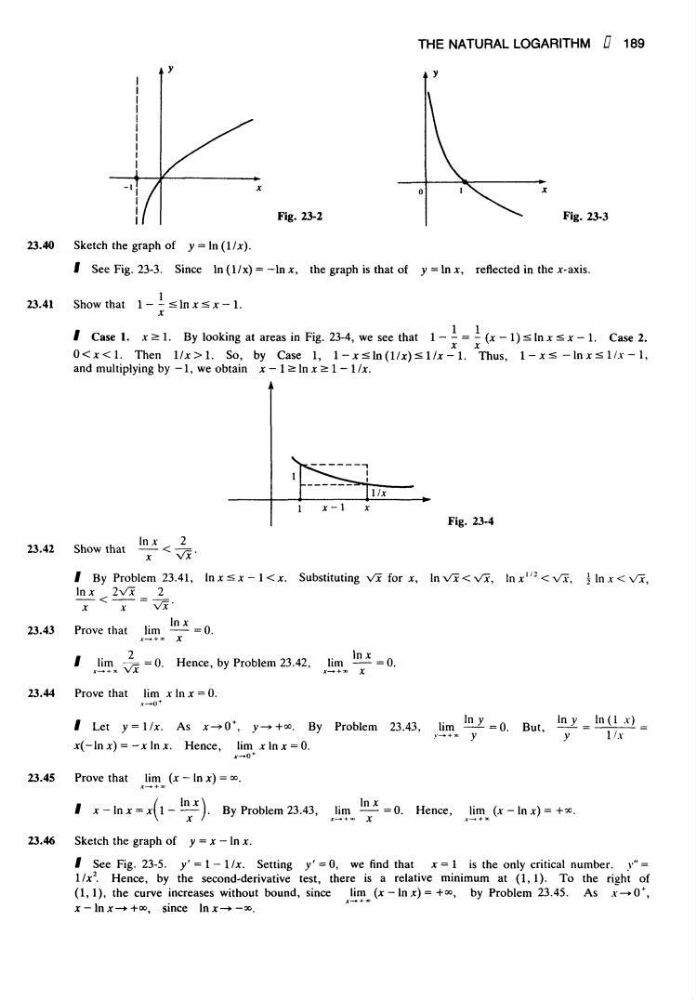
Fig. 23-2
Fig. 23-3
23.40
Sketch the graph of y = In (l/x).
See Fig. 23-3. Since In (l/x) = — Inx, the graph is that of y=\nx, reflected in the x-axis.
23.41
Show that
Case 1. x SL 1. By looking at areas in Fig. 23-4, we see that
Case 2.
0\. So, by Case 1, 1 - x<\n(llx)^\lx- 1. Thus, 1 - x < - lnx< l/.v - 1,
and multiplying by -1, we obtain x - 1 > In x > 1 - 1 /x.
23.42
Show that
By Problem 23.41, \nx
In
In
23.43
Prove that
Hence, by Problem 23.42,
23.44 Prove that Inx=0.
Let y = 1 Ix. As *—»0
+ , y—»+oo. By Problem 23.43,
But,
Hence,
23.45
Prove that
In
By Problem 23.43,
Hence,
23.46
Sketch the graph of y = x — In x.
See Fig. 23-5. y'= 1 — l/x. Setting y'=0, we find that x = 1 is the only critical number. v" =
l/x
2 . Hence, by the second-derivative test, there is a relative minimum at (1,1). To the right of
(1,1), the curve increases without bound, since
lim (x -In jc) = +», by Problem 23.45. As .v —»0
+ ,
jf—, + JC
* — Inx—»+<», since Inj:—»— ».
Fig. 23-4
lim (x - Inx) = +«.
A—- + ^
lim (jc — In x) = ».
-t—• + =c
jc(—In AT) = -x In jc.
Inx
<
1(x-1)
189
Fig. 23-2
Fig. 23-3
23.40
Sketch the graph of y = In (l/x).
See Fig. 23-3. Since In (l/x) = — Inx, the graph is that of y=\nx, reflected in the x-axis.
23.41
Show that
Case 1. x SL 1. By looking at areas in Fig. 23-4, we see that
Case 2.
0
and multiplying by -1, we obtain x - 1 > In x > 1 - 1 /x.
23.42
Show that
By Problem 23.41, \nx
In
In
23.43
Prove that
Hence, by Problem 23.42,
23.44 Prove that Inx=0.
Let y = 1 Ix. As *—»0
+ , y—»+oo. By Problem 23.43,
But,
Hence,
23.45
Prove that
In
By Problem 23.43,
Hence,
23.46
Sketch the graph of y = x — In x.
See Fig. 23-5. y'= 1 — l/x. Setting y'=0, we find that x = 1 is the only critical number. v" =
l/x
2 . Hence, by the second-derivative test, there is a relative minimum at (1,1). To the right of
(1,1), the curve increases without bound, since
lim (x -In jc) = +», by Problem 23.45. As .v —»0
+ ,
jf—, + JC
* — Inx—»+<», since Inj:—»— ».
Fig. 23-4
lim (x - Inx) = +«.
A—- + ^
lim (jc — In x) = ».
-t—• + =c
jc(—In AT) = -x In jc.
Inx
<
1(x-1)