

THE DEFINITE INTEGRAL AND THE FUNDAMENTAL THEOREM OF CALCULUS
161
20.80
Find a function / such that
Differentiating both sides of the given equation, we see that f(x) = cos x - 2x. In fact,
20.81
Find a function / such that
Differentiating both sides of the given equation, we obtain f(x) = -sin x - 2x. Checking back,
there to be a solution of
f(t)dt = g(x), we must have g(0) = 0.
Thus, there is no solution. In order for
20.82
Find
Hence,
20.83
Evaluate
By the addition formula,
cos (n — l)x = cos (nx — x) = cos nx cos x + sin nx sin x
cos (n + l)x = cos (nx + x) = cos nx cos x — sin nx sin x
whence
cos (n - l)x + costn + l)x = 2cos nxcosx. In particular,
cosSx -cos x = 5(cos6x + cos 4*1.
Hence,
20.84
If an object moves along a line with velocity u=sinf-cosf from time f = 0 to t=ir/2, find the
distance traveled.
The distance is
dt. Now, for 00 when and only when
Hence,
cos t, that is, if and only if tant>l, which is equivalent to
20.85
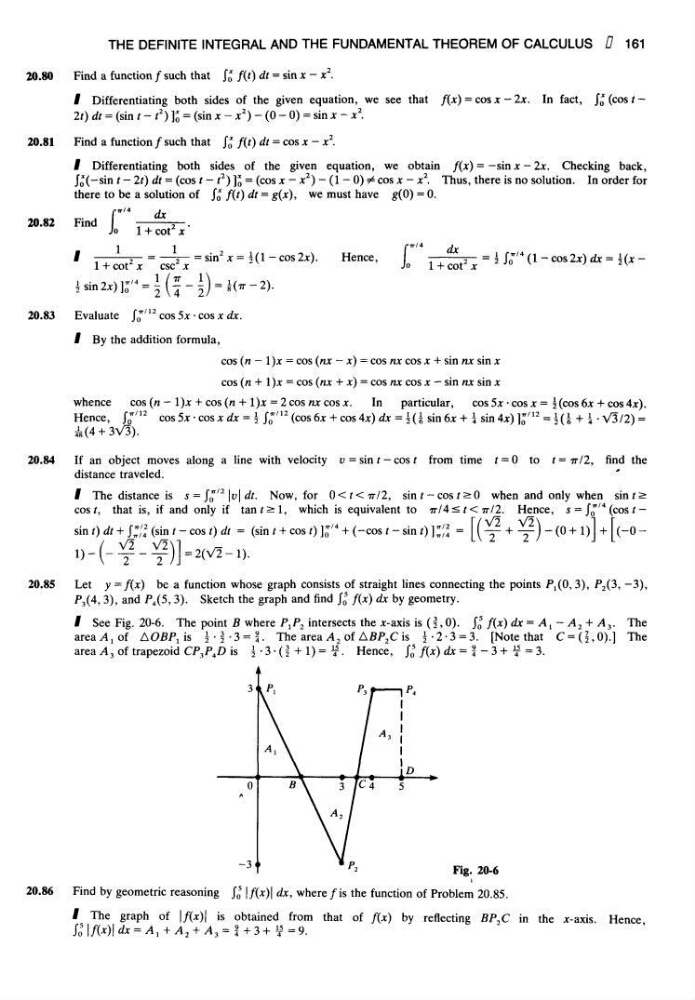
Let y = f(x) be a function whose graph consists of straight lines connecting the points ^(0,3), P 2 (3, —3),
P 3 (4,3), and P 4 (5, 3). Sketch the graph and find $„ f(x) dx by geometry.
See Fig. 20-6. The point B where P 1 P 2 intersects the *-axis is
The
area A l of
The area A 2 of
[Note that C =
The
area A 3 of trapezoid CP 3 P 4 D is | • 3 • (| + 1) =Hence,
Fig. 20-6
20.86
Find by geometric reasoning
/(*)| dx, where/is the function of Problem 20.85.
The graph of \f(x)\ is obtained from that of f(x) by reflecting SP,C in the *-axis. Hence
f(t) dt = cos x - x2.
f(t) dt = sin x - x
2 .
2t) dt = (sin t - r) ]o = (sin x - x*) - (0 - 0) = sin x - x.
(cos t -
cos 5* • cos x dx.
cos 5x • cos x dx =
(cos 6x + cos 4x) d* =
sin t) dt +
(sin t - cos /) dt = (sin f + cos t) ] + (-cos t - sin t)
sinra
f(x) dx =
.B/^Cis |-2-3 = 3.
f(x)dx = A,-A 2 + A 3 .
OBP, is
dx = A^ + A 2 + A 3 = + 3 + = 9
(-sin t - 2t) dt = (cos t - r
2 ) ]* = (cos x - x
2
) - (1 - 0) * cos x - x
2 .
161
20.80
Find a function / such that
Differentiating both sides of the given equation, we see that f(x) = cos x - 2x. In fact,
20.81
Find a function / such that
Differentiating both sides of the given equation, we obtain f(x) = -sin x - 2x. Checking back,
there to be a solution of
f(t)dt = g(x), we must have g(0) = 0.
Thus, there is no solution. In order for
20.82
Find
Hence,
20.83
Evaluate
By the addition formula,
cos (n — l)x = cos (nx — x) = cos nx cos x + sin nx sin x
cos (n + l)x = cos (nx + x) = cos nx cos x — sin nx sin x
whence
cos (n - l)x + costn + l)x = 2cos nxcosx. In particular,
cosSx -cos x = 5(cos6x + cos 4*1.
Hence,
20.84
If an object moves along a line with velocity u=sinf-cosf from time f = 0 to t=ir/2, find the
distance traveled.
The distance is
dt. Now, for 0
Hence,
cos t, that is, if and only if tant>l, which is equivalent to
20.85
Let y = f(x) be a function whose graph consists of straight lines connecting the points ^(0,3), P 2 (3, —3),
P 3 (4,3), and P 4 (5, 3). Sketch the graph and find $„ f(x) dx by geometry.
See Fig. 20-6. The point B where P 1 P 2 intersects the *-axis is
The
area A l of
The area A 2 of
[Note that C =
The
area A 3 of trapezoid CP 3 P 4 D is | • 3 • (| + 1) =Hence,
Fig. 20-6
20.86
Find by geometric reasoning
/(*)| dx, where/is the function of Problem 20.85.
The graph of \f(x)\ is obtained from that of f(x) by reflecting SP,C in the *-axis. Hence
f(t) dt = cos x - x2.
f(t) dt = sin x - x
2 .
2t) dt = (sin t - r) ]o = (sin x - x*) - (0 - 0) = sin x - x.
(cos t -
cos 5* • cos x dx.
cos 5x • cos x dx =
(cos 6x + cos 4x) d* =
sin t) dt +
(sin t - cos /) dt = (sin f + cos t) ] + (-cos t - sin t)
sinra
f(x) dx =
.B/^Cis |-2-3 = 3.
f(x)dx = A,-A 2 + A 3 .
OBP, is
dx = A^ + A 2 + A 3 = + 3 + = 9
(-sin t - 2t) dt = (cos t - r
2 ) ]* = (cos x - x
2
) - (1 - 0) * cos x - x
2 .