

160
CHAPTER 20
20.74
Compute
•3x
2 = -3/x = -3x~\ Hence,
20.75
Draw a region whose area is given by Jf (2x + 1) dx, and find the area by geometric reasoning.
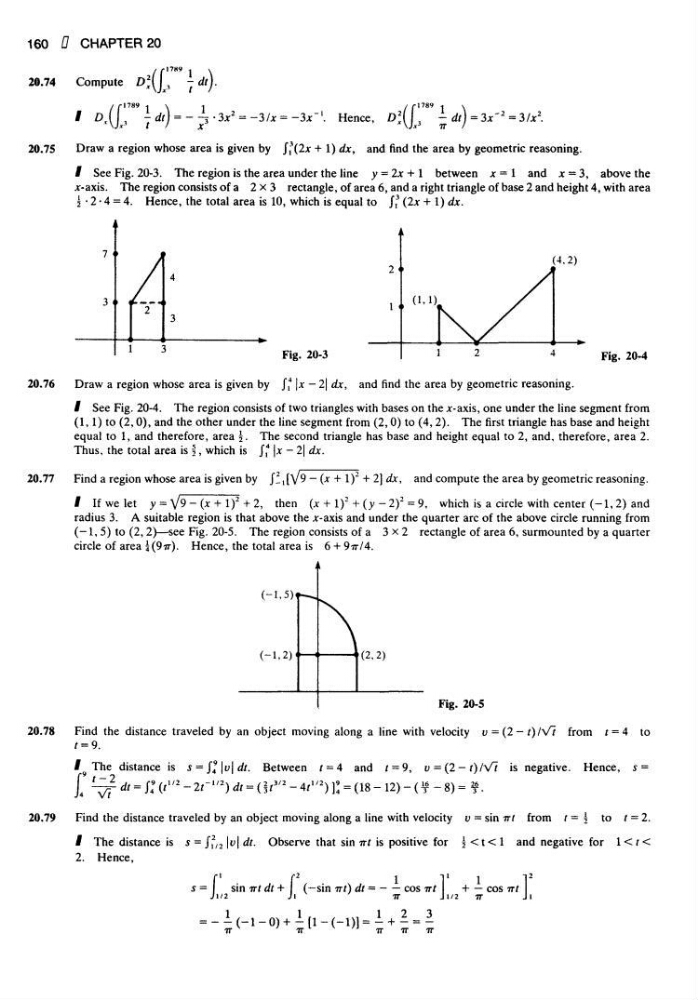
See Fig. 20-3. The region is the area under the line y = 2x + 1 between x = 1 and x = 3, above the
*-axis. The region consists of a 2x3 rectangle, of area 6. and a right triangle of base 2 and height 4. with area
5-2-4 = 4. Hence, the total area is 10, which is equal to /? (2* + 1) dx.
Fig. 20-3
Fig. 20-4
20.76
Draw a region whose area is given by
dx, and find the area by geometric reasoning.
See Fig. 20-4. The region consists of two triangles with bases on the x-axis, one under the line segment from
(1,1) to (2,0), and the other under the line segment from (2,0) to (4, 2). The first triangle has base and height
equal to 1, and therefore, area \. The second triangle has base and height equal to 2, and, therefore, area 2.
Thus, the total area is §, which is
20.77
Find a region whose area is given by
+ 2] dx, and compute the area by geometric reasoning.
If we let y =
+ 2, then (x + I)
2 + (y - 2)
2 = 9, which is a circle with center (—1,2) and
radius 3. A suitable region is that above the jr-axis and under the quarter arc of the above circle running from
(—1, 5) to (2,2)—see Fig. 20-5. The region consists of a 3x2 rectangle of area 6, surmounted by a quarter
circle of area j(9ir). Hence, the total area is 6 + 9ir/4.
Fig. 20-5
20.78
Find the distance traveled by an object moving along a line with velocity v = (2 - t) /V7 from t = 4 to
The distance is
Between t = 4 and t = 9, v = (2-t)/Vt is negative. Hence, s =
20.79
Find the distance traveled by an object moving along a line with velocity v = sin irt from / = I to t = 2.
The distance is
Observe that sin irt is positive for
and negative for
2. Hence,
dx.
= 3x2 =3/x
2 .
t = 9.
CHAPTER 20
20.74
Compute
•3x
2 = -3/x = -3x~\ Hence,
20.75
Draw a region whose area is given by Jf (2x + 1) dx, and find the area by geometric reasoning.
See Fig. 20-3. The region is the area under the line y = 2x + 1 between x = 1 and x = 3, above the
*-axis. The region consists of a 2x3 rectangle, of area 6. and a right triangle of base 2 and height 4. with area
5-2-4 = 4. Hence, the total area is 10, which is equal to /? (2* + 1) dx.
Fig. 20-3
Fig. 20-4
20.76
Draw a region whose area is given by
dx, and find the area by geometric reasoning.
See Fig. 20-4. The region consists of two triangles with bases on the x-axis, one under the line segment from
(1,1) to (2,0), and the other under the line segment from (2,0) to (4, 2). The first triangle has base and height
equal to 1, and therefore, area \. The second triangle has base and height equal to 2, and, therefore, area 2.
Thus, the total area is §, which is
20.77
Find a region whose area is given by
+ 2] dx, and compute the area by geometric reasoning.
If we let y =
+ 2, then (x + I)
2 + (y - 2)
2 = 9, which is a circle with center (—1,2) and
radius 3. A suitable region is that above the jr-axis and under the quarter arc of the above circle running from
(—1, 5) to (2,2)—see Fig. 20-5. The region consists of a 3x2 rectangle of area 6, surmounted by a quarter
circle of area j(9ir). Hence, the total area is 6 + 9ir/4.
Fig. 20-5
20.78
Find the distance traveled by an object moving along a line with velocity v = (2 - t) /V7 from t = 4 to
The distance is
Between t = 4 and t = 9, v = (2-t)/Vt is negative. Hence, s =
20.79
Find the distance traveled by an object moving along a line with velocity v = sin irt from / = I to t = 2.
The distance is
Observe that sin irt is positive for
and negative for
2. Hence,
dx.
= 3x2 =3/x
2 .
t = 9.