

CHAPTER 20
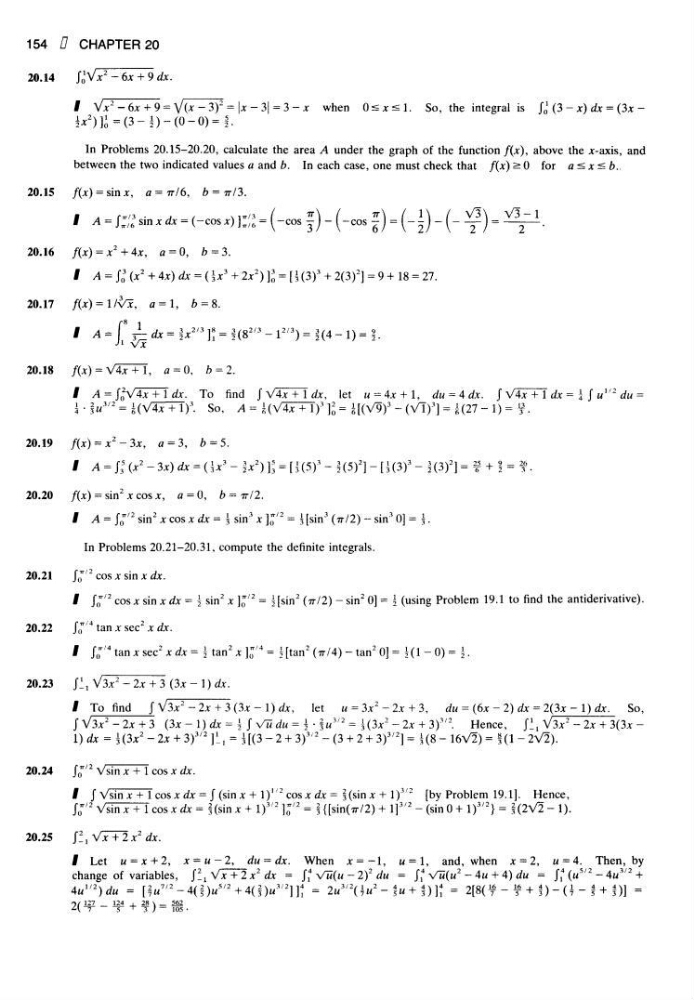
In Problems 20.15-20.20, calculate the area A under the graph of the function f(x), above the *-axis, and
between the two indicated values a and b. In each case, one must check that f(x)zQ for a-&x&b.
20.14
JoVx
2 - 6x + 9 dx.
154
when 0 s x < 1. So, the integral is
20.15
20.16
20.17
f(x) = l/Vx, a = l, 6 = 8.
20.18
/(*) =
20.19
To find
So,
20.20
20.21
J<7'
2 cos A; sin x dx.
In Problems 20.21-20.31, compute the definite integrals.
20.22
20.23
f' V3jc
2 - 2x + 3 (3* - 1) dx.
Hence,
20.24
J 0 "'
2 VsmTTT cos x dx.
fby Problem 19.1]. Hence,
20.25
J^Vm?*
2 ^.
change of variables,
Let u = x + 2, x = u — 2, du = dx When
and, when x = 2, u = 4. Then, by
(3 - x) dx = (3x -
= (3-i)-(0-0)=i.
f(x) = sinx, a = TT/6, 6 = 77/3.
f(x) = x
2 +4x, a = 0, b = 3.
« = 0, 6 = 2.
let M = 4* + l, du = 4dx
f(x) = x
2 -3x, a = 3, 6 = 5.
/(*) = sin
2 x cos *, a = 0, 6 = ir/2.
j"n"/2 cos A: sin x dx = \ sin2 x ]„/2 = | [sin2 (ir/2) — sin2 0] = |(using Problem 19.1 to find the antiderivative).
J ( 7'
4 tan * sec
2 * dx.
J0"'4 tan* sec2 xdx= \ tan2x]^'4= ^[tan2 (7r/4) - tan2 0] = \(\-®)=\.
To find
let
u = 3x
2 - 2x + 3, du = (6x - 2) dx = 2(3* - 1) dx. So,
x = —1, u — 1,
A = J 3
5 (*
2 - 3x) dx = (lx
3 - fx
2 ) ]^ = (I(5)
3 - 1(5)
2 ] - B(3)
3 - I(3)
2 ] = f + § = ¥
A = Jo"'
2 sin
2 x cos x dx = \ sin
3 x ]„
/2 = £ [sin
3 (7j72) - sin
3 0] = |.
/I = J
3 (^
2 + 4x) dr = (Ix
3 + 2^r
2 ) ]
3 = [| (3)
3 + 2(3)
2 ] = 9 + 18 = 27.
In Problems 20.15-20.20, calculate the area A under the graph of the function f(x), above the *-axis, and
between the two indicated values a and b. In each case, one must check that f(x)zQ for a-&x&b.
20.14
JoVx
2 - 6x + 9 dx.
154
when 0 s x < 1. So, the integral is
20.15
20.16
20.17
f(x) = l/Vx, a = l, 6 = 8.
20.18
/(*) =
20.19
To find
So,
20.20
20.21
J<7'
2 cos A; sin x dx.
In Problems 20.21-20.31, compute the definite integrals.
20.22
20.23
f' V3jc
2 - 2x + 3 (3* - 1) dx.
Hence,
20.24
J 0 "'
2 VsmTTT cos x dx.
fby Problem 19.1]. Hence,
20.25
J^Vm?*
2 ^.
change of variables,
Let u = x + 2, x = u — 2, du = dx When
and, when x = 2, u = 4. Then, by
(3 - x) dx = (3x -
= (3-i)-(0-0)=i.
f(x) = sinx, a = TT/6, 6 = 77/3.
f(x) = x
2 +4x, a = 0, b = 3.
« = 0, 6 = 2.
let M = 4* + l, du = 4dx
f(x) = x
2 -3x, a = 3, 6 = 5.
/(*) = sin
2 x cos *, a = 0, 6 = ir/2.
j"n"/2 cos A: sin x dx = \ sin2 x ]„/2 = | [sin2 (ir/2) — sin2 0] = |(using Problem 19.1 to find the antiderivative).
J ( 7'
4 tan * sec
2 * dx.
J0"'4 tan* sec2 xdx= \ tan2x]^'4= ^[tan2 (7r/4) - tan2 0] = \(\-®)=\.
To find
let
u = 3x
2 - 2x + 3, du = (6x - 2) dx = 2(3* - 1) dx. So,
x = —1, u — 1,
A = J 3
5 (*
2 - 3x) dx = (lx
3 - fx
2 ) ]^ = (I(5)
3 - 1(5)
2 ] - B(3)
3 - I(3)
2 ] = f + § = ¥
A = Jo"'
2 sin
2 x cos x dx = \ sin
3 x ]„
/2 = £ [sin
3 (7j72) - sin
3 0] = |.
/I = J
3 (^
2 + 4x) dr = (Ix
3 + 2^r
2 ) ]
3 = [| (3)
3 + 2(3)
2 ] = 9 + 18 = 27.