

THE DEFINITE INTEGRAL AND THE FUNDAMENTAL THEOREM OF CALCULUS
20.6
Evaluate
20.7
Evaluate
20.8
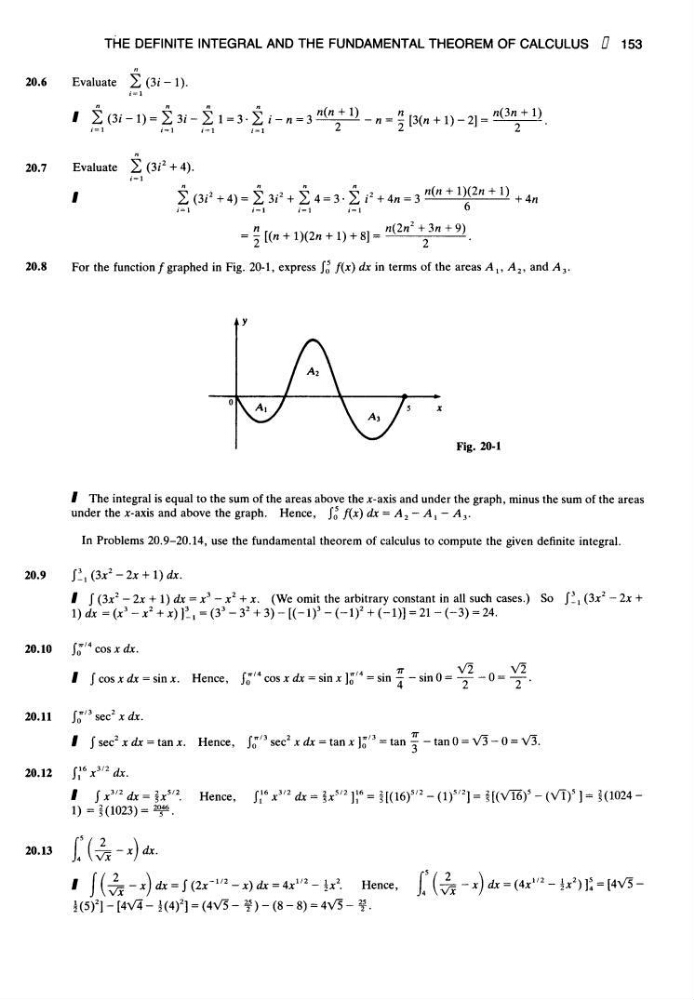
For the function / graphed in Fig. 20-1, express
Fig. 20-1
20.9
I The integral is equal to the sum of the areas above the *-axis and under the graph, minus the sum of the areas
under the x-axis and above the graph. Hence, J 0
5 f(x) dx = A 2 - A l - A 3 .
In Problems 20.9-20.14, use the fundamental theorem of calculus to compute the given definite integral.
20.10
20.11
J7
/3 sec
2 x dx.
20.12
20.1
Hence,
f(x) dx in terms of the areas A l , A 2 , and A 3 .
(We omit the arbitrary constant in all such cases.) So
Hence,
Hence,
Hence,
153
(3x
2 - 2x + 1) dx.
(3x
2 -2x + l)dx = x
3 -x
2 + x.
(3x
2 -2x +
l)^=(^
3 -x
2 + ^)]
3 _ 1 = (3
3 -3
2 + 3)-[(-l)
3 -(-l)
2 + (-l)] = 21-(-3) = 24.
cos x dx.
cos x dx = sin x.
sec
2 x dx = tan x.
dx = $ (2x'l/2 -x)dx = 4xl/2 - \x2.
x
312 dx
x
312 dx = f x
5 '
2 .
20.6
Evaluate
20.7
Evaluate
20.8
For the function / graphed in Fig. 20-1, express
Fig. 20-1
20.9
I The integral is equal to the sum of the areas above the *-axis and under the graph, minus the sum of the areas
under the x-axis and above the graph. Hence, J 0
5 f(x) dx = A 2 - A l - A 3 .
In Problems 20.9-20.14, use the fundamental theorem of calculus to compute the given definite integral.
20.10
20.11
J7
/3 sec
2 x dx.
20.12
20.1
Hence,
f(x) dx in terms of the areas A l , A 2 , and A 3 .
(We omit the arbitrary constant in all such cases.) So
Hence,
Hence,
Hence,
153
(3x
2 - 2x + 1) dx.
(3x
2 -2x + l)dx = x
3 -x
2 + x.
(3x
2 -2x +
l)^=(^
3 -x
2 + ^)]
3 _ 1 = (3
3 -3
2 + 3)-[(-l)
3 -(-l)
2 + (-l)] = 21-(-3) = 24.
cos x dx.
cos x dx = sin x.
sec
2 x dx = tan x.
dx = $ (2x'l/2 -x)dx = 4xl/2 - \x2.
x
312 dx
x
312 dx = f x
5 '
2 .