

132 D CHAPTER 16
16.59
16.60
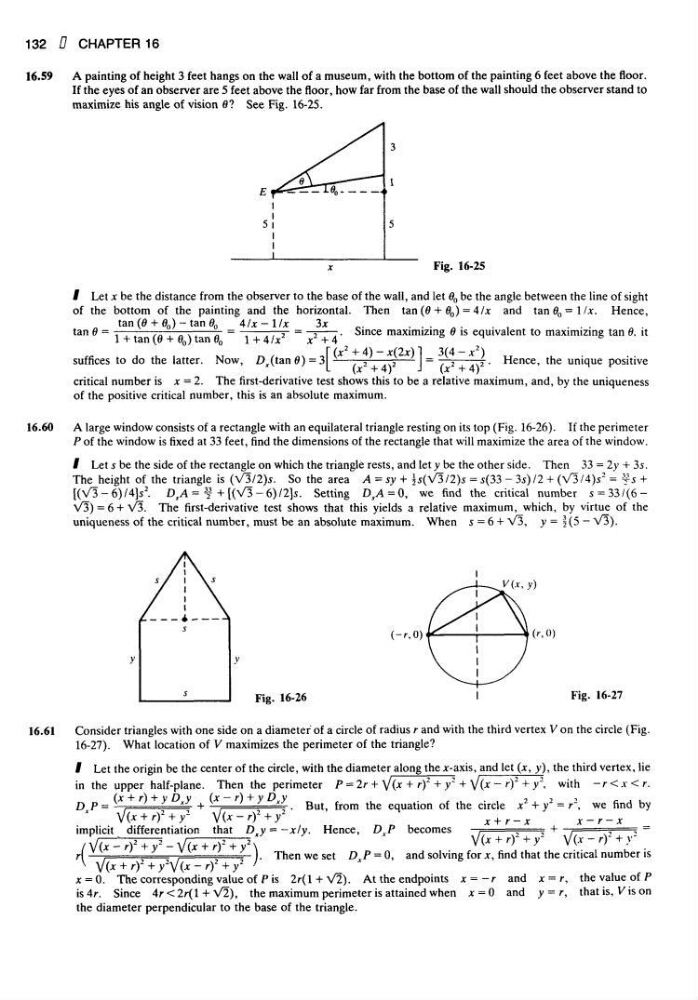
A painting of height 3 feet hangs on the wall of a museum, with the bottom of the painting 6 feet above the floor.
If the eyes of an observer are 5 feet above the floor, how far from the base of the wall should the observer stand to
maximize his angle of vision 6? See Fig. 16-25.
Since maximizing 6 is equivalent to maximizing tan 0, it
A large window consists of a rectangle with an equilateral triangle resting on its top (Fig. 16-26). If the perimeter
P of the window is fixed at 33 feet, find the dimensions of the rectangle that will maximize the area of the window.
I Let 5 be the side of the rectangle on which the triangle rests, and let y be the other side. Then 33 = 2y + 3s.
The height of the triangle is (V5/2)j. So the area A = sy + £j(V3/2)s = 5(33 - 3s) 12 + (V3/4)r = ¥s +
[(V3-6)/4]s
2 .
D s ,4= f+[(V3-6)/2]s. Setting D S A=0, we find the critical number 5 = 33/(6V3) = 6 +V5. The first-derivative test shows that this yields a relative maximum, which, by virtue of the
uniqueness of the critical number, must be an absolute maximum. When s = 6 + V3, y=|(5 —V5).
Fig. 16-27
Then we set D P = 0, and solving for x, find that the critical number is
Fig. 16-26
But, from the equation of the circle
16.61
Consider triangles with one side on a diameter of a circle of radius r and with the third vertex V on the circle (Fig.
16-27V What location of V maximizes the perimeter of the triangle?
in the upper half-plane. Then the perimeter
Let the origin be the center of the circle, with the diameter along the *-axis, and let (x, y), the third vertex, lie
x = 0. The corresponding value of P is 2r(l + V2). At the endpoints x = -r and x = r, the value of P
is4r. Since 4r<2r(l + V2), the maximum perimeter is attained when x = 0 and y = r, that is, Vis on
the diameter perpendicular to the base of the triangle.
implicit differentiation that
Hence, D f P becomes
we find by
with
Fig. 16-25
I Let x be the distance from the observer to the base of the wall, and let B a be the angle between the line of sight
of the bottom of the painting and the horizontal. Then tan(0 + ft.) = 4/x and tan ft, = 1 Ix. Hence,
suffices to do the latter. Now,
Hence, the unique positive
critical number is x = 2. The first-derivative test shows this to be a relative maximum, and, by the uniqueness
of the positive critical number, this is an absolute maximum.
x2+y2=r2,
D n y = - x
/y.
16.59
16.60
A painting of height 3 feet hangs on the wall of a museum, with the bottom of the painting 6 feet above the floor.
If the eyes of an observer are 5 feet above the floor, how far from the base of the wall should the observer stand to
maximize his angle of vision 6? See Fig. 16-25.
Since maximizing 6 is equivalent to maximizing tan 0, it
A large window consists of a rectangle with an equilateral triangle resting on its top (Fig. 16-26). If the perimeter
P of the window is fixed at 33 feet, find the dimensions of the rectangle that will maximize the area of the window.
I Let 5 be the side of the rectangle on which the triangle rests, and let y be the other side. Then 33 = 2y + 3s.
The height of the triangle is (V5/2)j. So the area A = sy + £j(V3/2)s = 5(33 - 3s) 12 + (V3/4)r = ¥s +
[(V3-6)/4]s
2 .
D s ,4= f+[(V3-6)/2]s. Setting D S A=0, we find the critical number 5 = 33/(6V3) = 6 +V5. The first-derivative test shows that this yields a relative maximum, which, by virtue of the
uniqueness of the critical number, must be an absolute maximum. When s = 6 + V3, y=|(5 —V5).
Fig. 16-27
Then we set D P = 0, and solving for x, find that the critical number is
Fig. 16-26
But, from the equation of the circle
16.61
Consider triangles with one side on a diameter of a circle of radius r and with the third vertex V on the circle (Fig.
16-27V What location of V maximizes the perimeter of the triangle?
in the upper half-plane. Then the perimeter
Let the origin be the center of the circle, with the diameter along the *-axis, and let (x, y), the third vertex, lie
x = 0. The corresponding value of P is 2r(l + V2). At the endpoints x = -r and x = r, the value of P
is4r. Since 4r<2r(l + V2), the maximum perimeter is attained when x = 0 and y = r, that is, Vis on
the diameter perpendicular to the base of the triangle.
implicit differentiation that
Hence, D f P becomes
we find by
with
Fig. 16-25
I Let x be the distance from the observer to the base of the wall, and let B a be the angle between the line of sight
of the bottom of the painting and the horizontal. Then tan(0 + ft.) = 4/x and tan ft, = 1 Ix. Hence,
suffices to do the latter. Now,
Hence, the unique positive
critical number is x = 2. The first-derivative test shows this to be a relative maximum, and, by the uniqueness
of the positive critical number, this is an absolute maximum.
x2+y2=r2,
D n y = - x
/y.