

APPLIED MAXIMUM AND MINIMUM PROBLEMS D 131
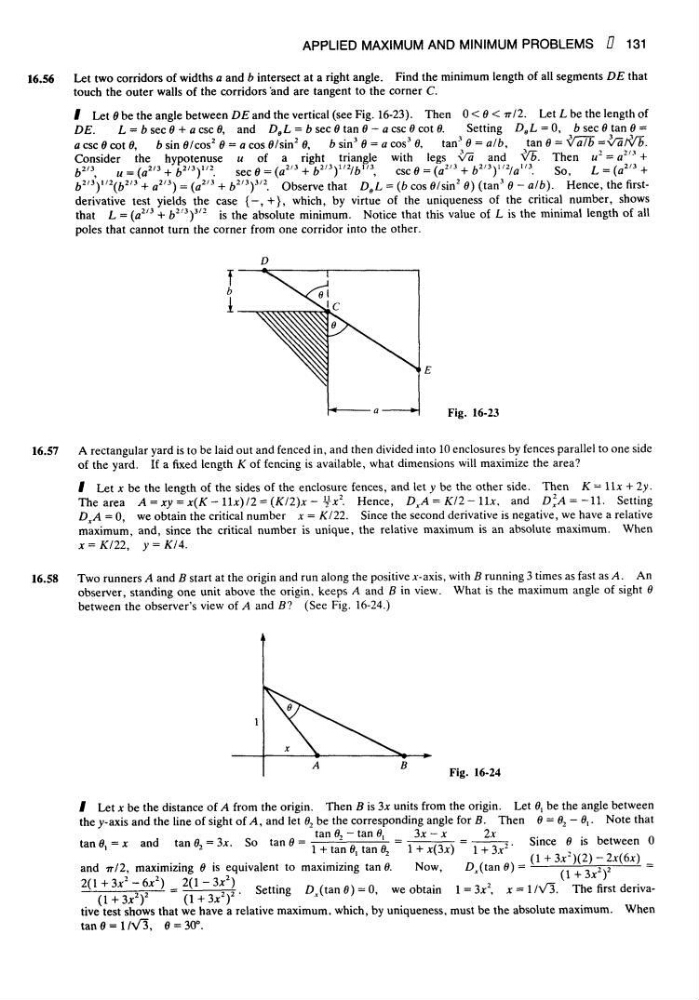
Fig. 16-23
16.57
A rectangular yard is to be laid out and fenced in, and then divided into 10 enclosures by fences parallel to one side
of the yard. If a fixed length K of fencing is available, what dimensions will maximize the area?
I Let x be the length of the sides of the enclosure fences, and let y be the other side. Then K-llx + 2y.
The area A = xy = x(K- llx)/2 = (K/2)x -
l ix
2 . Hence, D f A = KI2-llx, and D
2
x A = -ll. Setting
D X A=0, we obtain the critical number x = Kill. Since the second derivative is negative, we have a relative
maximum, and, since the critical number is unique, the relative maximum is an absolute maximum. When
x = K/22, y = K/4.
16.58
Two runners A and B start at the origin and run along the positive AT-axis, with B running 3 times as fast as A. An
observer, standing one unit above the origin, keeps A and B in view. What is the maximum angle of sight 0
between the observer's view of A and B7 (See Fig. 16-24.)
I Let x be the distance of A from the origin. Then B is 3x units from the origin. Let 0, be the angle between
the y-axis and the line of sight of A, and let 0, be the corresponding angle for B. Then 8 = 6 2 -O l . Note that
Fig. 16-24
and
So
maximizing 6 is equivalent to maximizing tan 0. Now,
Since 9 is between 0
Setting
we obtain
The first derivalive test shows that we have a relative maximum, which, by uniqueness, must be the absolute maximum. When
and
Let two corridors of widths a and b intersect at a right angle. Find the minimum length of all segments DE that
touch the outer walls of the corridors and are tangent to the corner C.
I Let 0 be the angle between DE and the vertical (see Fig. 16-23). Then 0<0<7r/2. Let L be the length of
DE.
L = bsecO + acsc8, and D e L = b sec0 tan 0 - a esc 0 cot 0.
Setting D a L=0, b sec 6 tan 6 =
a esc 0 cote, b sin 0/cos
2 0 = a cos 0/sin
2 0, ft sin
3 6 = a cos
3 0, tan
3 0 = a/6, land = VaTE =\/~atf/~b.
Consider the hypotenuse u of a right triangle with legs Va and Vb. Then u
1 = a
2 '
3 +
62'3, w = (a2/3 + 62/3)"2. sece = («2/3 + fo2/3)1'2/ft"3, csc0 = (a2'3 + &2/3)"V'3. So, L = (a2'3 +
fe
2 '
3 )"
2 (6
2/3 + a
2 '
3 ) = (a
2/3 + fe
2 '
3 )
3 '
2 . Observe that D 9 L = (fe cos 0/sin
2 0) (tan
3 0 - alb). Hence, the firstderivative test yields the case {-,+}, which, by virtue of the uniqueness of the critical number, shows
that L = (a
213 + b
2 '
3 )
3 '
2
is the absolute minimum. Notice that this value of L is the minimal length of all
poles that cannot turn the corner from one corridor into the other.
16.56
tan 0, = x
tan 0 2 = 3*.
tan 6 =
D c (tan 0) =
l = 3jc
2
, x = l/V3.
D ( (tan0) = 0,
tan 0 = 1 /V3, 0 = 30°.
Fig. 16-23
16.57
A rectangular yard is to be laid out and fenced in, and then divided into 10 enclosures by fences parallel to one side
of the yard. If a fixed length K of fencing is available, what dimensions will maximize the area?
I Let x be the length of the sides of the enclosure fences, and let y be the other side. Then K-llx + 2y.
The area A = xy = x(K- llx)/2 = (K/2)x -
l ix
2 . Hence, D f A = KI2-llx, and D
2
x A = -ll. Setting
D X A=0, we obtain the critical number x = Kill. Since the second derivative is negative, we have a relative
maximum, and, since the critical number is unique, the relative maximum is an absolute maximum. When
x = K/22, y = K/4.
16.58
Two runners A and B start at the origin and run along the positive AT-axis, with B running 3 times as fast as A. An
observer, standing one unit above the origin, keeps A and B in view. What is the maximum angle of sight 0
between the observer's view of A and B7 (See Fig. 16-24.)
I Let x be the distance of A from the origin. Then B is 3x units from the origin. Let 0, be the angle between
the y-axis and the line of sight of A, and let 0, be the corresponding angle for B. Then 8 = 6 2 -O l . Note that
Fig. 16-24
and
So
maximizing 6 is equivalent to maximizing tan 0. Now,
Since 9 is between 0
Setting
we obtain
The first derivalive test shows that we have a relative maximum, which, by uniqueness, must be the absolute maximum. When
and
Let two corridors of widths a and b intersect at a right angle. Find the minimum length of all segments DE that
touch the outer walls of the corridors and are tangent to the corner C.
I Let 0 be the angle between DE and the vertical (see Fig. 16-23). Then 0<0<7r/2. Let L be the length of
DE.
L = bsecO + acsc8, and D e L = b sec0 tan 0 - a esc 0 cot 0.
Setting D a L=0, b sec 6 tan 6 =
a esc 0 cote, b sin 0/cos
2 0 = a cos 0/sin
2 0, ft sin
3 6 = a cos
3 0, tan
3 0 = a/6, land = VaTE =\/~atf/~b.
Consider the hypotenuse u of a right triangle with legs Va and Vb. Then u
1 = a
2 '
3 +
62'3, w = (a2/3 + 62/3)"2. sece = («2/3 + fo2/3)1'2/ft"3, csc0 = (a2'3 + &2/3)"V'3. So, L = (a2'3 +
fe
2 '
3 )"
2 (6
2/3 + a
2 '
3 ) = (a
2/3 + fe
2 '
3 )
3 '
2 . Observe that D 9 L = (fe cos 0/sin
2 0) (tan
3 0 - alb). Hence, the firstderivative test yields the case {-,+}, which, by virtue of the uniqueness of the critical number, shows
that L = (a
213 + b
2 '
3 )
3 '
2
is the absolute minimum. Notice that this value of L is the minimal length of all
poles that cannot turn the corner from one corridor into the other.
16.56
tan 0, = x
tan 0 2 = 3*.
tan 6 =
D c (tan 0) =
l = 3jc
2
, x = l/V3.
D ( (tan0) = 0,
tan 0 = 1 /V3, 0 = 30°.