

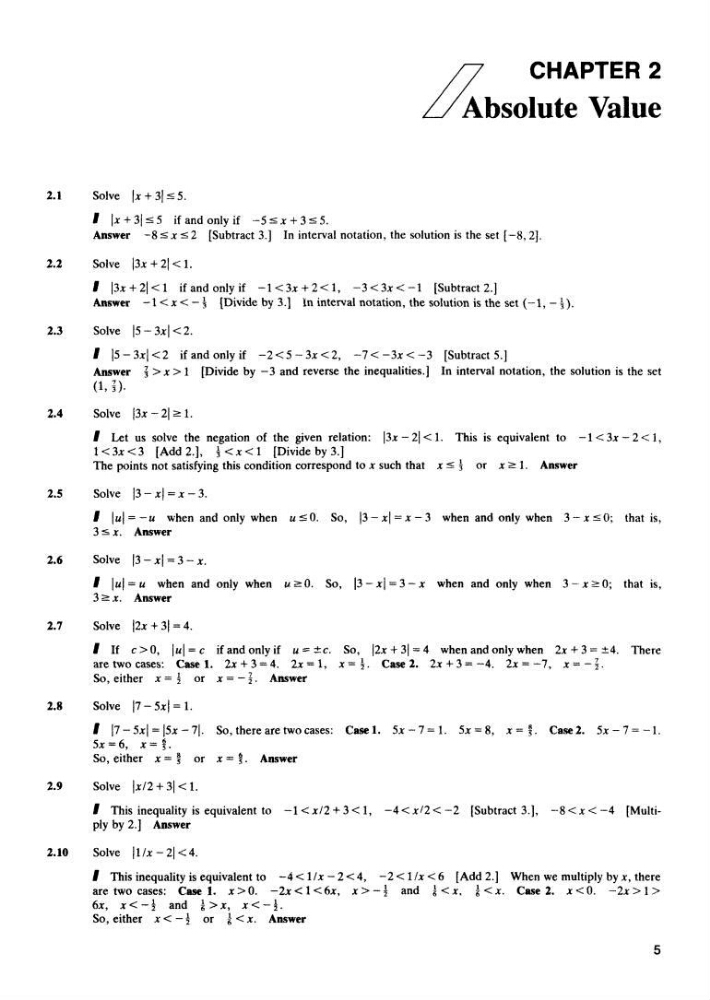
CHAPTER 2
Absolute Value
Solve |* + 3|<5.
Answer -8 s jc < 2 [Subtract 3.] In interval notation, the solution is the set [—8, 2].
Solve |3jt + 2|
Solve |5-3*|<2.
Answer | > x > 1 [Divide by —3 and reverse the inequalities.] In interval notation, the solution is the set
(i,3).
Solve |3*-2|s=l.
1<3*<3 [Add 2.], ^
Solve |3 - x\ = x - 3.
3 s x. Answer
Solve |3 - *| = 3 - x.
3 s x. Answer
Solve \2x + 3| = 4.
are two cases: Case 1. 2*+ 3 = 4. 2x = 1, x=|. Case 2. 2At+3=-4. 2x = -7, ac = -|.
So, either x = | or x = — j. AnswerSo, either x = | or x = — j. Answer
Solve |7-5*| = 1.
5x = 6, AC = f.
So, either *=| or *=|. Answer
Solve U/2 + 3|
Solve |l/*-2|<4.
are two cases: Casel. *>0. -2*<1<6*, x>-\ and g<*, \\>
6x, x<—\ and !>*, x< — \.
So, either x<— \ or \
2.2
2.3
2.4
2.5
2.6
2.7
2.8
2.9
2.10
5
\x + 3\<5 if and only if -5
|5-3x|<2 if and only if -2<5-3x<2, -7<-3x<-3 [Subtracts.]
Let us solve the negation of the given relation: |3* — 2|<1. This is equivalent to — l<3x — 2<1,
|M| = — u when and only when w^O. So, \3>-x\ = x—3 when and only when 3 — *:£0; that is,
\u\ = u when and only when j/>0. So, |3-*|=3 — x when and only when 3-*>(); that is,
If c>0, \u\ = c if and only if w = ±c. So, \2x + 3| = 4 when and only when 2^: + 3=±4. There
|7-5*| = |5*-7|. So, there are two cases: Casel. 5x-7 = l. 5* = 8, *=f. Case 2. 5*-7=-l.
This inequality is equivalent to -l
Absolute Value
Solve |* + 3|<5.
Answer -8 s jc < 2 [Subtract 3.] In interval notation, the solution is the set [—8, 2].
Solve |3jt + 2|
Solve |5-3*|<2.
Answer | > x > 1 [Divide by —3 and reverse the inequalities.] In interval notation, the solution is the set
(i,3).
Solve |3*-2|s=l.
1<3*<3 [Add 2.], ^
Solve |3 - x\ = x - 3.
3 s x. Answer
Solve |3 - *| = 3 - x.
3 s x. Answer
Solve \2x + 3| = 4.
are two cases: Case 1. 2*+ 3 = 4. 2x = 1, x=|. Case 2. 2At+3=-4. 2x = -7, ac = -|.
So, either x = | or x = — j. AnswerSo, either x = | or x = — j. Answer
Solve |7-5*| = 1.
5x = 6, AC = f.
So, either *=| or *=|. Answer
Solve U/2 + 3|
Solve |l/*-2|<4.
are two cases: Casel. *>0. -2*<1<6*, x>-\ and g<*, \
6x, x<—\ and !>*, x< — \.
So, either x<— \ or \
2.2
2.3
2.4
2.5
2.6
2.7
2.8
2.9
2.10
5
\x + 3\<5 if and only if -5
|5-3x|<2 if and only if -2<5-3x<2, -7<-3x<-3 [Subtracts.]
Let us solve the negation of the given relation: |3* — 2|<1. This is equivalent to — l<3x — 2<1,
|M| = — u when and only when w^O. So, \3>-x\ = x—3 when and only when 3 — *:£0; that is,
\u\ = u when and only when j/>0. So, |3-*|=3 — x when and only when 3-*>(); that is,
If c>0, \u\ = c if and only if w = ±c. So, \2x + 3| = 4 when and only when 2^: + 3=±4. There
|7-5*| = |5*-7|. So, there are two cases: Casel. 5x-7 = l. 5* = 8, *=f. Case 2. 5*-7=-l.
This inequality is equivalent to -l