

4
Solve (2jt + l)(jt-3)Cx + 7)<0.
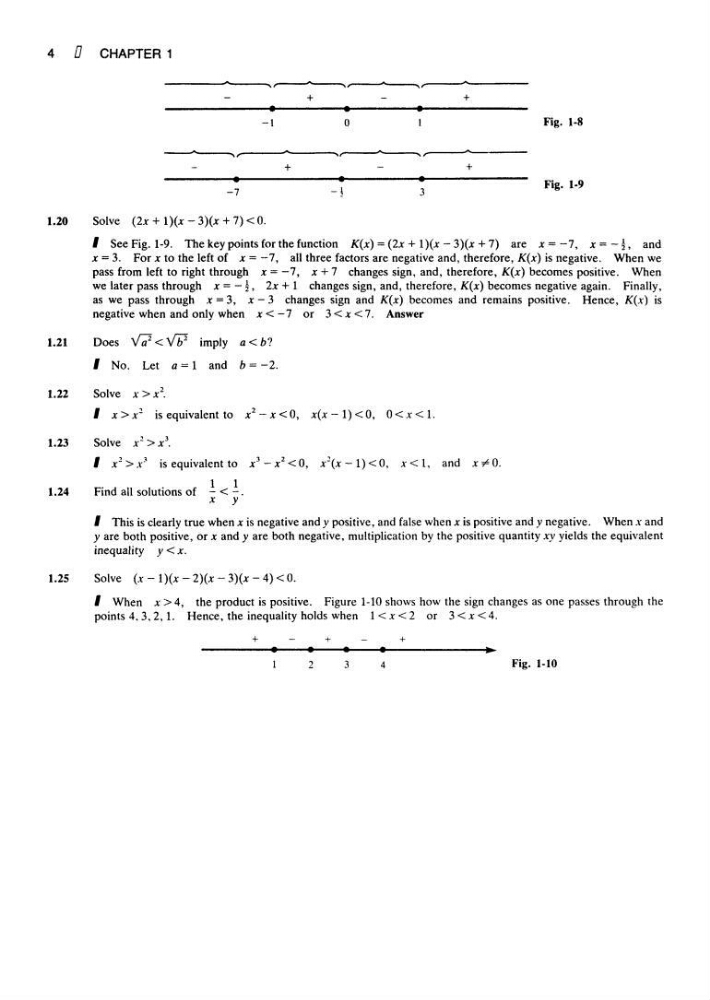
x = 3. For A: to the left of x--l, all three factors are negative and, therefore, AT(x) is negative. When we
pass from left to right through x = — 7, * + 7 changes sign, and, therefore, K(x) becomes positive. When
we later pass through x = - \, 2x + 1 changes sign, and, therefore, K(x) becomes negative again. Finally,
as we pass through x = 3, x — 3 changes sign and K(x) becomes and remains positive. Hence, K(x) is
negative when and only when x<-7 or 3 < * < 7. Answer
Does
Solve A- > x
2 .
Solve x
2 > x\
Find all solutions of
y are both positive, or x and y are both negative, multiplication by the positive quantity jcv yields the equivalent
inequality y < x.
Solve (x-l)(x-2)(x-3)(x-4)<0.Solve (x-l)(x-2)(x-3)(x-4)<0.
points 4, 3, 2,1. Hence, the inequality holds when l
Fig. 1-8
Fig. 1-9
1.20
1.21
1.22
1.23
1.24
1.25
imply
CHAPTER 1
See Fig. 1-9. The key points for the function K(x) = (2x + l)(x - 3)(x + 7) are x = -7, x=-%, and
No. Let a = 1 and b = -2.
x>x2 is equivalent to x2-x<0, x(x-l)<0, 0
This is clearly true when x is negative and y positive, and false when x is positive and y negative. When .v and
When x > 4, the product is positive. Figure 1-10 shows how the sign changes as one passes through the
Solve (2jt + l)(jt-3)Cx + 7)<0.
x = 3. For A: to the left of x--l, all three factors are negative and, therefore, AT(x) is negative. When we
pass from left to right through x = — 7, * + 7 changes sign, and, therefore, K(x) becomes positive. When
we later pass through x = - \, 2x + 1 changes sign, and, therefore, K(x) becomes negative again. Finally,
as we pass through x = 3, x — 3 changes sign and K(x) becomes and remains positive. Hence, K(x) is
negative when and only when x<-7 or 3 < * < 7. Answer
Does
Solve A- > x
2 .
Solve x
2 > x\
Find all solutions of
y are both positive, or x and y are both negative, multiplication by the positive quantity jcv yields the equivalent
inequality y < x.
Solve (x-l)(x-2)(x-3)(x-4)<0.Solve (x-l)(x-2)(x-3)(x-4)<0.
points 4, 3, 2,1. Hence, the inequality holds when l
Fig. 1-8
Fig. 1-9
1.20
1.21
1.22
1.23
1.24
1.25
imply
CHAPTER 1
See Fig. 1-9. The key points for the function K(x) = (2x + l)(x - 3)(x + 7) are x = -7, x=-%, and
No. Let a = 1 and b = -2.
x>x2 is equivalent to x2-x<0, x(x-l)<0, 0
This is clearly true when x is negative and y positive, and false when x is positive and y negative. When .v and
When x > 4, the product is positive. Figure 1-10 shows how the sign changes as one passes through the