

110 0 CHAPTER 15
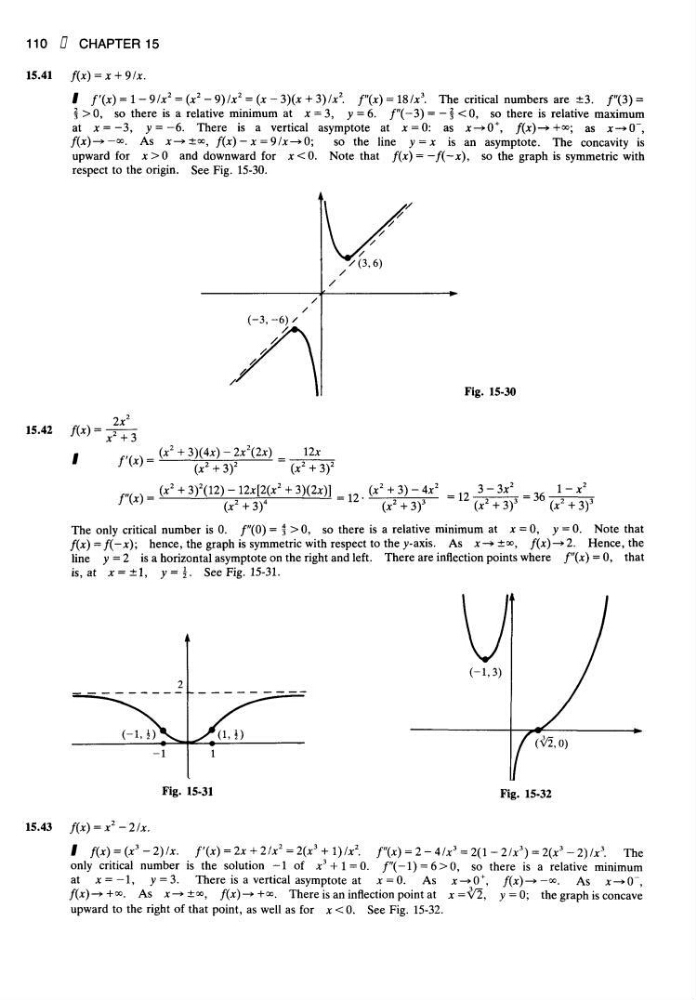
15.41 f(x) = x + 9/x.
I /'(*) = l-9/x2 = (x2-9)/x2 = (x-3)(x + 3)Ix2. f"(x) = 18lx\ The critical numbers are ±3. /"(3) =
| > 0, so there is a relative minimum at x = 3, y = 6. /"(~3) = — f < 0, so there is relative maximum
at * = — 3, y = — 6. There is a vertical asymptote at * = 0: as *—>0
+ , /(*)—»+°°; as *—»0~,
/(*)-»-oo. As x—>±<*>, f(x) - x = 9/je-»0;
so the line y = x is an asymptote. The concavity is
upward for x>0 and downward for *<0. Note that f(x)= —f(—x), so the graph is symmetric with
respect to the origin. See Fig. 15-30.
Fig. 15-30
The only critical number is 0. /"(O) = | > 0, so there is a relative minimum at x = 0, y = 0. Note that
/(*)=/(-*); hence, the graph is symmetric with respect to the y-axis. As *—» ±°°, /(*)—» 2. Hence, the
line y = 2 is a horizontal asymptote on the right and left. There are inflection points where /"(*) = 0, that
is, at x=±\, y=\. See Fig. 15-31.
15.42
Fig. 15-31
Fig. 15-32
15.43
f(x) = x
2 -2/x.
I f(x) = (x3-2)/x. f'(x) = 2x + 2/x2 = 2(x3 + l)/x2. /"(*) = 2- 4/x3 = 2(1 -2/x3) = 2(*3 -2)/x\ The
only critical number is the solution -1 of x
3 + l = 0. /"(-1) = 6>0, so there is a relative minimum
at JE = —1, y = 3. There is a vertical asymptote at * = 0. As jt—»0
+ , f(x)—>—°°.
As x^O",
/(x)-»+a>. As * -»±°o, /(x)-»+a>. There is an inflection point at x =i/2, y=0; the graph is concave
upward to the right of that point, as well as for x < 0. See Fig. 15-32.
15.41 f(x) = x + 9/x.
I /'(*) = l-9/x2 = (x2-9)/x2 = (x-3)(x + 3)Ix2. f"(x) = 18lx\ The critical numbers are ±3. /"(3) =
| > 0, so there is a relative minimum at x = 3, y = 6. /"(~3) = — f < 0, so there is relative maximum
at * = — 3, y = — 6. There is a vertical asymptote at * = 0: as *—>0
+ , /(*)—»+°°; as *—»0~,
/(*)-»-oo. As x—>±<*>, f(x) - x = 9/je-»0;
so the line y = x is an asymptote. The concavity is
upward for x>0 and downward for *<0. Note that f(x)= —f(—x), so the graph is symmetric with
respect to the origin. See Fig. 15-30.
Fig. 15-30
The only critical number is 0. /"(O) = | > 0, so there is a relative minimum at x = 0, y = 0. Note that
/(*)=/(-*); hence, the graph is symmetric with respect to the y-axis. As *—» ±°°, /(*)—» 2. Hence, the
line y = 2 is a horizontal asymptote on the right and left. There are inflection points where /"(*) = 0, that
is, at x=±\, y=\. See Fig. 15-31.
15.42
Fig. 15-31
Fig. 15-32
15.43
f(x) = x
2 -2/x.
I f(x) = (x3-2)/x. f'(x) = 2x + 2/x2 = 2(x3 + l)/x2. /"(*) = 2- 4/x3 = 2(1 -2/x3) = 2(*3 -2)/x\ The
only critical number is the solution -1 of x
3 + l = 0. /"(-1) = 6>0, so there is a relative minimum
at JE = —1, y = 3. There is a vertical asymptote at * = 0. As jt—»0
+ , f(x)—>—°°.
As x^O",
/(x)-»+a>. As * -»±°o, /(x)-»+a>. There is an inflection point at x =i/2, y=0; the graph is concave
upward to the right of that point, as well as for x < 0. See Fig. 15-32.